• Wyszukiwanie zaawansowane
  • Kategorie
  • Kategorie BISAC
  • Książki na zamówienie
  • Promocje
  • Granty
  • Książka na prezent
  • Opinie
  • Pomoc
  • Załóż konto
  • Zaloguj się

Who One Is: Book 2: Existenz and Transcendental Phenomenology » książka


zaloguj się | załóż konto
Logo Krainaksiazek.pl

koszyk

konto

szukaj
topmenu
Księgarnia internetowa
Szukaj
Książki na zamówienie
Promocje
Granty
Książka na prezent
Moje konto
Pomoc
 
 
Wyszukiwanie zaawansowane
Pusty koszyk
Bezpłatna dostawa dla zamówień powyżej 20 złBezpłatna dostawa dla zamówień powyżej 20 zł

Kategorie główne

• Nauka
 [2952079]
• Literatura piękna
 [1850969]

  więcej...
• Turystyka
 [71058]
• Informatyka
 [151066]
• Komiksy
 [35579]
• Encyklopedie
 [23181]
• Dziecięca
 [620496]
• Hobby
 [139036]
• AudioBooki
 [1646]
• Literatura faktu
 [228729]
• Muzyka CD
 [379]
• Słowniki
 [2932]
• Inne
 [445708]
• Kalendarze
 [1409]
• Podręczniki
 [164793]
• Poradniki
 [480107]
• Religia
 [510956]
• Czasopisma
 [511]
• Sport
 [61267]
• Sztuka
 [243299]
• CD, DVD, Video
 [3411]
• Technologie
 [219640]
• Zdrowie
 [100984]
• Książkowe Klimaty
 [124]
• Zabawki
 [2281]
• Puzzle, gry
 [3363]
• Literatura w języku ukraińskim
 [258]
• Art. papiernicze i szkolne
 [8020]
Kategorie szczegółowe BISAC

Who One Is: Book 2: Existenz and Transcendental Phenomenology

ISBN-13: 9781402091773 / Angielski / Twarda / 2009 / 668 str.
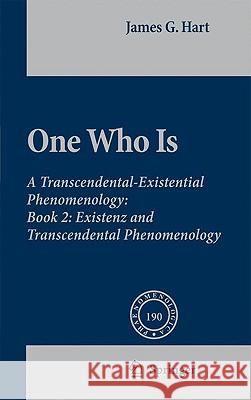
James G. Hart
Who One Is: Book 2: Existenz and Transcendental Phenomenology Hart, J. G. 9781402091773 Springer - książkaWidoczna okładka, to zdjęcie poglądowe, a rzeczywista szata graficzna może różnić się od prezentowanej.

Who One Is: Book 2: Existenz and Transcendental Phenomenology

ISBN-13: 9781402091773 / Angielski / Twarda / 2009 / 668 str.

James G. Hart
cena 805,10
(netto: 766,76 VAT:  5%)

Najniższa cena z 30 dni: 771,08
Termin realizacji zamówienia:
ok. 22 dni roboczych
Dostawa w 2026 r.

Darmowa dostawa!

If I am asked in the framework of Book 1, "Who are you?" I, in answering, might say "I don't know who in the world I am." Nevertheless there is a sense in which I always know what "I" refers to and can never not know, even if I have become, e.g., amnesiac. Yet in Book 2, "Who are you?" has other senses of oneself in mind than the non-sortal "myself." For example, it might be the pragmatic context, as in a bureaucratic setting; but "Who are you?" or "Who am I?" might be more anguished and be rendered by "What sort of person are you?" or "What sort am I?" Such a question often surfaces in the face of a "limit-situation," such as one's death or in the wake of a shameful deed where we are compelled to find our "centers," what we also will call "Existenz." "Existenz" here refers to the center of the person. In the face of the limit-situation one is called upon to act unconditionally in the determination of oneself and one's being in the world. In this Book 2 we discuss chiefly one's normative personal-moral identity which stands in contrast to the transcendental I where one's non-sortal unique identity is given from the start. This moral identity requires a unique self-determination and normative self-constitution which may be thought of with the help of the metaphor of "vocation." We will see that it has especial ties to one's Existenz as well as to love. This Book 2 claims that the moral-personal ideal sense of who one is is linked to the transcendental who through a notion of entelechy. The person strives to embody the I-ness that one both ineluctably is and which, however, points to who one is not yet and who one ought to be. The final two chapters tell a philosophical-theological likely story of a basic theme of Plotinus: We must learn to honor ourselves because of our honorable kinship and lineage "Yonder."


Kategorie:
Inne
Kategorie BISAC:
Philosophy > Movements - Phenomenology
Philosophy > Metaphysics
Philosophy > Mind & Body
Wydawca:
Springer
Seria wydawnicza:
Phaenomenologica
Język:
Angielski
ISBN-13:
9781402091773
Rok wydania:
2009
Wydanie:
2009
Numer serii:
000029619
Ilość stron:
668
Waga:
1.13 kg
Wymiary:
23.62 x 16.26 x 3.81
Oprawa:
Twarda
Wolumenów:
01
Dodatkowe informacje:
Bibliografia

From the reviews: "James G. Hart's ... presents the results of several decades of research on self- and personhood, combining transcendental phenomenology and existential philosophy. ... focuses on the core of the personal 'I.' Hart calls this core Existenz. ... Hart has undoubtedly given us a thought-provoking study that enriches many ongoing debates and deserves increasing scholarly attention.Its two volumes belong to the most impressive, comprehensive, and innovative works in this field. I appreciate the breadth and insight of this work and heartily recommend it to anyone who wishes to learn more about who one is ... ." (Claudia Welz, Philosophy Today, 2010) " In this large two-volume book, James Hart offers the reader an insightful and comprehensive treatment of the perplexing manner in which we, each of us, are aware of our own selves. The book is comprehensive in two senses: in regard to the topics treated, and in regard to the authorities invoked. (...) His book could serve as a reference work for someone who wished to explore this topic and wanted to know how it has been treated in philosophical and theological traditions other than his own." (Robert Sokolowski, School of Philosophy, Catholic University of America)

Preface: Transition from Book 1 and Prologue to Book 2 Chapter I: Assenting to My Death and that of the Other §1. My Death §2. Inherent Obstacles to the Real Assent to My Mortality §3. Death as Danger and Destiny §4. The Meaning of the Annihilation of an Individual Essence §5. The Secret of Death §6. Ghosts, Corpses, and Homer on the Secret of Death Chapter II. Transcendental Attitude and the Mystery of Death §1. The Mystery of Death and Ipseity §2. Transcendental Attitude and the Mystery of “My Death” §3. “My Death” and the Prospective Retrospection of “My Life” §4. “My Death” as a Gathering Experience §5. Transcendental Phenomenological Reflection on the Realization of “My Death” §6. The Question of the Appropriateness of the Transcendental Attitude in the Realization of “My Death” §7. Philosophy as Theoretic Analysis and as Preparation for Death Chapter III: Existenz, Conscience, and the Transcendental I §1. Existenz as a Third-Person Reference to First-Person Experience §2. Limit-Situations and Existenz §3. Conscience and Ought §4. The Problem of the Pure Conscience §5. Conscience and the Center of the I §6. Conscience, Existenz, and the Transcendental I §7. Excursus: “I myself” and my Daimonion §8. Excursus: The Illumination of Existenz and the Proustian-Stoic “Cataleptic Impression” Chapter IV: Ipseity and Teleology §1. Freedom to Do and Not to Do What Must Be Done §2. The Self-Inadequation of the Person §3. Position-Taking Acts as the Medium of Personhood §4. Self-Identifying Acts and the Moral Person §5. Ipseity and Freedom §6.Summary: Teleology of Personal Being §7. A Sense in Which Who One Is Equates With What Sort of Person One Is §8. The Sort of Person One Is and Freedom §9. Who One Is and One’s Story Chapter V: The Calling of Existenz §1. The Ideal True Self and the Metaphor of Vocation §2. Truths of Will §3. Love and Existenz §4. Existenz, Love, and Communication §5. Evidence for a Unique Calling: Husserl’s Example §6. The Calling as Limit-Situation §7. The Ontological End and the Purposes of the Person §8. The Calling and the Analogous Love of the Self’s Essence Chapter VI: Philosophical Theology of Vocation. Part One: Historical Setting §1. Plotinus: The Form of Socrates and the True Self §2. Christianity: A Calling Before the Creation of the World §3. Excursus: The Spiral of Spiritual Ascent in Sufism §4. Some More Differences between Neo-Platonism and Christianity Chapter VII: Philosophical Theology of Vocation. Part Two: Systematic-Theological Synthesis §1. Analogy, Exemplarism, and the Dogma of God the Creator §2. Analogy, Exemplarism, and the Divine Master Builder §3. Beginning Reflections on the Metaphysics of the Divine Exemplarity of the “Myself” §4. Three Aspects Under Which An Eternal Idea or Essence Can Be Made Present §5. Divine Awareness of the Unique Ipseity §6. The Theological Distinction §7. Wholes and Parts of The Theological Distinction §8. The Absurd, Paradox, and The Theological Distinction §9. Excursus on Prayer and the Stance of Faith §10. The Analogy of Divine Self-Awareness and Intentionality §11. Three Alternatives Avoided: Correlationism, Process Philosophy, and Monism §12. Conclusion

James G. Hart (b. 1936) did a Ph.D. at the University of Chicago after research in Munich on Hedwig Conrad Martius. He taught at Indiana University, Bloomington (USA) from 1971-2001 in the Department of Religious Studies. His writings have been primarily in the area of phenomenology; his teaching was primarily in the philosophy of religion and peace studies. Since retirement he has spent his energy on philosophy and on reform of the criminal justice system.

If I am asked in the framework of Book 1, "Who are you?" I, in answering, might say "I don’t know who in the world I am." Nevertheless there is a sense in which I always know what "I" refers to and can never not know, even if I have become, e.g., amnesiac. Yet in Book 2, "Who are you?"has other senses of oneself in mind than the non-sortal "myself." For example, it might be the pragmatic context, as in a bureaucratic setting; but "Who are you? Or "Who am I?" might be more anguished and be rendered by "What sort of person are you" or "What sort am I?" Such a question often surfaces in the face of a "limit-situation," such as one’s death or in the wake of a shameful deed where we are compelled to find our "centers," what we also will call "Existenz." "Existenz" here refers to the center of the person. In the face of the limit-situation one is called upon to act unconditionally in the determination of oneself and one’s being in the world.

In this Book 2 we discuss chiefly one’s normative personal-moral identity which stands in contrast to the transcendental I where one’s non-sortal unique identity is given from the start. This moral identity requires a unique self-determination and normative self-constitution which may be thought of with the help of the metaphor of "vocation." We will see that it has especial ties to one’s Existenz as well as to love. This Book 2 claims that the moral-personal ideal sense of who one is linked to the transcendental who through a notion of entelechy. The person strives to embody the I-ness that one both ineluctably is and which, however, points to who one is not yet and who one ought to be. The final two chapters tell a philosophical-theological likely story of a basic theme of Plotinus: We must learn to honor ourselves because of our honorable kinship and lineage "Yonder."

Hart, James G. Hart is Professor of the Philosophy of Religion at... więcej >


Udostępnij

Facebook - konto krainaksiazek.pl


Opinie o Krainaksiazek.pl na Opineo.pl

Partner Mybenefit

Krainaksiazek.pl w programie rzetelna firma Krainaksiaze.pl - płatności przez paypal

Czytaj nas na:

Facebook - krainaksiazek.pl
  • książki na zamówienie
  • granty
  • książka na prezent
  • kontakt
  • pomoc
  • opinie
  • regulamin
  • polityka prywatności

Zobacz:

  • Księgarnia czeska

  • Wydawnictwo Książkowe Klimaty

1997-2025 DolnySlask.com Agencja Internetowa

© 1997-2022 krainaksiazek.pl
     
KONTAKT | REGULAMIN | POLITYKA PRYWATNOŚCI | USTAWIENIA PRYWATNOŚCI
Zobacz: Księgarnia Czeska | Wydawnictwo Książkowe Klimaty | Mapa strony | Lista autorów
KrainaKsiazek.PL - Księgarnia Internetowa

Polityka prywatnosci - link
Krainaksiazek.pl - płatnośc Przelewy24
Przechowalnia Przechowalnia




