Who Do I Say That You Are? » książka





Who Do I Say That You Are?
ISBN-13: 9781606083208 / Angielski / Miękka / 2010 / 214 str.
Who Do I Say That You Are?
ISBN-13: 9781606083208 / Angielski / Miękka / 2010 / 214 str.
(netto: 104,98 VAT: 5%)
Najniższa cena z 30 dni: 108,71
ok. 16-18 dni roboczych.
Darmowa dostawa!
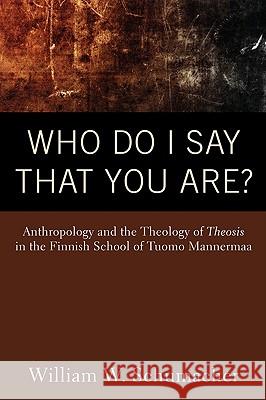
The question of what it means to be a human creature lies at the heart of contemporary wrestling with anthropology, and especially anthropology from a theological perspective. Through both historical and systematic engagement with the so-called Finnish school of Tuomo Mannermaa, this study explores and assesses the anthropological dimension of their theology of theosis, or deification. Mannermaa initiated a minor revolution in Luther studies and in contemporary Lutheran theology by interpreting Luther's doctrine of justification to be a close analog to the Eastern Orthodox doctrine of theosis, but his ecumenical interests led him to minimize or overlook key themes in Luther and sharp distinctions between Luther and Orthodox theologians. Mannermaa's colleague Simo Peura then developed this thesis with specific reference to anthropology in a way reminiscent of the sixteenth-century reformer Andreas Osiander. On closer inspection, the project of Mannermaa and his Finnish colleagues fails to understand adequately both Luther's sources and his own theological development. In this study, a theological anthropology which is more consistent with Luther's theology is developed, an anthropology which is determined by God's address to his human creatures: what God himself says we are, and what he makes us by that word. Such an answer to the anthropological question refuses to flee from creation but instead upholds the complex and paradoxical nature of human beings as creatures, sinners, and saints. ""What it means to be human has become the major topic in theology, philosophy, and the social sciences in our time . . . On the basis of Luther's understanding this study proposes a view of humanity in which God's word determines what human identity and human existence are. The Creator's address to his creatures makes their existence possible and frees them to be human--and nothing less Schumacher's proposal will command careful study and discussion throughout the world."" --Robert A. Kolb Concordia Seminary Saint Louis, Missouri ""Schumacher provides the most comprehensive appraisal of the Finns to date . . . He shows that Luther's is not an alternative view of divination to that of medieval theologians but a subversion of it. No ontic category is as real or definitive of the sinful human as God's justifying word. It is that word alone which imparts grace and new life. Schumacher's work is required reading for any scholar of Reformation studies who wants to understand Luther on his own terms."" --Mark C. Mattes Grand View University Des Moines, Iowa William W. Schumacher has lived and taught in Africa, Europe, and North America. He currently serves as Mission Associate Professor of Historical Theology and Dean of Theological Research and Publication at Concordia Seminary in Saint Louis, Missouri.
The question of what it means to be a human creature lies at the heart of contemporary wrestling with anthropology, and especially anthropology from a theological perspective. Through both historical and systematic engagement with the so-called Finnish school of Tuomo Mannermaa, this study explores and assesses the anthropological dimension of their theology of theosis, or deification. Mannermaa initiated a minor revolution in Luther studies and in contemporary Lutheran theology by interpreting Luthers doctrine of justification to be a close analog to the Eastern Orthodox doctrine of theosis, but his ecumenical interests led him to minimize or overlook key themes in Luther and sharp distinctions between Luther and Orthodox theologians. Mannermaas colleague Simo Peura then developed this thesis with specific reference to anthropology in a way reminiscent of the sixteenth-century reformer Andreas Osiander. On closer inspection, the project of Mannermaa and his Finnish colleagues fails to understand adequately both Luthers sources and his own theological development. In this study, a theological anthropology which is more consistent with Luthers theology is developed, an anthropology which is determined by Gods address to his human creatures: what God himself says we are, and what he makes us by that word. Such an answer to the anthropological question refuses to flee from creation but instead upholds the complex and paradoxical nature of human beings as creatures, sinners, and saints.""What it means to be human has become the major topic in theology, philosophy, and the social sciences in our time . . . On the basis of Luthers understanding this study proposes a view of humanity in which Gods word determines what human identity and human existence are. The Creators address to his creatures makes their existence possible and frees them to be human--and nothing less! Schumachers proposal will command careful study and discussion throughout the world.""--Robert A. KolbConcordia SeminarySaint Louis, Missouri ""Schumacher provides the most comprehensive appraisal of the Finns to date . . . He shows that Luthers is not an alternative view of divination to that of medieval theologians but a subversion of it. No ontic category is as real or definitive of the sinful human as Gods justifying word. It is that word alone which imparts grace and new life. Schumachers work is required reading for any scholar of Reformation studies who wants to understand Luther on his own terms."" --Mark C. MattesGrand View UniversityDes Moines, IowaWilliam W. Schumacher has lived and taught in Africa, Europe, and North America. He currently serves as Mission Associate Professor of Historical Theology and Dean of Theological Research and Publication at Concordia Seminary in Saint Louis, Missouri.




Czytaj nas na:
KrainaKsiazek.PL - Księgarnia Internetowa


