• Wyszukiwanie zaawansowane
  • Kategorie
  • Kategorie BISAC
  • Książki na zamówienie
  • Promocje
  • Granty
  • Książka na prezent
  • Opinie
  • Pomoc
  • Załóż konto
  • Zaloguj się

Water-Energy-Food Nexus and Climate Change in Cities » książka


zaloguj się | załóż konto
Logo Krainaksiazek.pl

koszyk

konto

szukaj
topmenu
Księgarnia internetowa
Szukaj
Książki na zamówienie
Promocje
Granty
Książka na prezent
Moje konto
Pomoc
 
 
Wyszukiwanie zaawansowane
Pusty koszyk
Bezpłatna dostawa dla zamówień powyżej 20 złBezpłatna dostawa dla zamówień powyżej 20 zł

Kategorie główne

• Nauka
 [2950560]
• Literatura piękna
 [1849509]

  więcej...
• Turystyka
 [71097]
• Informatyka
 [151150]
• Komiksy
 [35848]
• Encyklopedie
 [23178]
• Dziecięca
 [617388]
• Hobby
 [139064]
• AudioBooki
 [1657]
• Literatura faktu
 [228597]
• Muzyka CD
 [383]
• Słowniki
 [2855]
• Inne
 [445295]
• Kalendarze
 [1464]
• Podręczniki
 [167547]
• Poradniki
 [480102]
• Religia
 [510749]
• Czasopisma
 [516]
• Sport
 [61293]
• Sztuka
 [243352]
• CD, DVD, Video
 [3414]
• Technologie
 [219456]
• Zdrowie
 [101002]
• Książkowe Klimaty
 [124]
• Zabawki
 [2311]
• Puzzle, gry
 [3459]
• Literatura w języku ukraińskim
 [254]
• Art. papiernicze i szkolne
 [8079]
Kategorie szczegółowe BISAC

Water-Energy-Food Nexus and Climate Change in Cities

ISBN-13: 9783031054716 / Angielski / Twarda / 2022 / 327 str.
Lira Luz Benites Lazaro; Leandro Luiz Giatti; Laura S. Valente de Macedo
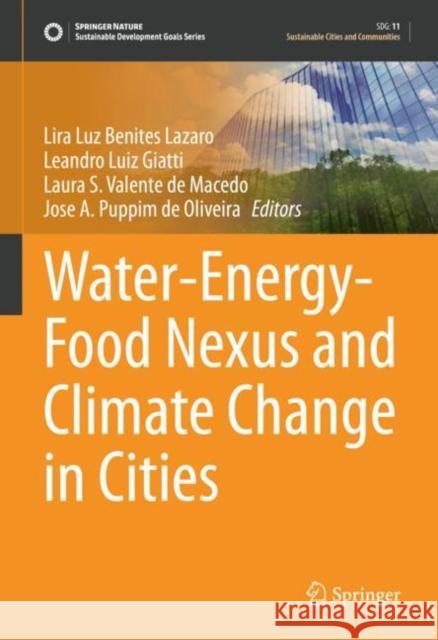
Water-Energy-Food Nexus and Climate Change in Cities Lira Luz Benites Lazaro Leandro Luiz Giatti Laura S. Valent 9783031054716 Springer - książkaWidoczna okładka, to zdjęcie poglądowe, a rzeczywista szata graficzna może różnić się od prezentowanej.

Water-Energy-Food Nexus and Climate Change in Cities

ISBN-13: 9783031054716 / Angielski / Twarda / 2022 / 327 str.

Lira Luz Benites Lazaro; Leandro Luiz Giatti; Laura S. Valente de Macedo
cena 602,40
(netto: 573,71 VAT:  5%)

Najniższa cena z 30 dni: 578,30
Termin realizacji zamówienia:
ok. 22 dni roboczych
Dostawa w 2026 r.

Darmowa dostawa!
inne wydania

This book aims to contribute to the transdisciplinary study of the water-energy-food (WEF) nexus in cities and to help policy makers adopt a more integrated approach to natural resources management in urban environments to face the challenges and threats of climate change. This approach is based on a multidimensional scientific framework that seeks to understand the complex and non-linear interrelationships and interdependencies between water-energy-food under climate change and to generate solutions to reduce trade-offs among development goals and generate co-benefits that help encourage sustainable development and contribute to the achievement of SDGs, mainly SDG 11 (make cities and human settlements inclusive, safe, resilient and sustainable) and SDG 13 (take urgent action to combat climate change and its impacts).Governing the WEF nexus in cities is one of the greatest resource challenges of our time, as cities consume large amounts of WEF, but one that can also generate relevant alternatives with which to tackle climate change. To help fostering these alternatives, this book analyzes the governance, institutional and political economy factors that determine the effectiveness of the nexus approach and reviews the potential, the benefits and the policy implications of the adoption of the WEF nexus approach at the urban level. Through a series of hands-on cases, chapters in this book present the opportunities of the WEF nexus approach to achieve innovation and transformative change and discuss concrete areas of synergy and policy initiative to raise urban resilience.Water-Energy-Food Nexus and Climate Change in Citieswill serve both as a guide for policy makers as well as a useful resource for students and researchers in fields such as urban studies, public health, environmental sciences, energy studies and public policy interested in learning how cities can represent possibilities to navigate and manage sustainability from local to global.


This book aims to contribute to the transdisciplinary study of the water-energy-food (WEF) nexus in cities and to help policy makers adopt a more integrated approach to natural resources management in urban environments to face the challenges and threats of climate change. This approach is based on a multidimensional scientific framework that seeks to understand the complex and non-linear interrelationships and interdependencies between water-energy-food under climate change and to generate solutions to reduce trade-offs among development goals and generate co-benefits that help encourage sustainable development and contribute to the achievement of SDGs, mainly SDG 11 (make cities and human settlements inclusive, safe, resilient and sustainable) and SDG 13 (take urgent action to combat climate change and its impacts).Governing the WEF nexus in cities is one of the greatest resource challenges of our time, as cities consume large amounts of WEF, but one that can also generate relevant alternatives with which to tackle climate change. To help fostering these alternatives, this book analyzes the governance, institutional and political economy factors that determine the effectiveness of the nexus approach and reviews the potential, the benefits and the policy implications of the adoption of the WEF nexus approach at the urban level. Through a series of hands-on cases, chapters in this book present the opportunities of the WEF nexus approach to achieve innovation and transformative change and discuss concrete areas of synergy and policy initiative to raise urban resilience. Water-Energy-Food Nexus and Climate Change in Cities will serve both as a guide for policy makers as well as a useful resource for students and researchers in fields such as urban studies, public health, environmental sciences, energy studies and public policy interested in learning how cities can represent possibilities to navigate and manage sustainability from local to global.

Kategorie:
Nauka, Socjologia i społeczeństwo
Kategorie BISAC:
Political Science > Public Policy - Environmental Policy
Social Science > Socjologia
Technology & Engineering > Environmental - General
Wydawca:
Springer
Seria wydawnicza:
Sustainable Development Goals
Język:
Angielski
ISBN-13:
9783031054716
Rok wydania:
2022
Dostępne języki:
Numer serii:
000812045
Ilość stron:
327
Oprawa:
Twarda

Chapter 1. WEF nexus  in cities: Opportunities for innovations to achieve sustainable development goals in the face of climate change.- Chapter 2. The importance of Water-Energy and Food Nexus in the promotion of Sustainable Cities in the perspective of the Sustainable Development Goals.- Chapter 3. What Can Cities Do to Enhance Water-Energy-Food Nexus as a Sustainable Development Strategy?.- Chapter 4. Water–Energy–Food nexus under climate change: analyzing different regional socio-ecological contexts in Brazil.- Chapter 5. How can the Water - Energy - Food Nexus approach contribute to enhancing the resilience of Amazonian cities to climate change?.- Chapter 6. The water-energy-food nexus and the micro-politics of everyday: a view from institutional bricolage.- Chapter 7. WEF Nexus Innovations: the institutional agenda for sustainability.- Chapter 8. Innovations towards 'the nexus' in the science-politics-society interface: What transformations do we really seek?.- Chapter 9. The Water-Energy-Food Nexus in Latin America and the Caribbean: Priority Interconnections.- Chapter 10. Methods for evaluating Food-Energy-Water Nexus: Data Envelopment Analysis and Network Equilibrium Model approaches.- Chapter 11. Learning about the nexus from vulnerable urban communities.- Chapter 12. Urban gardens and composting: effective governance for strengthening urban resilience and community waste management.- Chapter 13. WEF Nexus and Sustainable Investments in West Africa: The Case of Nigeria.- Chapter 14. The Food-Water-Renewable Energy Nexus Resource-Security examples for Asian-Pacific cities.- Chapter 15. Urban Living Labs and the water-energy-food nexus: experiences from the GLOCULL Project in São Paulo, Brazil..- Chapter 16. The challenges of the food, water, and energy nexus and potential interlinkages with instruments to tackle climate change: cases of Brazilian cities.- Chapter 17. Food waste redistribution and implications for achieving the Sustainable Development Goals: the case of a food bank in Sao Paulo Municipality, Brazil.

Lira Luz Benites Lazaro is a postdoctoral fellow at the Department of Environmental Health, School of Public Health, University of São Paulo, Brazil. Lira is visiting researcher at Durham Energy Institute and the Department of Anthropology at Durham University, UK. She holds a master’s and PhD in Latin America integration from the University of São Paulo, Brazil, and a second PhD in Earth system science at the National Institute for Space Research – INPE, Brazil. Lira develops research on the political and social dimensions of climate change, responses of social actors regarding climate change, corporate social responsibility, climate policy analysis, energy policy analysis, water-energy-food nexus security, and governance. Her areas of research include social sciences and interdisciplinary perspectives. Her most recent research projects examined the governance of water-energy-food nexus with a focus on biofuels.

Leandro Luiz Giatti is an associate professor in the Department of Environmental Health, School of Public Health, University of São Paulo (USP), Brazil. He has international expertise in sustainability and health, health promotion, participatory research approaches, and urban water-energy-food nexus. His experience is characterized through interdisciplinary studies and with the main efforts dedicated to socioenvironmental vulnerable groups, also with studies in the Brazilian Amazon Region. Giatti is a member of the Institute of Advanced Studies at USP and associate editor of the journal Ambiente & Sociedade (SCIELO – Brazil). During his academic research projects, he has advised theses and dissertations of graduate students and has also supervised postdoctoral partners.

Laura S. Valente de Macedo is a research fellow at the Global Cities Center of the Institute of Advanced Studies of the University of São Paulo (IEA-USP). She is also a fellow at the Center for Studies on Infrastructure and Environmental Solutions (CEISA) of Fundação Getúlio Vargas (FGVEAESP) in Brazil, where she also undertook postdoctoral research on urban green and blue infrastructure and the food-water-energy nexus. With an extensive career in environmental policies, she has held senior advisory or executive positions in both state and federal government departments since 1991. From 2002 to 2011, she was ICLEI’s regional director for Latin America, leading projects in a wide range of sustainability policies and management issues, such as climate change mitigation, green public procurement, and urban resilience. Ms. Macedo also lectured on sustainable consumption, cities, and climate change and collaborated as co-author and editor in numerous publications. She has a PhD and an MSc in environmental science from the University of São Paulo (USP), and an MSc in environmental change from the University of Oxford as a Chevening scholar. Before her career in the environmental field, she was a practicing architect in São Paulo.

Jose A. Puppim de Oliveira is a faculty member at Fundação Getulio Vargas (FGV/EAESP and FGV/EBAPE) in Brazil and a Visiting Fudan Chair Professor at the Institute for Global Public Policy. He has extensive experience in interdisciplinary research projects, particularly involving the developing world. He has over 20 years of experience in universities, businesses, think tanks, and governmental and international agencies in research, teaching, training, and academic management. His research and policy interests concentrate on themes around sustainable development, studying the patterns of governance, institution building, and policy implementation at different levels, and looking at how global and national institutions are interlinked to governance and action. He holds a PhD in planning from the Massachusetts Institute of Technology, USA.


This book aims to contribute to the transdisciplinary study of the water-energy-food (WEF) nexus in cities and to help policy makers adopt a more integrated approach to natural resources management in urban environments to face the challenges and threats of climate change. This approach is based on a multidimensional scientific framework that seeks to understand the complex and non-linear interrelationships and interdependencies between water-energy-food under climate change and to generate solutions to reduce trade-offs among development goals and generate co-benefits that help encourage sustainable development and contribute to the achievement of SDGs, mainly SDG 11 (make cities and human settlements inclusive, safe, resilient and sustainable) and SDG 13 (take urgent action to combat climate change and its impacts).

Governing the WEF nexus in cities is one of the greatest resource challenges of our time, as cities consume large amounts of WEF, but one that can also generate relevant alternatives with which to tackle climate change. To help fostering these alternatives, this book analyzes the governance, institutional and political economy factors that determine the effectiveness of the nexus approach and reviews the potential, the benefits and the policy implications of the adoption of the WEF nexus approach at the urban level. Through a series of hands-on cases, chapters in this book present the opportunities of the WEF nexus approach to achieve innovation and transformative change and discuss concrete areas of synergy and policy initiative to raise urban resilience.

Water-Energy-Food Nexus and Climate Change in Cities will serve both as a guide for policy makers as well as a useful resource for students and researchers in fields such as urban studies, public health, environmental sciences, energy studies and public policy interested in learning how cities can represent possibilities to navigate and manage sustainability from local to global.




Udostępnij

Facebook - konto krainaksiazek.pl


Opinie o Krainaksiazek.pl na Opineo.pl

Partner Mybenefit

Krainaksiazek.pl w programie rzetelna firma Krainaksiaze.pl - płatności przez paypal

Czytaj nas na:

Facebook - krainaksiazek.pl
  • książki na zamówienie
  • granty
  • książka na prezent
  • kontakt
  • pomoc
  • opinie
  • regulamin
  • polityka prywatności

Zobacz:

  • Księgarnia czeska

  • Wydawnictwo Książkowe Klimaty

1997-2025 DolnySlask.com Agencja Internetowa

© 1997-2022 krainaksiazek.pl
     
KONTAKT | REGULAMIN | POLITYKA PRYWATNOŚCI | USTAWIENIA PRYWATNOŚCI
Zobacz: Księgarnia Czeska | Wydawnictwo Książkowe Klimaty | Mapa strony | Lista autorów
KrainaKsiazek.PL - Księgarnia Internetowa

Polityka prywatnosci - link
Krainaksiazek.pl - płatnośc Przelewy24
Przechowalnia Przechowalnia




