Vulkan 3D Graphics Rendering Cookbook: Implement Expert-Level Techniques for High-Performance Graphics with Vulkan 1.3 » książka





Vulkan 3D Graphics Rendering Cookbook: Implement Expert-Level Techniques for High-Performance Graphics with Vulkan 1.3
ISBN-13: 9781803248110 / Angielski / Miękka / 2025
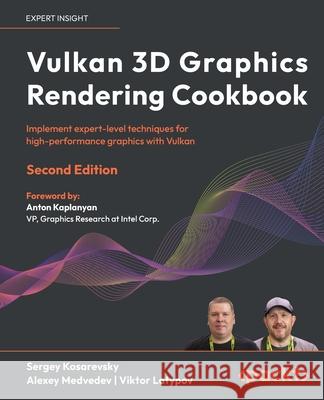
Vulkan 3D Graphics Rendering Cookbook: Implement Expert-Level Techniques for High-Performance Graphics with Vulkan 1.3
ISBN-13: 9781803248110 / Angielski / Miękka / 2025
(netto: 202,12 VAT: 5%)
Najniższa cena z 30 dni: 209,87
ok. 16-18 dni roboczych.
Darmowa dostawa!
Create a 3D rendering engine with Vulkan 1.3, including a custom glTF 2.0 rendering pipeline developed from scratch using advanced PBR extensions. Key Features Learn to integrate modern rendering techniques into a 3D real-time rendering engine. Leverage Vulkan 1.3 to render 3D content and understand modern real-time rendering methods. Implement a glTF 2.0 PBR rendering pipeline from scratch with advanced PBR extensions. Book DescriptionThis cookbook offers a practical guide to implementing many modern rendering techniques using Vulkan 1.3. This updated edition starts by setting up your development environment and quickly transitions to building a robust 3D rendering engine using self-contained recipes. Each recipe helps you incrementally enhance your codebase, integrating a variety of 3D rendering techniques and algorithms into a cohesive project. You will master core techniques such as physically based rendering, image-based rendering, and GPU-driven rendering. As you progress, the book delves into advanced topics, including glTF animations, screen-space rendering techniques, and optimization strategies. You will learn how to use advanced PBR extensions, and handle complex geometry data, ensuring your rendering engine is both powerful and versatile. These new additions empower you to create dynamic and realistic 3D graphics environments, fully utilizing Vulkan's capabilities. By the end of this 3D rendering book, you'll have gained an improved understanding of best practices used in modern graphics APIs and be able to create fast and versatile 3D rendering frameworks.What you will learn How to develop Vulkan applications Organize Vulkan resources management Manage a substantial amount of content in real-time 3D rendering engines Profile and debug Vulkan applications effectively and efficiently Create glTF 2.0 PBR rendering pipeline Utilize advanced PBR extensions for superior visual quality Combine different rendering techniques and optimizations Handle and render large geometry datasets in real-time applications Who this book is forThis book is meant for 3D graphics developers who already know the math behind 3D rendering and want to focus on building high-performance rendering engines with advanced Vulkan. It's perfect for those who are proficient in C++ and basic linear algebra, and have experience creating custom 3D applications without using premade rendering engines. This edition is especially helpful for developers looking to master the latest Vulkan features and modern rendering methods.
Create a 3D rendering engine with Vulkan 1.3, including a custom glTF 2.0 rendering pipeline developed from scratch using advanced PBR extensions. Key Features Learn to integrate modern rendering techniques into a 3D real-time rendering engine. Leverage Vulkan 1.3 to render 3D content and understand modern real-time rendering methods. Implement a glTF 2.0 PBR rendering pipeline from scratch with advanced PBR extensions. Book DescriptionThis cookbook offers a practical guide to implementing many modern rendering techniques using Vulkan 1.3. This updated edition starts by setting up your development environment and quickly transitions to building a robust 3D rendering engine using self-contained recipes. Each recipe helps you incrementally enhance your codebase, integrating a variety of 3D rendering techniques and algorithms into a cohesive project. You will master core techniques such as physically based rendering, image-based rendering, and GPU-driven rendering. As you progress, the book delves into advanced topics, including glTF animations, screen-space rendering techniques, and optimization strategies. You will learn how to use advanced PBR extensions, and handle complex geometry data, ensuring your rendering engine is both powerful and versatile. These new additions empower you to create dynamic and realistic 3D graphics environments, fully utilizing Vulkan's capabilities. By the end of this 3D rendering book, you'll have gained an improved understanding of best practices used in modern graphics APIs and be able to create fast and versatile 3D rendering frameworks.What you will learn How to develop Vulkan applications Organize Vulkan resources management Manage a substantial amount of content in real-time 3D rendering engines Profile and debug Vulkan applications effectively and efficiently Create glTF 2.0 PBR rendering pipeline Utilize advanced PBR extensions for superior visual quality Combine different rendering techniques and optimizations Handle and render large geometry datasets in real-time applications Who this book is forThis book is meant for 3D graphics developers who already know the math behind 3D rendering and want to focus on building high-performance rendering engines with advanced Vulkan. It's perfect for those who are proficient in C++ and basic linear algebra, and have experience creating custom 3D applications without using premade rendering engines. This edition is especially helpful for developers looking to master the latest Vulkan features and modern rendering methods.




Czytaj nas na:
KrainaKsiazek.PL - Księgarnia Internetowa


