Chapter One: Buddhism and the dilemma of whether to use violence in defence of a way of peace
Professor (Emeritus) Peter Harvey, University of Sunderland
Chapter Two: Violence and Peace in the Mahbharata and Ramayana
Dr Simon Brodbeck, University of Cardiff
Chapter Three: Spectres of Violence and Landscapes of Peace: imagining the religious other in patterns of Hindu modernity
Dr Ankur Barua, University of Cambridge
Chapter Four: Should Judaism Condone Violence?
Professor Alan Mittleman, Jewish Theological Seminary
Chapter Five: A Hermeneutic of Violence in Jewish Legal Sources
Dr Laliv Clenman, Leo Baeck College
Chapter Six: Subversion and Polyphony in Christian Scripture
Revd Dr Helen Paynter, Centre for the Study of Bible and Violence, Bristol Baptist College
Chapter Seven: The Essential Recovery of the Bible in Catholic Teachings on Violence and Peace
Dr Maria Power, University of Oxford
Chapter Eight: “Fear and Trembling”: a historical and phenomenological reading of the Muhammad-Event as Eschaton
Dr Milad Milani, Western Sydney University
Chapter Nine: Sources of Peace in Islam: Between theory and practice
Professor Mohammed Abunimer, American University
Chapter Ten: The Predicament of the Sant-Sipahi (Saint-Soldier): Theorising Violence in, and Beyond, the Sikh Tradition
Professor James Hegarty, University of Cardiff
Chapter Eleven: Text as Dialogue: Dialogue as Text
Dr Alisha Pomazon, St. Thomas More College, University of Saskatchewn
Maria Power, FRHistS, is a Senior Research Fellow in Human Dignity at the Las Casas Institute for Social Justice, Blackfriars Hall, University of Oxford. She is the author of Catholic Social Teaching and Theologies of Peace in Northern Ireland (2020) and From Ecumenism to Community Relations: Inter-Church Relationships in Northern Ireland 1980-2005 (2007). She is editor of Building Peace in Northern Ireland (2011).
Helen Paynter is a UK Baptist Minister, tutor in Biblical Studies at Bristol Baptist College, and Director of the Centre for the Study of Bible and Violence, Bristol Baptist College. She is the author and editor of a number of books, including Telling Terror in Judges 19: Rape and Reparation for the Levite’s Wife (2020), God of violence yesterday, God of love today? Wrestling honestly with the Old Testament (2019), and Reduced Laughter: Seriocomic Features and their Functions in the Book of Kings (2016).
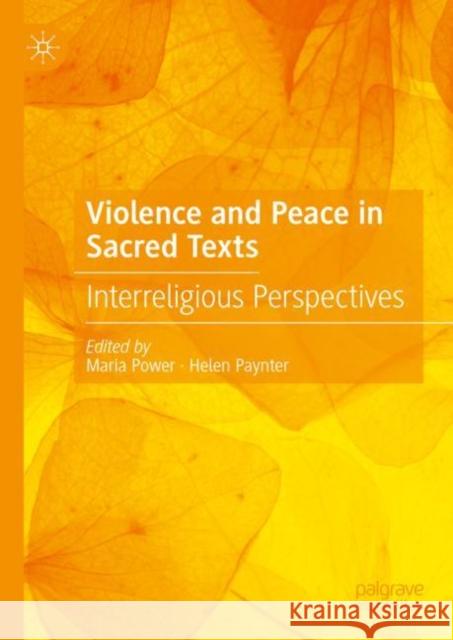
This volume brings together 11 experts from a range of religious backgrounds, to consider how each tradition has interpreted matters of violence and peace in relation to its sacred text. The traditions covered are Hinduism, Buddhism, Judaism, Christianity, Islam and Sikhism.
The role of religion in conflict, war, and the creation of peaceful settlements has attracted much academic attention, including considerations of the interpretation of violence in sacred texts. This collection breaks new ground by bringing multiple faiths into conversation with one another with specific regard to the handling of violence and peace in sacred texts. This combination of close attention to text and expansive scope of religious inclusion is the first of its kind.
Maria Power, FRHistS, is a Senior Research Fellow in Human Dignity at the Las Casas Institute for Social Justice, Blackfriars Hall, University of Oxford. She is the author of Catholic Social Teaching and Theologies of Peace in Northern Ireland (2020) and From Ecumenism to Community Relations: Inter-Church Relationships in Northern Ireland 1980-2005 (2007). She is editor of Building Peace in Northern Ireland (2011).
Helen Paynter is a UK Baptist Minister, tutor in Biblical Studies at Bristol Baptist College, and Director of the Centre for the Study of Bible and Violence, Bristol Baptist College. She is the author and editor of a number of books, including Telling Terror in Judges 19: Rape and Reparation for the Levite’s Wife (2020), God of violence yesterday, God of love today? Wrestling honestly with the Old Testament (2019), and Reduced Laughter: Seriocomic Features and their Functions in the Book of Kings (2016).