• Wyszukiwanie zaawansowane
  • Kategorie
  • Kategorie BISAC
  • Książki na zamówienie
  • Promocje
  • Granty
  • Książka na prezent
  • Opinie
  • Pomoc
  • Załóż konto
  • Zaloguj się

Using Mathematica for Quantum Mechanics: A Student's Manual » książka

zaloguj się | załóż konto
Logo Krainaksiazek.pl

koszyk

konto

szukaj
topmenu
Księgarnia internetowa
Szukaj
Książki na zamówienie
Promocje
Granty
Książka na prezent
Moje konto
Pomoc
 
 
Wyszukiwanie zaawansowane
Pusty koszyk
Bezpłatna dostawa dla zamówień powyżej 20 złBezpłatna dostawa dla zamówień powyżej 20 zł

Kategorie główne

• Nauka
 [2948695]
• Literatura piękna
 [1824038]

  więcej...
• Turystyka
 [70868]
• Informatyka
 [151073]
• Komiksy
 [35227]
• Encyklopedie
 [23181]
• Dziecięca
 [621575]
• Hobby
 [138961]
• AudioBooki
 [1642]
• Literatura faktu
 [228651]
• Muzyka CD
 [371]
• Słowniki
 [2933]
• Inne
 [445341]
• Kalendarze
 [1243]
• Podręczniki
 [164416]
• Poradniki
 [479493]
• Religia
 [510449]
• Czasopisma
 [502]
• Sport
 [61384]
• Sztuka
 [243086]
• CD, DVD, Video
 [3417]
• Technologie
 [219673]
• Zdrowie
 [100865]
• Książkowe Klimaty
 [124]
• Zabawki
 [2168]
• Puzzle, gry
 [3372]
• Literatura w języku ukraińskim
 [260]
• Art. papiernicze i szkolne
 [7838]
Kategorie szczegółowe BISAC

Using Mathematica for Quantum Mechanics: A Student's Manual

ISBN-13: 9789811375873 / Angielski / Twarda / 2019 / 193 str.
Roman Schmied
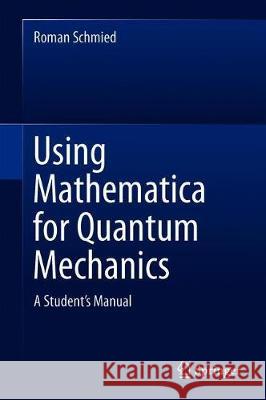
Using Mathematica for Quantum Mechanics: A Student's Manual Schmied, Roman 9789811375873 Springer - książkaWidoczna okładka, to zdjęcie poglądowe, a rzeczywista szata graficzna może różnić się od prezentowanej.

Using Mathematica for Quantum Mechanics: A Student's Manual

ISBN-13: 9789811375873 / Angielski / Twarda / 2019 / 193 str.

Roman Schmied
cena promocyjna 242,43
(netto: 230,89 VAT:  5%)
484,87
Rabat: -50%

Najniższa cena z 30 dni: 385,52
Termin realizacji zamówienia:
22 dni roboczych

Darmowa dostawa!
inne wydania
Zobacz inne książki w promocji: Wyprzedaż publikacji z zakresu nauk stosowanych
Kategorie:
Nauka, Fizyka
Kategorie BISAC:
Science > Fizyka kwantowa
Science > Fizyka matematyczna
Science > Fizyka atomowa i molekularna
Wydawca:
Springer
Język:
Angielski
ISBN-13:
9789811375873
Rok wydania:
2019
Wydanie:
2020
Ilość stron:
193
Waga:
0.46 kg
Wymiary:
23.39 x 15.6 x 1.27
Oprawa:
Twarda
Wolumenów:
01
Dodatkowe informacje:
Wydanie ilustrowane



1 Wolfram language overview
1.1 introduction
1.1.1 exercises
1.2 variables and assignments
1.2.1 immediate and delayed assignments
1.2.2 exercises
1.3 four kinds of bracketing
1.4 prefix and postfix
1.4.1 exercises
1.5 programming constructs
1.5.1 procedural programming
1.5.2 exercises
1.5.3 functional programming
1.5.4 exercises
1.6 function definitions
1.6.1 immediate function definitions
1.6.2 delayed function definitions
1.6.3 functions that remember their results
1.6.4 functions with conditions on their arguments
1.6.5 functions with optional arguments
1.7 rules and replacements
1.7.1 immediate and delayed rules
1.7.2 repeated rule replacement
1.8 many ways to define the factorial function
1.8.1 exercises
1.9 vectors, matrices, tensors
1.9.1 vectors
1.9.2 matrices
1.9.3 sparse vectors and matrices
1.9.4 matrix diagonalization
1.9.5 tensor operations
1.9.6 exercises
1.10 complex numbers
1.11 units
2 quantum  mechanics
2.1 basis sets and representations 
2.1.1 incomplete basis sets 
2.1.2 exercises 
2.2 time-independent Schrödinger equation 
2.2.1 diagonalization 
2.2.2 exercises 
2.3 time-dependent Schrödinger equation 
2.3.1 time-independent  basis 
2.3.2 time-dependent basis: interaction picture 
2.3.3 special case: I ˆ(t), ˆ(tt)l = 0 ∀(t, tt) 
H H
2.3.4 special case: time-independent Hamiltonian 
2.3.5 exercises 
2.4 basis construction 
2.4.1 description of a single degree of freedom 
2.4.2 description of coupled degrees of freedom 
2.4.3 reduced density matrices 
2.4.4 exercises 
3 spin systems
3.1 quantum-mechanical spin and angular momentum operators 
3.1.1 exercises 
3.2 spin-1/2 electron in a dc magnetic field 
3.2.1 time-independent Schrödinger equation 
3.2.2 exercises 
3.3 coupled spin systems: 87Rb hyperfine structure 
3.3.1 eigenstate analysis 
3.3.2 “magic” magnetic field 
3.3.3 coupling to an oscillating magnetic field 
3.3.4 exercises 
3.4 coupled spin systems: Ising model in a transverse field 
3.4.1 basis set 
3.4.2 asymptotic ground states 
3.4.3 Hamiltonian diagonalization 
3.4.4 analysis of the ground state 
3.4.5 exercises 
4 real-space systems
4.1 one particle in one dimension 
4.1.1 computational basis functions 
4.1.2 example: square well with bottom step 
4.1.3 the Wigner quasi-probability distribution 
4.1.4 1D dynamics in the square well 
4.1.5 1D dynamics in a time-dependent potential 
4.2 non-linear Schrödinger equation 
4.2.1 ground state of the non-linear Schrödinger equation 
4.3 several particles in one dimension: interactions 
4.3.1 two identical particles in one dimension with contact interaction 
4.3.2 two particles in one dimension with arbitrary interaction 
4.4 one particle in several dimensions 
4.4.1 exercises 
5 combining space and spin
5.1 one particle in 1D with spin 
5.1.1 separable  Hamiltonian 
5.1.2 non-separable  Hamiltonian      
5.1.3 exercises
5.2 one particle in 2D with spin: Rashba coupling
5.2.1 exercises 
5.3 phase-space dynamics in the Jaynes–Cummings model 
exercises 

PD Dr. Roman Schmied studied physics at the École Polytechnique Fédérale de Lausanne and the University of Texas at Austin. He wrote his diploma thesis on helium nanodroplet spectroscopy at Princeton University with Kevin Lehmann and Giacinto Scoles, and later obtained his Ph.D. from the same group, working on the superfluidity of helium nanodroplets and on the spectroscopy of molecules solvated within these droplets. He carried out his postdoctoral work at the Max Planck Institute of Quantum Optics in Garching, Germany, where he first began working with quantum simulators and quantum simulations. After a short stay at the NIST ion storage group in Boulder, USA, he took on his current position at the University of Basel, where he was habilitated in 2017. Since 2016 he has also been working at the University’s Human Optics Lab, where he is currently using digital technology for child health, particularly eye health.

This book revisits many of the problems encountered in introductory quantum mechanics, focusing on computer implementations for finding and visualizing analytical and numerical solutions. It subsequently uses these implementations as building blocks to solve more complex problems, such as coherent laser-driven dynamics in the Rubidium hyperfine structure or the Rashba interaction of an electron moving in 2D. The simulations are highlighted using the programming language Mathematica. No prior knowledge of Mathematica is needed; alternatives, such as Matlab, Python, or Maple, can also be used.


Udostępnij

Facebook - konto krainaksiazek.pl


Opinie o Krainaksiazek.pl na Opineo.pl

Partner Mybenefit

Krainaksiazek.pl w programie rzetelna firma Krainaksiaze.pl - płatności przez paypal

Czytaj nas na:

Facebook - krainaksiazek.pl
  • książki na zamówienie
  • granty
  • książka na prezent
  • kontakt
  • pomoc
  • opinie
  • regulamin
  • polityka prywatności

Zobacz:

  • Księgarnia czeska

  • Wydawnictwo Książkowe Klimaty

1997-2026 DolnySlask.com Agencja Internetowa

© 1997-2022 krainaksiazek.pl
     
KONTAKT | REGULAMIN | POLITYKA PRYWATNOŚCI | USTAWIENIA PRYWATNOŚCI
Zobacz: Księgarnia Czeska | Wydawnictwo Książkowe Klimaty | Mapa strony | Lista autorów
KrainaKsiazek.PL - Księgarnia Internetowa

Polityka prywatnosci - link
Krainaksiazek.pl - płatnośc Przelewy24
Przechowalnia Przechowalnia





