• Wyszukiwanie zaawansowane
  • Kategorie
  • Kategorie BISAC
  • Książki na zamówienie
  • Promocje
  • Granty
  • Książka na prezent
  • Opinie
  • Pomoc
  • Załóż konto
  • Zaloguj się

Using Eye Movements as an Experimental Probe of Brain Function: A Symposium in Honor of Jean Büttner-Ennever Volume 171 » książka


zaloguj się | załóż konto
Logo Krainaksiazek.pl

koszyk

konto

szukaj
topmenu
Księgarnia internetowa
Szukaj
Książki na zamówienie
Promocje
Granty
Książka na prezent
Moje konto
Pomoc
 
 
Wyszukiwanie zaawansowane
Pusty koszyk
Bezpłatna dostawa dla zamówień powyżej 20 złBezpłatna dostawa dla zamówień powyżej 20 zł

Kategorie główne

• Nauka
 [2950560]
• Literatura piękna
 [1849509]

  więcej...
• Turystyka
 [71097]
• Informatyka
 [151150]
• Komiksy
 [35848]
• Encyklopedie
 [23178]
• Dziecięca
 [617388]
• Hobby
 [139064]
• AudioBooki
 [1657]
• Literatura faktu
 [228597]
• Muzyka CD
 [383]
• Słowniki
 [2855]
• Inne
 [445295]
• Kalendarze
 [1464]
• Podręczniki
 [167547]
• Poradniki
 [480102]
• Religia
 [510749]
• Czasopisma
 [516]
• Sport
 [61293]
• Sztuka
 [243352]
• CD, DVD, Video
 [3414]
• Technologie
 [219456]
• Zdrowie
 [101002]
• Książkowe Klimaty
 [124]
• Zabawki
 [2311]
• Puzzle, gry
 [3459]
• Literatura w języku ukraińskim
 [254]
• Art. papiernicze i szkolne
 [8079]
Kategorie szczegółowe BISAC

Using Eye Movements as an Experimental Probe of Brain Function: A Symposium in Honor of Jean Büttner-Ennever Volume 171

ISBN-13: 9780444531636 / Angielski / Twarda / 2008 / 652 str.
R. John Leigh; Christopher Kennard
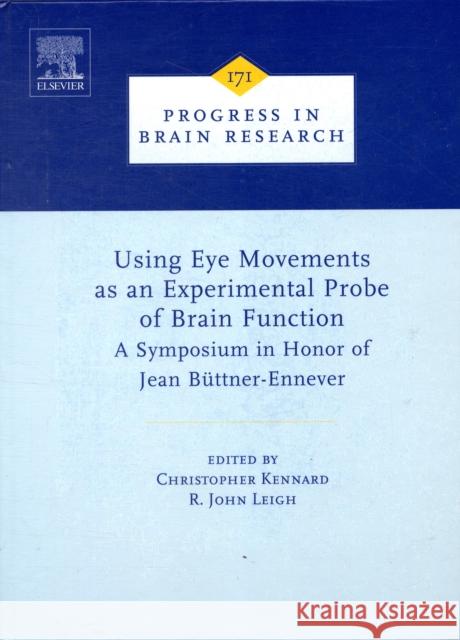
Using Eye Movements as an Experimental Probe of Brain Function: A Symposium in Honor of Jean Büttner-Ennever Volume 171 Leigh, R. John 9780444531636 Elsevier Science - książkaWidoczna okładka, to zdjęcie poglądowe, a rzeczywista szata graficzna może różnić się od prezentowanej.

Using Eye Movements as an Experimental Probe of Brain Function: A Symposium in Honor of Jean Büttner-Ennever Volume 171

ISBN-13: 9780444531636 / Angielski / Twarda / 2008 / 652 str.

R. John Leigh; Christopher Kennard
cena 971,57
(netto: 925,30 VAT:  5%)

Najniższa cena z 30 dni: 965,58
Termin realizacji zamówienia:
ok. 30 dni roboczych
Dostawa w 2026 r.

Darmowa dostawa!

This volume of Progress in Brain Research is based on the proceedings of a conference, "Using Eye Movements as an Experimental Probe of Brain Function," held at the Charing Cross Hospital Campus of Imperial College London, UK on 5th -6th December, 2007 to honor Professor Jean Buttner-Ennever. With 87 contributions from international experts - both basic scientists and clinicians - the volume provides many examples of how eye movements can be used to address a broad range of research questions. Section 1 focuses on extraocular muscle, highlighting new concepts of proprioceptive control that involve even the cerebral cortex. Section 2 comprises structural, physiological, pharmacological, and computational aspects of brainstem mechanisms, and illustrates implications for disorders as diverse as opsoclonus, and congenital scoliosis with gaze palsy. Section 3 addresses how the cerebellum transforms neural signals into motor commands, and how disease of such mechanisms may lead to ataxia and disorders such as oculopalatal tremor. Section 4 deals with sensory-motor processing of visual, vestibular, somatosensory, and auditory inputs, such as are required for navigation, and gait. Section 5 illustrates how eye movements, used in conjunction with single-unit electrophysiology, functional imaging, transcranial magnetic stimulation, and lesion studies have illuminated cognitive processes, including memory, prediction, and even free will. Section 6 includes 18 papers dealing with disorders ranging from congenital to acquired forms of nystagmus, genetic and degenerative neurological disorders, and treatments for nystagmus and motion sickness.

* Clinicians will find important new information on the substrate for spinocerebellar ataxia, late-onset Tay-Sachs disease, Huntington disease, and pulvinar lesions
* Organizes multiple articles on such topics as proprioception, short and longer-term memory, and hereditary cerebellar ataxias for a more coherent presentation
* Articles on anatomic tracers, functional imaging, and computational neuroscience are illustrated in color


Kategorie:
Nauka, Psychologia
Kategorie BISAC:
Psychology > Neuropsychology
Medical > Neurologia i neurofizjologia kliniczna
Medical > Neuroscience
Wydawca:
Elsevier Science
Seria wydawnicza:
Progress in Brain Research
Język:
Angielski
ISBN-13:
9780444531636
Rok wydania:
2008
Numer serii:
000061059
Ilość stron:
652
Waga:
1.67 kg
Wymiary:
25.91 x 19.3 x 3.05
Oprawa:
Twarda
Wolumenów:
01

Section 1: Using Novel Techniques to Define the Neural Substrate for Eye Movements

Jean Büttner-Ennever, Munich: Re-mapping the oculomotor system
Joseph Demer, Los Angeles: Using high-definition MRI to re-define the mechanics of eye rotations
Michael Goldberg, New York: The cortical representation of oculomotor proprioception
David Zee, Baltimore: How new knowledge of the anatomy of the eye muscles and their innervation translates into improved treatment of patients with ocular motor palsies
Paul Knox, Liverpool: Testing the influences of extraocular proprioception in humans
James Sharpe, Toronto: Reinterpreting palsies of the ocular motor nerves
Dominik Straumann: New insights into trochlear nerve palsy
Paul May: Anatomical insights into peripheral gaze control
Louis Dell'Osso: How disrupting ocular proprioception can be therapy for congenital nsyatgmus


Section 2: New Insights into Brainstem Generation of Ocular Motor Commands
Anja Horn, Munich: New insights into the circuitry and pharmacology of the brainstem reticular formation
Edward Keller, San Francisco: Using multiple electrode arrays to map moving fields of neural activity in the superior colliculus
Paul Gamlin, Birmingham: Synthesis of vergence control by brainstem circuits
Holger Rambold, Lübeck: Disturbances of vergence and saccadic eye movements by human brainstem lesions
Christoph Helmchen, Luebeck: Understanding how the cerebellar disease could cause saccadic oscillations
Stefano Ramat, Pavia: A brainstem network that accounts for abnormal saccades
Mark Gibson, Belfast: Human saccadic disorders and their brainstem mechanisms
Richard Clement: A black-box approach to saccadic disorders

Section 3: Using Eye Movements as an Index of Transformation of Signals by the Cerebellum
Stephen Highstein, St. Louis: How the cerebellar transforms sensory inputs into motor commands
Albert Fuchs, Seattle: How visual and motor signals interact in the cerebellum
John Stahl, Cleveland: How mutant mice with calcium channel defects provide insight into the cerebellar role in balance
Michael Strupp, Munich: How knowledge about calcium channel disorders translates into treatment of human cerebellar disease
Bernard Cohen, New York: Cerebellar governance of vestibular mechanisms
Mark Walker, Baltimore: Influence of cerebellar nodulus on translational vestibulo-ocular reflex
Ulrich Büttner, Munich: Control of smooth-pursuit eye movements by cerebellum
Robert McCrea, Chicago: Influence of cerebellum on combined eye-head tracking
Adolfo Bronstein, London: Degenerative disorders that affect the cerebellar control of eye movements

Section 3: Using Eye Movements as a Probe of Sensory-Motor Processing
Frederick Miles, Bethesda: How the brain uses visual motion as we move through the environment
Peter Hoffmann: How motion signals are encoded in visual areas
Michael Mustari, Atlanta: How disturbed maturation of visual motion processing leads to nystagmus in infancy
Thomas Brandt: How vestibular and visual inputs may be abnormally processed in cerebral cortex
Richard Abadi, Manchester: Visual perceptions during ocular oscillations
Michael Gresty, London: Self-motion, gaze control and visual perception
Bernhard Hess, Zurich: Understanding interactions between responses to head rotations and translations
Michael Halmagyi, Sydney: Probing otolith-ocular reflexes using novel stimuli in humans
Sergei Yakushin, New York: How visual inputs from subcortical pathways influence perception of self-motion

Section 4: Using Eye Movements as a Probe of Cognition
James Lynch, Jackson: Concepts of the contribution of cerebral cortex based on new anatomical findings
Kikuro Fukushima, Sapporo: Prediction, eye movements, and the frontal lobes
Rene Müri, Bern: Using transcranial magnetic stimulation to probe decision-making and memory
Parashkev Nachev, London: Using functional imaging to during conflict resolution and free choice
Charles Pierrot-Deseilligny, Paris: Using saccades to probe different forms of memory
Christopher Kennard, London: Role of the supplementary eye fields in countermanding saccades
Masud Husain, London: Using eye movements to probe shifts of instruction set
Graham Barnes, Manchester: Using smooth tracking movements to probe prediction
R. John Leigh, Cleveland, Ohio: Eye movements: The meaning of it all (Epilogue)


Udostępnij

Facebook - konto krainaksiazek.pl


Opinie o Krainaksiazek.pl na Opineo.pl

Partner Mybenefit

Krainaksiazek.pl w programie rzetelna firma Krainaksiaze.pl - płatności przez paypal

Czytaj nas na:

Facebook - krainaksiazek.pl
  • książki na zamówienie
  • granty
  • książka na prezent
  • kontakt
  • pomoc
  • opinie
  • regulamin
  • polityka prywatności

Zobacz:

  • Księgarnia czeska

  • Wydawnictwo Książkowe Klimaty

1997-2025 DolnySlask.com Agencja Internetowa

© 1997-2022 krainaksiazek.pl
     
KONTAKT | REGULAMIN | POLITYKA PRYWATNOŚCI | USTAWIENIA PRYWATNOŚCI
Zobacz: Księgarnia Czeska | Wydawnictwo Książkowe Klimaty | Mapa strony | Lista autorów
KrainaKsiazek.PL - Księgarnia Internetowa

Polityka prywatnosci - link
Krainaksiazek.pl - płatnośc Przelewy24
Przechowalnia Przechowalnia






