• Wyszukiwanie zaawansowane
  • Kategorie
  • Kategorie BISAC
  • Książki na zamówienie
  • Promocje
  • Granty
  • Książka na prezent
  • Opinie
  • Pomoc
  • Załóż konto
  • Zaloguj się

User Models in Dialog Systems » książka


zaloguj się | załóż konto
Logo Krainaksiazek.pl

koszyk

konto

szukaj
topmenu
Księgarnia internetowa
Szukaj
Książki na zamówienie
Promocje
Granty
Książka na prezent
Moje konto
Pomoc
 
 
Wyszukiwanie zaawansowane
Pusty koszyk
Bezpłatna dostawa dla zamówień powyżej 20 złBezpłatna dostawa dla zamówień powyżej 20 zł

Kategorie główne

• Nauka
 [2949965]
• Literatura piękna
 [1857847]

  więcej...
• Turystyka
 [70818]
• Informatyka
 [151303]
• Komiksy
 [35733]
• Encyklopedie
 [23180]
• Dziecięca
 [617748]
• Hobby
 [139972]
• AudioBooki
 [1650]
• Literatura faktu
 [228361]
• Muzyka CD
 [398]
• Słowniki
 [2862]
• Inne
 [444732]
• Kalendarze
 [1620]
• Podręczniki
 [167233]
• Poradniki
 [482388]
• Religia
 [509867]
• Czasopisma
 [533]
• Sport
 [61361]
• Sztuka
 [243125]
• CD, DVD, Video
 [3451]
• Technologie
 [219309]
• Zdrowie
 [101347]
• Książkowe Klimaty
 [123]
• Zabawki
 [2362]
• Puzzle, gry
 [3791]
• Literatura w języku ukraińskim
 [253]
• Art. papiernicze i szkolne
 [7933]
Kategorie szczegółowe BISAC

User Models in Dialog Systems

ISBN-13: 9783642832321 / Angielski / Miękka / 2011 / 471 str.
Alfred Kobsa; Wolfgang Wahlster; S. Carberry
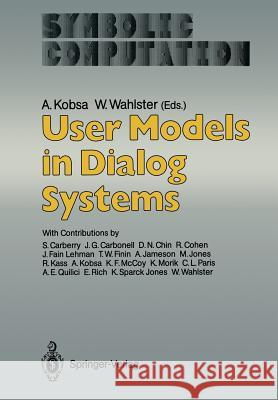
User Models in Dialog Systems Alfred Kobsa Wolfgang Wahlster S. Carberry 9783642832321 Springer - książkaWidoczna okładka, to zdjęcie poglądowe, a rzeczywista szata graficzna może różnić się od prezentowanej.

User Models in Dialog Systems

ISBN-13: 9783642832321 / Angielski / Miękka / 2011 / 471 str.

Alfred Kobsa; Wolfgang Wahlster; S. Carberry
cena 403,47 zł
(netto: 384,26 VAT:  5%)

Najniższa cena z 30 dni: 385,52 zł
Termin realizacji zamówienia:
ok. 22 dni roboczych
Bez gwarancji dostawy przed świętami

Darmowa dostawa!

User models have recently attracted much research interest in the field of artificial intelligence dialog systems. It has become evident that flexible user-oriented dialog behavior of such systems can be achieved only if the system has access to a model of the user containing assumptions about his/her background knowledge as well as his/her goals and plans in consulting the system. Research in the field of user models investigates how such assumptions can be automatically created, represented and exploited by the system in the course of an "on-line" interaction with the user. The communication medium in this interaction need not necessarily be a natural language, such as English or German. Formal interaction languages are also permit- ted. The emphasis is placed on systems with natural language input and output, however. A dozen major and several more minor user modeling systems have been de- signed and implemented in the last decade, mostly in the context of natural-language dialog systems. The goal of UM86, the first international workshop on user model- ing, was to bring together the researchers working on these projects so that results could be discussed and analyzed, and hopefully general insights be found, that could prove useful for future research. The meeting took place in Maria Laach, a small village some 40 miles south of Bonn, West Germany. 25 prominent researchers were invited to participate.


Kategorie:
Informatyka, Bazy danych
Kategorie BISAC:
Computers > Interactive & Multimedia
Gardening > General
Medical > Administration
Wydawca:
Springer
Seria wydawnicza:
Symbolic Computation / Artificial Intelligence
Język:
Angielski
ISBN-13:
9783642832321
Rok wydania:
2011
Wydanie:
Softcover Repri
Numer serii:
000307844
Ilość stron:
471
Waga:
0.83 kg
Wymiary:
24.2 x 17.0
Oprawa:
Miękka
Wolumenów:
01
Dodatkowe informacje:
Bibliografia

I. A Survey of User Modeling.- 1 User Models in Dialog Systems.- 1. Introduction.- 2. Constructing User Models.- 3. Representing User Models.- 4. Exploiting User Models.- 5. Open Questions and Future Research in User Modeling.- 6. References.- 2 Stereotypes and User Modeling.- 1. Introduction.- 2. The Definition of a Stereotype.- 3. The Space of User Models.- 4. Stereotypes and User Modeling.- 5. Stereotypes and Contradiction Resolution.- 6. Adaptation of Stereotype Systems.- 7. Parallel Models of System Knowledge and of Users.- 8. Summary.- 9. References.- 3 A Taxonomy of Beliefs and Goals for User Models in Dialog Systems.- 1. Introduction.- 2. Beliefs, Goals and Plans.- 3. Basic Beliefs.- 4. Basic Goals.- 5. Beliefs with Respect to Other Agents’ Beliefs and Goals.- 6. Goals with Respect to Other Agents’ Beliefs and Goals.- 7. A Classification of Existing User Models.- 8. Discussion.- 9. References.- II. Building User Models.- 4 KNOME: Modeling What the User Knows in UC.- 1. Introduction.- 2. Internal Representation of Users.- 3. Deducing the User’s Level of Expertise.- 4. Modeling UC’s Knowledge.- 5. Exploiting KNOME.- 6. Conclusion.- 7. References.- 5 Detecting and Responding to Plan-Oriented Misconceptions.- 1. Introduction.- 2. An Explanation-Based Approach.- 3. Representing User and Advisor Beliefs.- 4. Explanation-Based Misconception Recognition and Response.- 5. A Taxonomy of Potential Explanations.- 6. A Detailed Process Model.- 7. Accessing Advisor Planning Knowledge.- 8. Related Work.- 9. Implementation Details.- 10. Limitations and Future Work.- 11. Conclusions.- 12. References.- 6 Plan Recognition and Its Use in Understanding Dialog.- 1. Introduction.- 2. Plan Recognition in Dialog Systems.- 3. Inferring and Modeling the Task-Related Plan.- 4. Application of User Models.- 5. Improving Plan Recognition.- 6. Constructing and Exploiting Other Components of a User Model.- 7. Conclusions and Current Research.- 8. References.- 7 Learning the User’s Language: A Step Towards Automated Creation of User Models.- 1. Introduction: Adaptable Interfaces.- 2. Foundations: Least-Deviant-First Parsing and MULTIPAR.- 3. CHAMP: Design for an Adaptive Parser.- 4. Hidden Operator Experiments with Professional Secretaries.- 5. Concluding Remarks.- 6. References.- III. Exploiting User Models.- 8 The Use of Explicit User Models in a Generation System for Tailoring Answers to the User’s Level of Expertise.- 1. Introduction.- 2. Identifying What Needs to Be in the User Model.- 3. Two Descriptions Strategies Found in Texts: Constituency Schema and Process Trace.- 4. Mixing the Strategies.- 5. TAILOR.- 6. Further Work and Related Issues.- 7. Conclusions.- 8. References.- 9 Highlighting a User Model to Respond to Misconceptions.- 1. Introduction.- 2. Knowledge Available.- 3. Related Work on Correcting Misconceptions.- 4. Misclassifications.- 5. Misattributions.- 6. A Rule for Choosing a Strategy.- 7. Highlighting and Object Similarity.- 8. Object Perspective.- 9. Using Perspective to Set f.- 10. Modeling a Domain with Perspectives.- 11. Choosing the Active Perspective.- 12. Perspective’s Influence on Responses.- 13. Conclusions.- 14. References.- 10 But What Will the Listener Think? Belief Ascription and Image Maintenance in Dialog.- 1. Introduction.- 2. Situation 1: Generating an Informative Monolog.- 3. Situation 2: Positive or Negative Bias.- 4. Situation 3: Anticipating the Pragmatic Interpretation of Comments.- 5. Situation 4: Discrepancy Between Actual and Projected Biases.- 6. Situation 5: Responding to Specific Questions.- 7. Situation 6: Establishing a Desired Projected Bias.- 8. Situation 7: Discrepancy Between Actual and Projected Ascriptions.- 9. Situation 8: Uncertainty in the Listener About the Speaker’s Ascriptions.- 10. Situation 9: Uncertainty in the Speaker About Her Projected Ascriptions.- 11. Conclusions.- 12. References.- 11 Incorporating User Models into Expert Systems for Educational Diagnosis.- 1. Introduction.- 2. Application Domain.- 3. Designing the System.- 4. The User Model Structure.- 5. Related Work.- 6. A General Proposal for User Modeling in Expert Systems.- 7. Current Status and Future Work.- 8. Conclusions.- 9. References.- IV. Shortcomings of Current Models, Prospects for the Future.- 12 Realism About User Modeling.- 1. Introduction.- 2. What Is Being Modeled.- 3. What Modeling Is For.- 4. What Modeling Is From.- 5. Rational Principles for Modeling.- 6. Conclusion.- 7. References.- 13 User Models and Conversational Settings: Modeling the User’s Wants.- 1. Introduction.- 2. Terminology.- 3. Conversational Settings.- 4. User Modeling in HAM-ANS.- 5. Conclusion.- 6. References.- 14 Student Modeling in Intelligent Tutoring Systems — Implications for User Modeling.- 1. Introduction.- 2. Intelligent Tutoring Systems.- 3. Student Modeling.- 4. Four Intelligent Tutoring Systems That Model Students.- 5. Further Work in Student Modeling.- 6. Summary: Comparing User Modeling and Student Modeling.- 7. Conclusion.- 8. References.- 15 GUMS — A General User Modeling Shell.- 1. Introduction — The Need for User Modeling.- 2. What Kind of User Model?.- 3. A General User Modeling System.- 4. The Current GUMS System.- 5. The GUMS Command Language.- 6. Conclusions.- 7. References.- Appendices.- List of Contributors.

Wahlster, Wolfgang Wolfgang Wahlster is Director and CEO of the Germa... więcej >


Udostępnij

Facebook - konto krainaksiazek.pl


Opinie o Krainaksiazek.pl na Opineo.pl

Partner Mybenefit

Krainaksiazek.pl w programie rzetelna firma Krainaksiaze.pl - płatności przez paypal

Czytaj nas na:

Facebook - krainaksiazek.pl
  • książki na zamówienie
  • granty
  • książka na prezent
  • kontakt
  • pomoc
  • opinie
  • regulamin
  • polityka prywatności

Zobacz:

  • Księgarnia czeska

  • Wydawnictwo Książkowe Klimaty

1997-2025 DolnySlask.com Agencja Internetowa

© 1997-2022 krainaksiazek.pl
     
KONTAKT | REGULAMIN | POLITYKA PRYWATNOŚCI | USTAWIENIA PRYWATNOŚCI
Zobacz: Księgarnia Czeska | Wydawnictwo Książkowe Klimaty | Mapa strony | Lista autorów
KrainaKsiazek.PL - Księgarnia Internetowa

Polityka prywatnosci - link
Krainaksiazek.pl - płatnośc Przelewy24
Przechowalnia Przechowalnia





