• Wyszukiwanie zaawansowane
  • Kategorie
  • Kategorie BISAC
  • Książki na zamówienie
  • Promocje
  • Granty
  • Książka na prezent
  • Opinie
  • Pomoc
  • Załóż konto
  • Zaloguj się

Urban Regeneration and Social Sustainability: Best Practice from European Cities » książka


zaloguj się | załóż konto
Logo Krainaksiazek.pl

koszyk

konto

szukaj
topmenu
Księgarnia internetowa
Szukaj
Książki na zamówienie
Promocje
Granty
Książka na prezent
Moje konto
Pomoc
 
 
Wyszukiwanie zaawansowane
Pusty koszyk
Bezpłatna dostawa dla zamówień powyżej 20 złBezpłatna dostawa dla zamówień powyżej 20 zł

Kategorie główne

• Nauka
 [2952079]
• Literatura piękna
 [1850969]

  więcej...
• Turystyka
 [71058]
• Informatyka
 [151066]
• Komiksy
 [35579]
• Encyklopedie
 [23181]
• Dziecięca
 [620496]
• Hobby
 [139036]
• AudioBooki
 [1646]
• Literatura faktu
 [228729]
• Muzyka CD
 [379]
• Słowniki
 [2932]
• Inne
 [445708]
• Kalendarze
 [1409]
• Podręczniki
 [164793]
• Poradniki
 [480107]
• Religia
 [510956]
• Czasopisma
 [511]
• Sport
 [61267]
• Sztuka
 [243299]
• CD, DVD, Video
 [3411]
• Technologie
 [219640]
• Zdrowie
 [100984]
• Książkowe Klimaty
 [124]
• Zabawki
 [2281]
• Puzzle, gry
 [3363]
• Literatura w języku ukraińskim
 [258]
• Art. papiernicze i szkolne
 [8020]
Kategorie szczegółowe BISAC

Urban Regeneration and Social Sustainability: Best Practice from European Cities

ISBN-13: 9781405194198 / Angielski / Twarda / 2010 / 334 str.
Andrea Colantonio;Tim Dixon;¬Abar
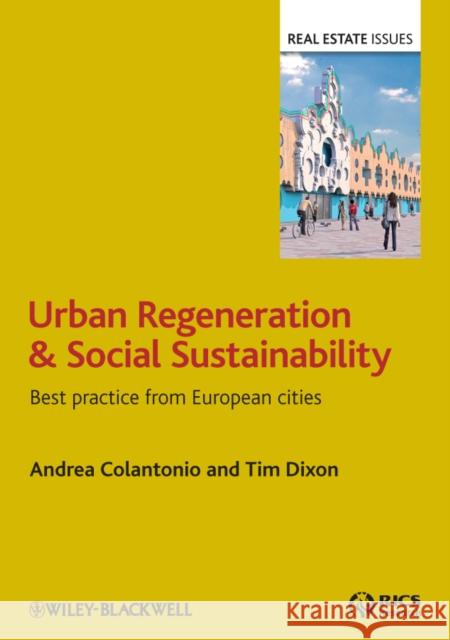
Urban Regeneration and Social Sustainability: Best Practice from European Cities Colantonio, Andrea 9781405194198  - książkaWidoczna okładka, to zdjęcie poglądowe, a rzeczywista szata graficzna może różnić się od prezentowanej.

Urban Regeneration and Social Sustainability: Best Practice from European Cities

ISBN-13: 9781405194198 / Angielski / Twarda / 2010 / 334 str.

Andrea Colantonio;Tim Dixon;¬Abar
cena 505,98
(netto: 481,89 VAT:  5%)

Najniższa cena z 30 dni: 502,87
Termin realizacji zamówienia:
ok. 30 dni roboczych
Dostawa w 2026 r.

Darmowa dostawa!

Urban regeneration is a key focus for public policy throughout Europe. This book examines social sustainability and analyses its meaning and significance - an area of research which has, until now, been comparatively neglected. The authors offer a comprehensive European perspective to identify best practice in sustainable urban regeneration in five major cities in Spain, Italy, Netherlands, Germany, and the UK. Urban Regeneration & Social Sustainability: best practice from European cities examines the extent to which social sustainability is incorporated within urban regeneration projects in the EU, but also investigates how local authorities, developers, investors and other key stakeholders approach sustainability. The book covers the recent economic recession and the growth of responsible investment (RI) and corporate responsibility (CR) agendas of investors and developers. It also provides a thorough analysis of the current metrics and tools used by the public, private and NGO sectors to implement, measure and monitor social sustainability. A range of urban regeneration models and vehicles are reviewed, with a particular emphasis on public private partnerships (PPPs) and EU structural funds, and a new framework for assessing social sustainability is described. City-specific case studies examine regeneration projects in which institutional arrangements, financial products and tools, monitoring and measurement systems for social sustainability and stakeholders' participation in PPPs have delivered successful urban regeneration. This comprehensive, systematic and authoritative overview of both the scholarly literature and current best practice across Europe makes the book essential reading for researchers and post-graduate students in sustainable development, real estate, geography, urban studies and urban planning, as well as consultants and policy advisors in urban regeneration and the built environment.

  • Provides a comprehensive European perspective, comparing case studies across five cities and identifying best practice in sustainable urban regeneration by focusing on social sustainability
  • Defines and shows how social sustainability (a key aspect in sustainable development) can be assessed, measured and monitored within urban regeneration projects
  • Takes a real estate 'institutional' focus by examining the role of key stakeholders within the property development industry and the public sector
  • Examines detailed studies of urban regeneration projects in Spain (Sant Adria de Besos), Italy (Turin), Netherlands (Rotterdam), Germany (Leipzig), and the UK (Cardiff)
  • Sets the research in the context of the recent economic recession and the growth of responsible investment (RI) and corporate responsibility (CR) agendas of investors and developers
  • Is based on a major three year independent, funded programme of research through the European Investment Bank's EIBURS programme.
-Regeneration is a difficult task with multiple ambitions and multiple problems. This book manages successfully to draw lessons from a series of case studies to bring out lessons for the slippery concept of social sustainability which will help guide practitioners both in setting up programmes and in monitoring their success.-
--Bridget Roswell, Chief Economic Adviser, Greater London Authority -The social sustainability agenda is complex and will be instrumental in shaping the future development of our cities and towns over the coming decades. This book, in drawing together the knowledge base on the subject through generic considerations and best practice examples is a major contribution in raising the level of debate on the understanding and interpretation of social sustainability.-
--Stanley McGreal, Director of the Built Environment Research Institute, University of Ulster; Plus Bill Boler, Steve Rayner, Bridget Rosewell, Michael Parkinson and Pooran Desai. Urban regeneration is a key focus for public policy throughout Europe. This book examines social sustainability and analyses its meaning and significance - an area of research which has, until now, been comparatively neglected. The authors offer a comprehensive European perspective to identify best practice in sustainable urban regeneration in five major cities in Spain, Italy, Netherlands, Germany, and the UK. Urban Regeneration & Social Sustainability: best practice from European cities examines the extent to which social sustainability is incorporated within urban regeneration projects in the EU, but also investigates how local authorities, developers, investors and other key stakeholders approach sustainability. The book covers the recent economic recession and the growth of responsible investment (RI) and corporate responsibility (CR) agendas of investors and developers. It also provides a thorough analysis of the current metrics and tools used by the public, private and NGO sectors to implement, measure and monitor social sustainability. A range of urban regeneration models and vehicles are reviewed, with a particular emphasis on public private partnerships (PPPs) and EU structural funds, and a new framework for assessing social sustainability is described. City-specific case studies examine regeneration projects in which institutional arrangements, financial products and tools, monitoring and measurement systems for social sustainability and stakeholders' participation in PPPs have delivered successful urban regeneration. This comprehensive, systematic and authoritative overview of both the scholarly literature and current best practice across Europe, makes the book essential reading for researchers and post-graduate students in sustainable development, real estate, geography, urban studies and urban planning, as well as consultants and policy advisors in urban regeneration and the built environment.

This book identifies and examines socially sustainable urban regeneration models, vehicles and best practice across EU27, including innovative social sustainability metrics and tools. It looks at sustainable development from a built environment view point at policy, industry and academic levels.

Urban Regeneration & Social Sustainability examines to what extent social sustainability is incorporated within urban renewal projects in the EU and investigates how lenders and investors approach sustainability.

It provides a thorough analysis of the current sustainability metrics and tools used by the public, private and NGO sectors to measure, monitor and implement social sustainability. Past and present urban regeneration delivering models and vehicles are reviewed – with special emphasis on public–private partnerships and EU structural funds: PPPs are now a fundamental requirement for EU funding.

Case studies are examined where institutional arrangements, financial products and tools, management systems and stakeholders’ participation in PPPs have delivered successful urban renewal.


Kategorie:
Sztuka, Architektura
Kategorie BISAC:
Social Science > Socjologia
Architecture > Urban & Land Use Planning
Seria wydawnicza:
Real Estate Issues
Język:
Angielski
ISBN-13:
9781405194198
Rok wydania:
2010
Numer serii:
000280009
Ilość stron:
334
Waga:
0.87 kg
Wymiary:
24.38 x 17.27 x 2.29
Oprawa:
Twarda
Wolumenów:
01
Dodatkowe informacje:
Bibliografia
Wydanie ilustrowane

The Authors xiii

Contributing Authors xiv

Foreword: Stanley McGreal xv

All chapters authored by Andrea Colantonio and Tim Dixon unless otherwise stated

PART I SOCIAL SUSTAINABILITY AND URBAN REGENERATION 1

1 Introduction 3

Background and context 3

Urban regeneration and social sustainability 7

Aims and objectives 9

Methodology for the research 11

Case study selection 13

Outline of the book 17

2 Social Sustainability and Sustainable Communities: Towards a Conceptual Framework 18

Introduction 18

What is social sustainability? 19

Traditional and emerging themes and dimensions 24

Sustainable cities and communities 30

Conclusions 35

3 Metrics and Tools for Social Sustainability 37

Introduction 37

Impact assessment and social sustainability assessment 38

A brief overview of sustainability indicators and social sustainability tools 47

Traditional social indicators versus emerging social sustainability indicators 50

Conclusions 52

4 Urban Regeneration: Delivering Social Sustainability 54

Introduction 54

A question of definition 55

Evolution of urban regeneration policy 57

Responsible investment practices 62

Institutional involvement in urban regeneration 65

Partnership models 71

Integrating and measuring social sustainability in urban regeneration 77

Conclusions 78

PART I I SOCIALLY SUSTAINABLE URBAN REGENERATION IN EUROPE 81

5 Integrated Urban Regeneration and Sustainability: Approaches from the European Union 83
Juliet Carpenter

Introduction 83

The EU policy framework 84

The Structural Funds and Cohesion Fund to 2006 88

The URBAN Community Initiative 95

Structural Funds 2007 2013 97

Conclusions 100

6 The Future Regeneration of Roath Basin, Cardiff Bay 102
Tim Dixon and Austine Ngómbe

Introduction 102

Historic perspective 103

Regeneration policy: Cardiff Bay 105

Policy and context: Recent developments 110

Regeneration of Roath Basin 112

Conclusions 121

7 The Regeneration of La Mina Sant Adriá de Besós 122
Venere Stefania Sanna and Andrea Colantonio

Introduction 122

Urban development and decline 124

The policy context 125

Urban regeneration and partnership arrangements 127

Social sustainability 135

Conclusions 141

8 The Regeneration of Turin and Porta Palazzo 143

Introduction 143

Urban development and decline 144

The policy context 145

Urban regeneration and partnership arrangements 149

Social sustainability 159

Conclusions 167

9 The Regeneration of Rotterdam and the South Pact 168

Introduction 168

Urban development and decline 170

Policy context 171

The regeneration of South Rotterdam and partnership arrangements 174

Social sustainability 179

Conclusions 185

10 Leipzig East and the Socially Integrative City ( Soziale Stadt ) Programme 187
Robin Ganser

Introduction 187

Policy context 188

Funding structures 199

Partnership arrangements 200

Social sustainability 201

Conclusions 204

PART I I I BEST PRACTICES IN URBAN REGENERATION: CONCLUDING PERSPECTIVES 207

11 Towards Best Practice and a Social Sustainability Assessment Framework 209

Introduction and context 209

Best practice in social sustainability monitoring systems: igloo s SRI system 211

The social sustainability assessment framework 215

Conclusions 238

12 Conclusions 240

Introduction 240

Setting the scene: From distressed urban areas to regenerated urban areas? 242

Socially sustainable urban regeneration policy 245

Best approaches and practices to implement and monitor social sustainability 249

Public private partnerships and emerging urban regeneration delivery vehicles 253

The future of urban regeneration: Moving out of recession and retaining the social dimension 254

Appendices 259

1 Interviews conducted as part of the research process and fieldworks 259

2 Vancouver s quality of life and social sustainability indicators 262

3 The evolution of sustainable development metrics initiatives by governmental and institutional organisations 263

4 Main CSR and social capital initiatives, tools and techniques 266

5 Assessment of igloo s SRI policy objectives 270

6 List of comparative baseline basic indicators for La Mina neighbourhood (2001) 273

Bibliography 285

Index 309

Andrea Colantonio is Research Coordinator at LSE Cities, London School of Economics and Political Sciences, London, UK. He is an urban geographer and economist who specialises in the investigation of the complex linkages between urban growth, sustainability and the geographies of development in both developing and developed countries. He has worked and researched in numerous international universities, and he is main author of Urban Tourism and Development in the Socialist State, Havana during the ′Special Period′ (2006).

Tim Dixon is Director of the Oxford Institute of Sustainable Development (OISD) and Professor of Real Estate in the Department of Real Estate and Construction at Oxford Brookes University. With more than 25 years experience of research, education and professional practice in the built environment he is a qualified fellow of the RICS and of the Higher Education Academy, a member of SEEDA s South East Excellence Advisory Board, as well as the editorial boards of five leading international real estate journals. He has worked on funded collaborative research projects with UK and overseas academics and practitioners and his personal research interests revolve around (1) the sustainability agenda and its impact on property development, investment and occupation, and (2) the impact of ICT on commercial property and real estate markets. The research is based on a strong interdisciplinary approach which incorporates policy and practice impacts, and futures thinking. He is also a member of the CORENET Sustainability Working Group, and a member of the Steering Group for the Future of Cities Research programme, based in the James Martin 21st Century School at Oxford University. In 2009 he was awarded Honorary Fellow status of the Institute of Green Professionals.

"Regeneration is a difficult task with multiple ambitions and multiple problems. This book manages successfully to draw lessons from a series of case studies to bring out lessons for the slippery concept of social sustainability which will help guide practitioners both in setting up programmes and in monitoring their success."
Bridget Roswell, Chief Economic Adviser, Greater London Authority

"The social sustainability agenda is complex and will be instrumental in shaping the future development of our cities and towns over the coming decades. This book, in drawing together the knowledge base on the subject through generic considerations and best practice examples is a major contribution in raising the level of debate on the understanding and interpretation of social sustainability."
Stanley McGreal, Director of the Built Environment Research Institute, University of Ulster; Plus Bill Boler, Steve Rayner, Bridget Rosewell, Michael Parkinson and Pooran Desai.

Urban regeneration is a key focus for public policy throughout Europe. This book examines social sustainability and analyses its meaning and significance an area of research which has, until now, been comparatively neglected. The authors offer a comprehensive European perspective to identify best practice in sustainable urban regeneration in five major cities in Spain, Italy, Netherlands, Germany, and the UK.

Urban Regeneration & Social Sustainability: best practice from European cities examines the extent to which social sustainability is incorporated within urban regeneration projects in the EU, but also investigates how local authorities, developers, investors and other key stakeholders approach sustainability. The book covers the recent economic recession and the growth of responsible investment (RI) and corporate responsibility (CR) agendas of investors and developers. It also provides a thorough analysis of the current metrics and tools used by the public, private and NGO sectors to implement, measure and monitor social sustainability. A range of urban regeneration models and vehicles are reviewed, with a particular emphasis on public private partnerships (PPPs) and EU structural funds, and a new framework for assessing social sustainability is described.

City–specific case studies examine regeneration projects in which institutional arrangements, financial products and tools, monitoring and measurement systems for social sustainability and stakeholders′ participation in PPPs have delivered successful urban regeneration.

This comprehensive, systematic and authoritative overview of both the scholarly literature and current best practice across Europe, makes the book essential reading for researchers and post–graduate students in sustainable development, real estate, geography, urban studies and urban planning, as well as consultants and policy advisors in urban regeneration and the built environment.


Udostępnij

Facebook - konto krainaksiazek.pl


Opinie o Krainaksiazek.pl na Opineo.pl

Partner Mybenefit

Krainaksiazek.pl w programie rzetelna firma Krainaksiaze.pl - płatności przez paypal

Czytaj nas na:

Facebook - krainaksiazek.pl
  • książki na zamówienie
  • granty
  • książka na prezent
  • kontakt
  • pomoc
  • opinie
  • regulamin
  • polityka prywatności

Zobacz:

  • Księgarnia czeska

  • Wydawnictwo Książkowe Klimaty

1997-2025 DolnySlask.com Agencja Internetowa

© 1997-2022 krainaksiazek.pl
     
KONTAKT | REGULAMIN | POLITYKA PRYWATNOŚCI | USTAWIENIA PRYWATNOŚCI
Zobacz: Księgarnia Czeska | Wydawnictwo Książkowe Klimaty | Mapa strony | Lista autorów
KrainaKsiazek.PL - Księgarnia Internetowa

Polityka prywatnosci - link
Krainaksiazek.pl - płatnośc Przelewy24
Przechowalnia Przechowalnia






