• Wyszukiwanie zaawansowane
  • Kategorie
  • Kategorie BISAC
  • Książki na zamówienie
  • Promocje
  • Granty
  • Książka na prezent
  • Opinie
  • Pomoc
  • Załóż konto
  • Zaloguj się

Understanding Pendulums: A Brief Introduction » książka


zaloguj się | załóż konto
Logo Krainaksiazek.pl

koszyk

konto

szukaj
topmenu
Księgarnia internetowa
Szukaj
Książki na zamówienie
Promocje
Granty
Książka na prezent
Moje konto
Pomoc
 
 
Wyszukiwanie zaawansowane
Pusty koszyk
Bezpłatna dostawa dla zamówień powyżej 20 złBezpłatna dostawa dla zamówień powyżej 20 zł

Kategorie główne

• Nauka
 [2952079]
• Literatura piękna
 [1850969]

  więcej...
• Turystyka
 [71058]
• Informatyka
 [151066]
• Komiksy
 [35579]
• Encyklopedie
 [23181]
• Dziecięca
 [620496]
• Hobby
 [139036]
• AudioBooki
 [1646]
• Literatura faktu
 [228729]
• Muzyka CD
 [379]
• Słowniki
 [2932]
• Inne
 [445708]
• Kalendarze
 [1409]
• Podręczniki
 [164793]
• Poradniki
 [480107]
• Religia
 [510956]
• Czasopisma
 [511]
• Sport
 [61267]
• Sztuka
 [243299]
• CD, DVD, Video
 [3411]
• Technologie
 [219640]
• Zdrowie
 [100984]
• Książkowe Klimaty
 [124]
• Zabawki
 [2281]
• Puzzle, gry
 [3363]
• Literatura w języku ukraińskim
 [258]
• Art. papiernicze i szkolne
 [8020]
Kategorie szczegółowe BISAC

Understanding Pendulums: A Brief Introduction

ISBN-13: 9789400714144 / Angielski / Twarda / 2011 / 136 str.
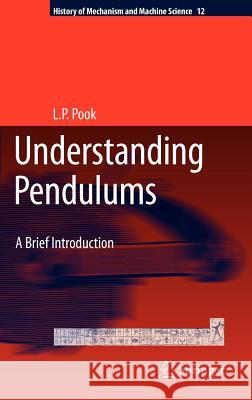
L.P. Pook
Understanding Pendulums: A Brief Introduction L.P. Pook 9789400714144 Springer - książkaWidoczna okładka, to zdjęcie poglądowe, a rzeczywista szata graficzna może różnić się od prezentowanej.

Understanding Pendulums: A Brief Introduction

ISBN-13: 9789400714144 / Angielski / Twarda / 2011 / 136 str.

L.P. Pook
cena 402,53
(netto: 383,36 VAT:  5%)

Najniższa cena z 30 dni: 385,52
Termin realizacji zamówienia:
ok. 22 dni roboczych
Dostawa w 2026 r.

Darmowa dostawa!
inne wydania

Despite their apparent simplicity, the behaviour of pendulums can be remarkably complicated. Historically, pendulums for specific purposes have been developed using a combination of simplified theory and trial and error. There do not appear to be any introductory books on pendulums, written at an intermediate level, and covering a wide range of topics. This book aims to fill the gap. It is written for readers with some background in elementary geometry, algebra, trigonometry and calculus. Historical information, where available and useful for the understanding of various types of pendulum and their applications, is included.Perhaps the best known use of pendulums is as the basis of clocks in which a pendulum controls the rate at which the clock runs. Interest in theoretical and practical aspects of pendulums, as applied to clocks, goes back more than four centuries. The concept of simple pendulums, which are idealised versions of real pendulums is introduced. The application of pendulums to clocks is described, with detailed discussion of the effect of inevitable differences between real pendulums and simple pendulums. In a clock, the objective is to ensure that the pendulum controls the timekeeping. However, pendulums are sometimes driven, and how this affects their behaviour is described. Pendulums are sometimes used for occult purposes. It is possible to explain some apparently occult results by using modern pendulum theory. For example, why a ring suspended inside a wine glass, by a thread from a finger, eventually strikes the glass. Pendulums have a wide range of uses in scientific instruments, engineering, and entertainment. Some examples are given as case studies.Indexed in the Book Citation Index Science (BKCI-S)"


Kategorie:
Technologie
Kategorie BISAC:
Technology & Engineering > Mechanical
Science > Fizyka
Science > History
Wydawca:
Springer
Seria wydawnicza:
History of Mechanism and Machine Science
Język:
Angielski
ISBN-13:
9789400714144
Rok wydania:
2011
Dostępne języki:
Angielski
Wydanie:
2011
Numer serii:
000342995
Ilość stron:
136
Waga:
0.45 kg
Wymiary:
23.523.5 x 15.5
Oprawa:
Twarda
Wolumenów:
01

From the reviews:

"The present volume is a more modest contribution and is essentially an introduction to the topic. ... for a mathematically inclined audience, this is a nice book, introducing the more technological issues associated with the pendulum in an interesting way. The author uses elementary mathematics throughout, and accessible language. ... this booklet is an original and worthwhile addition to the literature. ... it is an ideal introduction to the fascinating world of the pendulum from the perspective of a professional engineer. I enjoyed reading it." (Giuseppe Saccomandi, Mathematical Reviews, August, 2013)

"Pook, a retired professional mechanical engineer and teacher, distinguishes it from others in the field by requiring that readers have a certain amount of mathematical knowledge to follow his discourse. In this, he largely succeeds. ... But most of his discussion relates to very practical and useful applications in engineering. ... The volume includes useful, clear diagrams and pictures to help the reader understand the material. Every chapter has extensive references, and there is a good index. Summing Up: Recommended. Lower-division undergraduates through professionals." (N. Sadanand, Choice, Vol. 49 (4), December, 2011)

Preface.-  Notation.-  1 Introduction.-  References.-  2 Simple Pendulums.-  2.1 Introduction.-  2.2 Simple Harmonic Motion.-  2.3 Analysis of a Simple Rod Pendulum.-  2.3.1 Acceleration due to Gravity.-  2.3.2 Accelerations of a Simple Rod Pendulum.-  2.3.3 Potential and Kinetic Energy of a Simple Rod Pendulum.-  2.3.4 Circular Error of a Simple Rod Pendulum.-  2.3.5 Effect of the Earth’s Curvature.-  2.4           Analysis of a Simple String Pendulum.-  2.5 Spherical Rod Pendulum.-  References.-  3 Variations on Simple Pendulums.-  3.1 Introduction.-  3.2 Compound Pendulum.-  3.3 Double Rod Pendulum.-  3.4 Blackburn Pendulum.-  3.5 Bifilar Pendulum.-  3.6 Rotating Simple Rod Pendulum.-  3.7 Quadrifilar Pendulum.-  3.7.1 Dual String Pendulum.-  3.8 Trapezium Pendulum.-  3.8.1 Dual Rod Pendulum.-  3.9 Double String Pendulum.-  References.-  4      Pendulum Clocks.-  4.1 Introduction.-  4.2 Pendulum Quality Q.-  4.2.1 Damped Simple Harmonic Motion.-  4.2.2 Definition of Q.-  4.3 Buoyancy.-  4.4 Suspensions and Modes of Oscillation.-  4.4.1 Spring Suspensions.-  4.4.2 Pivot Suspensions.-  4.4.3 Knife Edge Suspensions.-  4.5 Effects of Escapements.-  4.6 Reduction of Effects of Circular Error.-  References.-  5 Driven Pendulums.-  5.1 Introduction.-  5.2 Random Process Theory.-  5.2.1 Bandwidth.-  5.3 Driven Damped Simple Harmonic Motion.-  5.3.1 Periodic Driving.-  5.3.2 Random Driving.-  5.4 Horizontal Driving of Pendulums.-  5.4.1 Periodic Driving.-  5.4.2 Random Driving.-  5.5 Occult Uses of Pendulums.-  References.-  6 Scientific Instruments.-  6.1  Introduction.-  6.2 Kater’s Pendulum.-  6.3 Newton’s Cradle.-  6.3.1 Modes of Oscillation.-  6.3.2 Theoretical Analysis.-  6.4 The Foucault Pendulum.-  6.4.1 Essential Features.-  6.4.2 Pumping.-  6.4.3 Motions of the Bob.-  6.5 Charpy Impact Testing Machine.-  References.-  7 Engineering.-  7.1 Introduction.-  7.2 Watt Steam Governor.-  7.3 Cable Car.-  7.4 Tension Leg Platform.-  References.-  8 Entertainment.-  8.1 Introduction.-  8.2 Child’s Swings.-  8.2.1 Pumping of Child’s Swings.-  8.3 Child’s Rocking Horse.-  8.4 Pendulum Harmonographs.-  8.5 Harmonograms and Pendulum Harmonographs.-  8.5.1 Lissajous Figures.-  8.5.2 Circular Harmony Curves.-  8.5.3 Miscellaneous Harmonograms.-  8.5.4 Some Practical Considerations.-  References.-  Index.

Leslie Philip (Les) Pook was born in Middlesex, England in 1935. He obtained a BSc in metallurgy from the University of London in 1956. He started his career at Hawker Siddeley Aviation Ltd, Coventry in 1956. In 1963 he moved to the National Engineering Laboratory, East Kilbride, Glasgow. In 1969, while at the National Engineering Laboratory, he obtained a PhD in mechanical engineering from the University of Strathclyde. Dr Pook moved to University College London in 1990. He retired formally in 1998 but remained professionally active in the fields of metal fatigue and fracture mechanics, and is affiliated to University College London as a visiting professor. He now has more tine to pursue long standing interests in recreational mathematics, including flexagons, and in horology. He is a Fellow of the Institution of Mechanical Engineers and a Fellow of the Institute of Materials, Minerals and Mining. Les married his wife Ann in 1960. They have a daughter, Stephanie, and a son, Adrian. His previous books are listed below.

Frost N E, Marsh K J and Pook L P. Metal fatigue. Oxford: Clarendon Press, 1974. ISBN 0 19 856114 8. Reprinted with minor corrections. Mineola, NY: Dover Publications Inc., 1999. ISBN 0-486-40927-9.

Pook L P. The role of crack growth in metal fatigue. London: Metals Society, 1983. ISBN 0 904357 63 5.

Pook L P. Linear elastic fracture mechanics for engineers. Theory and applications. Southampton: WIT Press, 2000. ISBN 1 85312 7035.

Pook L P. Crack paths. Southampton: WIT Press, 2002. ISBN 1-85312-927-5.

Pook L P. Flexagons inside out. Cambridge: Cambridge University Press, 2003. ISBN 0 521 81970 9 hardback 0 521 52574 8 paperback.

Pook L P. Metal Fatigue: What it is, why it matters. Dordrecht: Springer, 2007. ISBN 1-4020-5596-6.

Pook L P. Serious fun with flexagons. A compendium and guide. Dordrecht: Springer. To be published July 2009. ISBN 978-90-481-2502-9.

dy>

Despite their apparent simplicity, the behaviour of pendulums can be remarkably complicated. Historically, pendulums for specific purposes have been developed using a combination of simplified theory and trial and error. There do not appear to be any introductory books on pendulums, written at an intermediate level, and covering a wide range of topics. This book aims to fill the gap. It is written for readers with some background in elementary geometry, algebra, trigonometry and calculus. Historical information, where available and useful for the understanding of various types of pendulum and their applications, is included.


Perhaps the best known use of pendulums is as the basis of clocks in which a pendulum controls the rate at which the clock runs. Interest in theoretical and practical aspects of pendulums, as applied to clocks, goes back more than four centuries. The concept of simple pendulums, which are idealised versions of real pendulums is introduced. The application of pendulums to clocks is described, with detailed discussion of the effect of inevitable differences between real pendulums and simple pendulums. In a clock, the objective is to ensure that the pendulum controls the timekeeping. However, pendulums are sometimes driven, and how this affects their behaviour is described. Pendulums are sometimes used for occult purposes. It is possible to explain some apparently occult results by using modern pendulum theory. For example, why a ring suspended inside a wine glass, by a thread from a finger, eventually strikes the glass. Pendulums have a wide range of uses in scientific instruments, engineering, and entertainment. Some examples are given as case studies.

Indexed in the Book Citation Index– Science (BKCI-S)


Udostępnij

Facebook - konto krainaksiazek.pl


Opinie o Krainaksiazek.pl na Opineo.pl

Partner Mybenefit

Krainaksiazek.pl w programie rzetelna firma Krainaksiaze.pl - płatności przez paypal

Czytaj nas na:

Facebook - krainaksiazek.pl
  • książki na zamówienie
  • granty
  • książka na prezent
  • kontakt
  • pomoc
  • opinie
  • regulamin
  • polityka prywatności

Zobacz:

  • Księgarnia czeska

  • Wydawnictwo Książkowe Klimaty

1997-2025 DolnySlask.com Agencja Internetowa

© 1997-2022 krainaksiazek.pl
     
KONTAKT | REGULAMIN | POLITYKA PRYWATNOŚCI | USTAWIENIA PRYWATNOŚCI
Zobacz: Księgarnia Czeska | Wydawnictwo Książkowe Klimaty | Mapa strony | Lista autorów
KrainaKsiazek.PL - Księgarnia Internetowa

Polityka prywatnosci - link
Krainaksiazek.pl - płatnośc Przelewy24
Przechowalnia Przechowalnia





