• Wyszukiwanie zaawansowane
  • Kategorie
  • Kategorie BISAC
  • Książki na zamówienie
  • Promocje
  • Granty
  • Książka na prezent
  • Opinie
  • Pomoc
  • Załóż konto
  • Zaloguj się

Understanding Financial Risk Tolerance: Institutional, Behavioral and Normative Dimensions » książka


zaloguj się | załóż konto
Logo Krainaksiazek.pl

koszyk

konto

szukaj
topmenu
Księgarnia internetowa
Szukaj
Książki na zamówienie
Promocje
Granty
Książka na prezent
Moje konto
Pomoc
 
 
Wyszukiwanie zaawansowane
Pusty koszyk
Bezpłatna dostawa dla zamówień powyżej 20 złBezpłatna dostawa dla zamówień powyżej 20 zł

Kategorie główne

• Nauka
 [2944077]
• Literatura piękna
 [1814251]

  więcej...
• Turystyka
 [70679]
• Informatyka
 [151074]
• Komiksy
 [35590]
• Encyklopedie
 [23169]
• Dziecięca
 [611005]
• Hobby
 [136031]
• AudioBooki
 [1718]
• Literatura faktu
 [225599]
• Muzyka CD
 [379]
• Słowniki
 [2916]
• Inne
 [443741]
• Kalendarze
 [1187]
• Podręczniki
 [166463]
• Poradniki
 [469211]
• Religia
 [506887]
• Czasopisma
 [481]
• Sport
 [61343]
• Sztuka
 [242115]
• CD, DVD, Video
 [3348]
• Technologie
 [219293]
• Zdrowie
 [98602]
• Książkowe Klimaty
 [124]
• Zabawki
 [2385]
• Puzzle, gry
 [3504]
• Literatura w języku ukraińskim
 [260]
• Art. papiernicze i szkolne
 [7151]
Kategorie szczegółowe BISAC

Understanding Financial Risk Tolerance: Institutional, Behavioral and Normative Dimensions

ISBN-13: 9783031131301 / Angielski / Twarda / 2022
Caterina Cruciani;Gloria Gardenal;Giuseppe Amitrano
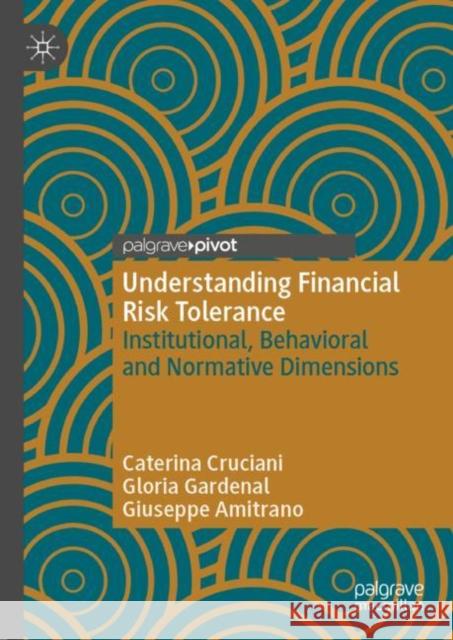
Understanding Financial Risk Tolerance: Institutional, Behavioral and Normative Dimensions Cruciani, Caterina 9783031131301 Springer International Publishing - książkaWidoczna okładka, to zdjęcie poglądowe, a rzeczywista szata graficzna może różnić się od prezentowanej.

Understanding Financial Risk Tolerance: Institutional, Behavioral and Normative Dimensions

ISBN-13: 9783031131301 / Angielski / Twarda / 2022

Caterina Cruciani;Gloria Gardenal;Giuseppe Amitrano
cena 181,11
(netto: 172,49 VAT:  5%)

Najniższa cena z 30 dni: 173,46
Termin realizacji zamówienia:
ok. 22 dni roboczych.

Darmowa dostawa!

 This book revolves around the concept of financial risk tolerance and its role in financial markets. Bridging different literatures and reviewing in detail the impact of European regulation on the evolution of risk tolerance assessment, this book discusses the intersection of scholarly research, practitioner experience and current and likely normative developments.In particular, the book focuses on the evolution of the debate on the suitability questionnaire – a key tool introduced with the Markets in Financial Instruments Directive (MiFID) and further developed with MiFID’s successor - comparing it with empirical evidence on financial risk tolerance determinants, spanning from sociodemographic to behavioral components and life events. The book also looks at the future evolution of the normative framework post MiFID2 addressing in detail two key trends that are already affecting the way in which risk tolerance is dealt with in European financial markets – sustainable development and fintech and roboadvisory. The book includes an original survey run with financial market experts to assess the perceptions regarding these two trends and includes commentaries by a professional financial advisor on the key topics discussed.


Kategorie:
Nauka, Ekonomia i biznes
Kategorie BISAC:
Business & Economics > Insurance - Risk Assessment & Management
Business & Economics > Finance - Financial Risk Management
Wydawca:
Springer International Publishing
Język:
Angielski
ISBN-13:
9783031131301
Rok wydania:
2022
Waga:
0.40 kg
Wymiary:
21.0 x 14.8
Oprawa:
Twarda
Dodatkowe informacje:
Wydanie ilustrowane

Chapter 1: Financial risk tolerance: where does it all start from?

1.    A crossroad: why looking at risk tolerance?. 3

1.1.     The economists’ view.. 4

1.2.     The macroeconomic perspective. 5

1.3.     The regulator’s view.. 6

2.    Trends in financial risk tolerance. 9

2.1.     Definitions of risk tolerance. 9

2.2.     Risk tolerance determinants. 10

2.2.1.       Socio-demographic factors. 10

2.2.2.       Economic factors. 15

2.2.3.       Personality psychology. 15

2.3.     Measurement tools. 19

Box 1.1 The practitioner’s view... 23

3.    Conclusions and roadmap of the book. 24

References. 24

Chapter 2: Risk tolerance tools: from academia to regulation and back. 28

1.    The Market in Financial Instruments Directive (MiFID) and its impact on risk tolerance measurement  28

1.1.      Introducing MiFID.. 28

1.2.      MiFID and the suitability questionnaire. 31

2.    The academic debate after MiFID.. 35

2.1.      Sociodemographic variables. 35

2.2.      Life events. 37

2.3.      Behavioral and personality factors. 38

2.4.      Risk tolerance: stable trait or adaptive feature?. 39

3.    The Market in Financial Instruments Directive 2 (MiFID2) 40

3.1.      Mifid2, context and content. 40

3.2.      Suitability and MiFID2. 41

3.3.      Implementing the Directive: empirical evidence and practitioners’ views. 42

4.    The academic debate after MiFID2. 43

4.1.      Socio-demographic factors. 44

4.2.      Life events. 47

4.3.      Behavioral and personality factors. 49

4.4.      Risk tolerance: stable trait or adaptive feature?. 50

Box 2.1 The practitioner’s view... 51

5.    Taking stock and looking at the challenges ahead. 53

References. 53

Chapter 3: Challenges and opportunities in the regulation of financial instruments post Mifid2 – Sustainable finance. 59

1.    Sustainable finance in a sustainable Union. 59

1.1.      Sustainable development in the European Union legislation. 59

1.2.      From theory to action: the EU Action Plan on Sustainable development. 60

1.3.      Setting the Plan into Action. 61

1.4.      The Action plan and investor protection: taking stock and moving forward. 69

2.    Investing in sustainability – investor preferences, risk tolerance and investment behavior. 70

2.1.      Sustainability investment – where does Europe stand?. 70

2.2.      Sustainable investors – who are they and why do they choose sustainable products?. 71

2.3.      Are sustainable investors biased?. 79

3.    Implications for financial risk tolerance and investment choices. 82

References. 83

Chapter 4: The digital challenge: how are new technologies shaping the financial industry?. 87

Abstract. 87

1.    The technological revolution of the financial services industry. 87

1.1.      The digitalization and open challenges. 87

2.    Fintech. 88

2.1.      A definition. 88

2.2.      Fintech Users. 89

2.3.      Fintech services. 89

2.4.      The academic point of view on Fintech. 90

3.    Open Banking and Open Finance. 92

3.1.      A definition of Open Banking. 92

3.2.      The evolution of Open Banking: towards Open Finance. 94

3.3.      The academic point of view on Open Banking. 94

4.    Robo advisory. 96

4.1.      A definition of robo advisory services. 96

4.2.      Business models for robo advisory. 97

4.3.      The academic point of view on robo advisory. 98

5.    The Regulatory Framework. 103

5.1.      The Payment Services Directive (PSD2) 103

5.2.      The revised Guidelines on Suitability by ESMA (2018) 104

6.    Conclusions. 106

References. 107

Challenges and opportunities for the future investor – a practitioner’s guide. 112

1.    The survey. 112

1.1.      Some reasons why. 112

1.2.      Survey structure and participant pool 113

2.    Survey results. 115

2.1.      Participants overview.. 115

2.2.      Sustainable finance. 116

2.3.      Robo advisory and open finance. 118

Box 5.1 The practitioner’s view... 120

3.    Final discussion and conclusions. 123

4.    Appendix – the questionnaire. 124

References. 132

Caterina Cruciani is an Assistant Professor in Financial Markets and Institutions at the Department of Management, Ca’ Foscari University of Venice, where she also received a PhD in Economics. She is the Operating Director of the Center for Experimental Research in Management and Economics (CERME) and a member of the Risk-Lab at Ca’ Foscari University of Venice.

Gloria Gardenal is Assistant Professor of Corporate Finance and a member of the Risk-Lab and the Center for Experimental Research in Management and Economics (CERME) at Ca’ Foscari University of Venice, where she also received a PhD in Business.

Giuseppe Amitrano is the Founder and CEO of WieldMore Investment Management. After over 25 years of experience as managing director in rates, credits and derivatives in leading financial institutions in Europe, Giuseppe has founded and leads as CEO Wieldmore Investment Management

This book revolves around the concept of financial risk tolerance and its role in financial markets. Bridging different literatures and reviewing in detail the impact of European regulation on the evolution of risk tolerance assessment, this book discusses the intersection of scholarly research, practitioner experience and current and likely normative developments.

In particular, the book focuses on the evolution of the debate on the suitability questionnaire—a key tool introduced with the Markets in Financial Instruments Directive (MiFID) and further developed with MiFID’s successor—comparing it with empirical evidence on financial risk tolerance determinants, spanning from sociodemographic to behavioral components and life events.

The book also looks at the future evolution of the normative framework post MiFID2 addressing in detail two key trends that are already affecting the way in which risk tolerance is dealt with in European financial markets—sustainable development and fintech and roboadvisory.

The book includes an original survey run with financial market experts to assess the perceptions regarding these two trends and includes commentaries by a professional financial advisor on the key topics discussed.

Caterina Cruciani is an Assistant Professor in Financial Markets and Institutions at the Department of Management, Ca’ Foscari University of Venice, where she also received a PhD in Economics. She is the Operating Director of the Center for Experimental Research in Management and Economics (CERME) and a member of the Risk-Lab at Ca’ Foscari University of Venice.

Gloria Gardenal is Associate Professor of Corporate Finance and a member of the Risk-Lab and the Center for Experimental Research in Management and Economics (CERME) at Ca’ Foscari University of Venice, where she also received a PhD in Business.

Giuseppe Amitrano is the Founder and CEO of WieldMore Investment Management.


Udostępnij

Facebook - konto krainaksiazek.pl


Opinie o Krainaksiazek.pl na Opineo.pl

Partner Mybenefit

Krainaksiazek.pl w programie rzetelna firma Krainaksiaze.pl - płatności przez paypal

Czytaj nas na:

Facebook - krainaksiazek.pl
  • książki na zamówienie
  • granty
  • książka na prezent
  • kontakt
  • pomoc
  • opinie
  • regulamin
  • polityka prywatności

Zobacz:

  • Księgarnia czeska

  • Wydawnictwo Książkowe Klimaty

1997-2026 DolnySlask.com Agencja Internetowa

© 1997-2022 krainaksiazek.pl
     
KONTAKT | REGULAMIN | POLITYKA PRYWATNOŚCI | USTAWIENIA PRYWATNOŚCI
Zobacz: Księgarnia Czeska | Wydawnictwo Książkowe Klimaty | Mapa strony | Lista autorów
KrainaKsiazek.PL - Księgarnia Internetowa

Polityka prywatnosci - link
Krainaksiazek.pl - płatnośc Przelewy24
Przechowalnia Przechowalnia




