• Wyszukiwanie zaawansowane
  • Kategorie
  • Kategorie BISAC
  • Książki na zamówienie
  • Promocje
  • Granty
  • Książka na prezent
  • Opinie
  • Pomoc
  • Załóż konto
  • Zaloguj się

Understanding Emotion in Chinese Culture: Thinking Through Psychology » książka


zaloguj się | załóż konto
Logo Krainaksiazek.pl

koszyk

konto

szukaj
topmenu
Księgarnia internetowa
Szukaj
Książki na zamówienie
Promocje
Granty
Książka na prezent
Moje konto
Pomoc
 
 
Wyszukiwanie zaawansowane
Pusty koszyk
Bezpłatna dostawa dla zamówień powyżej 20 złBezpłatna dostawa dla zamówień powyżej 20 zł

Kategorie główne

• Nauka
 [2948695]
• Literatura piękna
 [1824038]

  więcej...
• Turystyka
 [70868]
• Informatyka
 [151073]
• Komiksy
 [35227]
• Encyklopedie
 [23181]
• Dziecięca
 [621575]
• Hobby
 [138961]
• AudioBooki
 [1642]
• Literatura faktu
 [228651]
• Muzyka CD
 [371]
• Słowniki
 [2933]
• Inne
 [445341]
• Kalendarze
 [1243]
• Podręczniki
 [164416]
• Poradniki
 [479493]
• Religia
 [510449]
• Czasopisma
 [502]
• Sport
 [61384]
• Sztuka
 [243086]
• CD, DVD, Video
 [3417]
• Technologie
 [219673]
• Zdrowie
 [100865]
• Książkowe Klimaty
 [124]
• Zabawki
 [2168]
• Puzzle, gry
 [3372]
• Literatura w języku ukraińskim
 [260]
• Art. papiernicze i szkolne
 [7838]
Kategorie szczegółowe BISAC

Understanding Emotion in Chinese Culture: Thinking Through Psychology

ISBN-13: 9783319182209 / Angielski / Twarda / 2015 / 210 str.
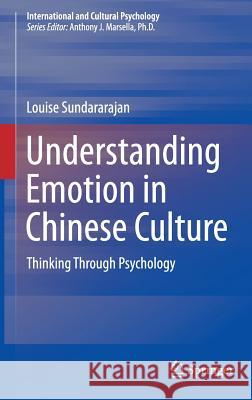
Louise Sundararajan
Understanding Emotion in Chinese Culture: Thinking Through Psychology Sundararajan, Louise 9783319182209 Springer - książkaWidoczna okładka, to zdjęcie poglądowe, a rzeczywista szata graficzna może różnić się od prezentowanej.

Understanding Emotion in Chinese Culture: Thinking Through Psychology

ISBN-13: 9783319182209 / Angielski / Twarda / 2015 / 210 str.

Louise Sundararajan
cena 363,12
(netto: 345,83 VAT:  5%)

Najniższa cena z 30 dni: 346,96
Termin realizacji zamówienia:
ok. 22 dni roboczych.

Darmowa dostawa!

This mind-opening take on indigenous psychology presents a multi-level analysis of culture to frame the differences between Chinese and Western cognitive and emotive styles. Eastern and Western cultures are seen here as mirror images in terms of rationality, relational thinking, and symmetry or harmony. Examples from the philosophical texts of Confucianism, Daoism, Buddhism, and classical poetry illustrate constructs of shading and nuancing emotions in contrast to discrete emotions and emotion regulation commonly associated with traditional psychology. The resulting text offers readers bold new understandings of emotion-based states both familiar (intimacy, solitude) and unfamiliar (resonance, being spoiled rotten), as well as larger concepts of freedom, creativity, and love. Included among the topics:

  • The mirror universes of East and West.
  • In the crucible of Confucianism.
  • Freedom and emotion: Daoist recipes for authenticity and creativity.
  • Chinese creativity, with special focus on solitude and its seekers.
  • Savoring, from aesthetics to the everyday.
  • What is an emotion? Answers from a wild garden of knowledge.
Understanding Emotion in Chinese Culture has a wealth of research and study potential for undergraduate and graduate courses in affective science, cognitive psychology, cultural and cross- cultural psychology, indigenous psychology, multicultural studies, Asian psychology, theoretical and philosophical psychology, anthropology, sociology, international psychology, and regional studies.

Kategorie:
Nauka, Psychologia
Kategorie BISAC:
Psychology > Social Psychology
Psychology > Research & Methodology
Wydawca:
Springer
Seria wydawnicza:
International and Cultural Psychology (Hardcover)
Język:
Angielski
ISBN-13:
9783319182209
Rok wydania:
2015
Wydanie:
2015
Numer serii:
000263842
Ilość stron:
210
Waga:
4.73 kg
Wymiary:
23.5 x 15.5
Oprawa:
Twarda
Wolumenów:
01
Dodatkowe informacje:
Wydanie ilustrowane

"The book, on the whole, is insightful and dazzling in making interdisciplinary connections across psychology and related disciplines and it serves as a powerful example of articulating a sophisticated and elaborate theoretically informed indigenous psychology. ... it will be of importance to cognitive psychology, cultural psychology, indigenous psychology, theoretical and philosophical psychology, anthropology, and Asian studies and to ongoing scholarly debates on the cultural meaning of emotions." (Sunil Bhatia, Journal of Theoretical and Philosophical Psychology, Vol. 36 (4), 2016)

"Understanding Emotion in Chinese Culture by Louise Sundararajan is an elegant account of the ways in which emotions are experienced by Chinese people, and the book uses this discussion to enrich the Western psychological study of emotion. ... Understanding Emotion in Chinese Culture offers a rich network of complexly nuanced ideas. ... an eloquently constructed book that addresses difficult but important issues holistically within the context of naturalistic science. There are probably not many who would attempt such a task." (Richard E. Duus, PsycCRITIQUES, Vol. 60 (48), November, 2015)

Part 1 Conceptual Foundations for the analysis of Chinese Emotions.- The Mirror Universes of East and West.- Harmony: A Delicate Dance of Symmetry.- In the Crucible of Confucianism.- On the Wings of Daoism.- Part II.  Tracing Emotions daintily through Things Psychologically Chinese.- Heart-Aching Love (Teng, 疼).- The Art of Intimacy.- Freedom and Emotion:  Daoist recipes for Authenticity and Creativity.- Being Spoiled Rotten (Sajiao 撒嬌):  Lessons in Gratitude.- Part III.  Chinese Creativity.- Chinese Creativity, with special focus on Solitude and its Seekers.- Savoring (Pin wei 品味), from Aesthetics to the Everyday.- Emptiness (Kong):  Insight-based Emotional Transformations.- Part IV: Conclusion.- What is an Emotion?  Answers from a Wild Garden of Knowledge.

Louise Sundararajan was born in Yunnan, China, and grew up in Taiwan.  She received her BA in English Literature from Tunghai University, Taiwan, her Ph.D. in History of Religions from Harvard University, and her Ed.D. in Counseling Psychology from Boston University.  She chairs the Task Force on Indigenous Psychology, which is joined by near two hundred researchers from around the globe.  She served as past president of The International Society for the Study of Human Ideas on Ultimate Reality and Meaning, and also past president of the Society for Humanistic Psychology (Division 32 of the American Psychological Association).  She is recipient of the Abraham Maslow Award for 2014, from Division 32 of APA.  She is a Fellow of the American Psychological Association, and also a member of the Board of Directors for the International Society for Research on Emotions.  She serves on the editorial boards of The Humanistic Psychologist, and Journal of Humanistic Psychology.  She is Associate Editor for Journal of Theoretical and Philosophical Psychology.  She has published extensively on topics related to culture and emotions. Outside academia, she practices psychology as a forensic psychologist, and enjoys the family life of a grandmother.

This mind-opening take on indigenous psychology presents a multi-level analysis of culture to frame the differences between Chinese and Western cognitive and emotive styles. Eastern and Western cultures are seen here as mirror images in terms of rationality, relational thinking, and symmetry or harmony. Examples from the philosophical texts of Confucianism, Daoism, Buddhism, and classical poetry illustrate constructs of shading and nuancing emotions in contrast to discrete emotions and emotion regulation commonly associated with traditional psychology. The resulting text offers readers bold new understandings of emotion-based states both familiar (intimacy, solitude) and unfamiliar (resonance, being spoiled rotten), as well as larger concepts of freedom, creativity, and love. 

Included among the topics: 

  • The mirror universes of East and West.
  • In the crucible of Confucianism.
  • Freedom and emotion: Daoist recipes for authenticity and creativity.
  • Chinese creativity, with special focus on solitude and its seekers.
  • Savoring, from aesthetics to the everyday.
  • What is an emotion? Answers from a wild garden of knowledge. 

Understanding Emotion in Chinese Culture has a wealth of research and study potential for undergraduate and graduate courses in affective science, cognitive psychology, cultural and cross- cultural psychology, indigenous psychology, multicultural studies, Asian psychology, theoretical and philosophical psychology, anthropology, sociology, international psychology, religion studies, and international business and management. 


Udostępnij

Facebook - konto krainaksiazek.pl


Opinie o Krainaksiazek.pl na Opineo.pl

Partner Mybenefit

Krainaksiazek.pl w programie rzetelna firma Krainaksiaze.pl - płatności przez paypal

Czytaj nas na:

Facebook - krainaksiazek.pl
  • książki na zamówienie
  • granty
  • książka na prezent
  • kontakt
  • pomoc
  • opinie
  • regulamin
  • polityka prywatności

Zobacz:

  • Księgarnia czeska

  • Wydawnictwo Książkowe Klimaty

1997-2026 DolnySlask.com Agencja Internetowa

© 1997-2022 krainaksiazek.pl
     
KONTAKT | REGULAMIN | POLITYKA PRYWATNOŚCI | USTAWIENIA PRYWATNOŚCI
Zobacz: Księgarnia Czeska | Wydawnictwo Książkowe Klimaty | Mapa strony | Lista autorów
KrainaKsiazek.PL - Księgarnia Internetowa

Polityka prywatnosci - link
Krainaksiazek.pl - płatnośc Przelewy24
Przechowalnia Przechowalnia





