• Wyszukiwanie zaawansowane
  • Kategorie
  • Kategorie BISAC
  • Książki na zamówienie
  • Promocje
  • Granty
  • Książka na prezent
  • Opinie
  • Pomoc
  • Załóż konto
  • Zaloguj się

Understanding Editorial Text: A Computer Model of Argument Comprehension » książka


zaloguj się | załóż konto
Logo Krainaksiazek.pl

koszyk

konto

szukaj
topmenu
Księgarnia internetowa
Szukaj
Książki na zamówienie
Promocje
Granty
Książka na prezent
Moje konto
Pomoc
 
 
Wyszukiwanie zaawansowane
Pusty koszyk
Bezpłatna dostawa dla zamówień powyżej 20 złBezpłatna dostawa dla zamówień powyżej 20 zł

Kategorie główne

• Nauka
 [2952079]
• Literatura piękna
 [1850969]

  więcej...
• Turystyka
 [71058]
• Informatyka
 [151066]
• Komiksy
 [35579]
• Encyklopedie
 [23181]
• Dziecięca
 [620496]
• Hobby
 [139036]
• AudioBooki
 [1646]
• Literatura faktu
 [228729]
• Muzyka CD
 [379]
• Słowniki
 [2932]
• Inne
 [445708]
• Kalendarze
 [1409]
• Podręczniki
 [164793]
• Poradniki
 [480107]
• Religia
 [510956]
• Czasopisma
 [511]
• Sport
 [61267]
• Sztuka
 [243299]
• CD, DVD, Video
 [3411]
• Technologie
 [219640]
• Zdrowie
 [100984]
• Książkowe Klimaty
 [124]
• Zabawki
 [2281]
• Puzzle, gry
 [3363]
• Literatura w języku ukraińskim
 [258]
• Art. papiernicze i szkolne
 [8020]
Kategorie szczegółowe BISAC

Understanding Editorial Text: A Computer Model of Argument Comprehension

ISBN-13: 9780792391234 / Angielski / Twarda / 1990 / 296 str.
Sergio Jose Alvarado
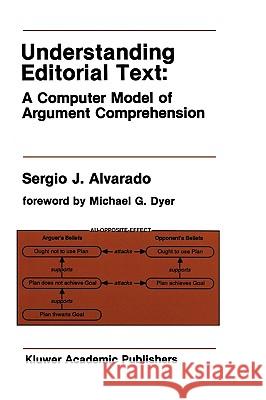
Understanding Editorial Text: A Computer Model of Argument Comprehension Sergio Jose Alvarado 9780792391234 Kluwer Academic Publishers - książkaWidoczna okładka, to zdjęcie poglądowe, a rzeczywista szata graficzna może różnić się od prezentowanej.

Understanding Editorial Text: A Computer Model of Argument Comprehension

ISBN-13: 9780792391234 / Angielski / Twarda / 1990 / 296 str.

Sergio Jose Alvarado
cena 605,23
(netto: 576,41 VAT:  5%)

Najniższa cena z 30 dni: 578,30
Termin realizacji zamówienia:
ok. 22 dni roboczych.

Darmowa dostawa!

by Michael G. Dyer Natural language processing (NLP) is an area of research within Artificial Intelligence (AI) concerned with the comprehension and generation of natural language text. Comprehension involves the dynamic construction of conceptual representations, linked by causal relationships and organized/indexed for subsequent retrieval. Once these conceptual representations have been created, comprehension can be tested by means of such tasks as paraphrasing, question answering, and summarization. Higher-level cognitive tasks are also modeled within the NLP paradigm and include: translation, acquisition of word meanings and concepts through reading, analysis of goals and plans in multi-agent environments (e. g., coalition and counterplanning behavior by narrative characters), invention of novel stories, recognition of abstract themes (such as irony and hypocrisy), extraction of the moral or point of a story, and justification/refutation of beliefs through argumentation. The robustness of conceptually-based text comprehension systems is directly related to the nature and scope of the knowledge constructs applied during conceptual analysis of the text. Until recently, conceptually-based natural language systems were developed for, and applied to, the task of narrative comprehension (Dyer, 1983a; Schank and Abelson, 1977; Wilensky, 1983). These systems worked by recognizing the goals and plans of narrative characters, and. using this knowledge to build a conceptual representation of the narrative, xx UNDERSTANDING EDITORIAL TEXT including actions and intentions which must be inferred to complete the representation. A large portion of text appearing in newspapers and magazines, however, is editorial in nature.


Kategorie:
Informatyka, Bazy danych
Kategorie BISAC:
Computers > Artificial Intelligence - General
Wydawca:
Kluwer Academic Publishers
Seria wydawnicza:
High Performance Computing
Język:
Angielski
ISBN-13:
9780792391234
Rok wydania:
1990
Wydanie:
1990
Numer serii:
000074230
Ilość stron:
296
Waga:
1.40 kg
Wymiary:
23.5 x 15.5
Oprawa:
Twarda
Wolumenów:
01
Dodatkowe informacje:
Komentarz

1. The Nature of Argument Comprehension.- 1.1. Introduction.- 1.2. Argument Comprehension in OpEd.- 1.2.1. Domain-Specific Knowledge.- 1.2.2. Beliefs and Belief Relationships.- 1.2.3. Causal Chains of Reasoning.- 1.2.4. Abstract Knowledge of Argumentation.- 1.2.5. Conceptual Representation of Arguments.- 1.2.6. Memory Retrieval.- 1.3. Scope of OpEd.- 1.4. Architecture of OpEd.- 1.5. Contents of the Dissertation.- 2. Representing Politico-Economic Knowledge.- 2.1. Introduction.- 2.2. Politico-Economic Conflicts.- 2.2.1. Basic Socials Acts and Authority Triangles.- 2.2.2. Modeling Situations of Protectionism With Authority Triangles.- 2.2.3. Beliefs and Goals Associated With Situations of Protectionism.- 2.2.4. Organizing Conflict-Resolution Events With Planboxes.- 2.3. Politico-Economic Reasoning.- 2.3.1. Graph of Economic Quantities.- 2.3.2. Modeling Trade With Graphs of Economic Quantities.- 2.3.3. Modeling Reasoning About Protectionism With Reasoning Scripts.- 2.4. Summary.- 3. Beliefs and Belief Relationships.- 3.1. Introduction.- 3.2. Belief Representation.- 3.3. Attack Relationships.- 3.3.1. Attacks Based on Mutually-Exclusive Planning Situations.- 3.3.2. Attacks Based on Opposite Effects on Interrelated Goals.- 3.4. Support Relationships.- 3.4.1. Supports Based on Refinements of Plan Evaluations.- 3.4.2. Supports Based on Refinements of Plan-Goal Relationships.- 3.4.3. Supports Based on Analogies.- 3.4.4. Supports Based on Examples.- 3.5. Summary.- 4. Argument Units.- 4.1. Introduction.- 4.2. Taxonomy of Argument Units.- 4.2.1. Argument Units Based on Unrealized Successes.- 4.2.2. Argument Units Based on Realized Failures.- 4.2.3. Argument Units Based on Realized Successes.- 4.2.4. Argument Units Based on Unrealized Failures.- 4.3. Representing Editorials With Configurations of Argument Units.- 4.4. Generality of Argument Units.- 4.4.1. Language-Independent Nature of Argument Units.- 4.4.2. Domain-Independent Nature of Argument Units.- 4.5. Summary.- 5. Meta-Arguntellt Units.- 5.1. Introduction.- 5.2. Meta-Argument Units Based on Hypocritical Behavior.- 5.2.1. Inconsistencies Between Actions and Professed Beliefs.- 5.2.2. Inconsistencies Between Actions and Criticisms.- 5.2.3. Hypocritical Behavior and Expectation Failures.- 5.2.4. Hypocritical Behavior in Multiple Domains.- 5.3. Meta-Argument Units Based on Unsound Reasoning.- 5.3.1. Burden of Proof.- 5.3.2. Plausibility.- 5.3.3. Tautology.- 5.3.4. Self-Contradiction.- 5.3.5. Reasoning Errors in Multiple Domains.- 5.4. Summary.- 6. Recognizing Argument Structures.- 6. 1. Introduction.- 6.2. Recognizing Evaluative Beliefs From Explicit Standpoints.- 6.3. Recognizing Evaluative Beliefs From Emotional Reactions.- 6.4. Recognizing Causal Beliefs From Evaluative Beliefs.- 6.5. Recognizing Reasoning Scripts From Causal Beliefs.- 6.6. Recognizing Argument Units From Linguistic Constructs.- 6.6.1. Contradictory-Effect Construct.- 6.6.2. Expectation-Failure Construct.- 6.6.3. Argument-Evaluation COnstruct.- 6.7. Recognizing Argument Units From Plan-Failure Beliefs.- 6.8. Summary.- 7. Memory Search and Retrieval.- 7.1. Introduction.- 7.2. Organizing and Indexing Editorial Memory.- 7.3. Retrieving Information From Editorial Memory.- 7.3.1. Belief-Holder Questions.- 7.3.2. Causal-Belief Questions.- 7.3.3. Belief-Justification Questions.- 7.3.4. Affect/Belief Questions.- 7.3.5. Top-Belief/AU Questions.- 7.4. Summary.- 8. Annotated Example of the OpEd System.- 8.1. Introduction.- 8.2. Editorial-Comprehension Trace.- 8.2.1. First Sentence.- 8.2.2. Second Sentence.- 8.2.3. Third Sentence.- 8.2.4. Fourth Sentence.- 8.2.5. Fifth Sentence.- 8.2.6. Sixth Sentence.- 8.2.7. Seventh Sentence.- 8.2.8. Eighth Sentence.- 8.3. Question-Answering Traces.- 8.3.1. Belief-Holder Question.- 8.3.2. Causal-Belief Question.- 8.3.3. Belief-Justification Question.- 8.3.4. Affect/Belief Question.- 8.3.5. Top-Belief/AU Question.- 8.4. Current Status of OpEd.- 9. Future Work and Condusions.- 9.1. Introduction.- 9.2. Comparison With Other Work.- 9.2.1. Argument Analysis in Rhetoric.- 9.2.2. Formal/Logical Approaches to Belief Systems.- 9.2.3. Artificial Intelligence Approaches to Argument Comprehension.- 9.2.4. Psycholinguistic Analysis of Editorial Text.- 9.3. Future Work.- 9.3.1. Long-Term Memory Organization of Arguments.- 9.3.2. Subjective Comprehension of Arguments.- 9.3.3. Belief Inferences Based on Past Arguments.- 9.3.4. Modeling Persuasion.- 9.3.5. Meta-Argument Comprehension.- 9.3.6. Knowledge Engineering Bottlenecks.- 9.4. Summary and Conclusions.- References.


Udostępnij

Facebook - konto krainaksiazek.pl


Opinie o Krainaksiazek.pl na Opineo.pl

Partner Mybenefit

Krainaksiazek.pl w programie rzetelna firma Krainaksiaze.pl - płatności przez paypal

Czytaj nas na:

Facebook - krainaksiazek.pl
  • książki na zamówienie
  • granty
  • książka na prezent
  • kontakt
  • pomoc
  • opinie
  • regulamin
  • polityka prywatności

Zobacz:

  • Księgarnia czeska

  • Wydawnictwo Książkowe Klimaty

1997-2026 DolnySlask.com Agencja Internetowa

© 1997-2022 krainaksiazek.pl
     
KONTAKT | REGULAMIN | POLITYKA PRYWATNOŚCI | USTAWIENIA PRYWATNOŚCI
Zobacz: Księgarnia Czeska | Wydawnictwo Książkowe Klimaty | Mapa strony | Lista autorów
KrainaKsiazek.PL - Księgarnia Internetowa

Polityka prywatnosci - link
Krainaksiazek.pl - płatnośc Przelewy24
Przechowalnia Przechowalnia






