• Wyszukiwanie zaawansowane
  • Kategorie
  • Kategorie BISAC
  • Książki na zamówienie
  • Promocje
  • Granty
  • Książka na prezent
  • Opinie
  • Pomoc
  • Załóż konto
  • Zaloguj się

Understanding Computation: Pillars, Paradigms, Principles » książka


zaloguj się | załóż konto
Logo Krainaksiazek.pl

koszyk

konto

szukaj
topmenu
Księgarnia internetowa
Szukaj
Książki na zamówienie
Promocje
Granty
Książka na prezent
Moje konto
Pomoc
 
 
Wyszukiwanie zaawansowane
Pusty koszyk
Bezpłatna dostawa dla zamówień powyżej 20 złBezpłatna dostawa dla zamówień powyżej 20 zł

Kategorie główne

• Nauka
 [2946600]
• Literatura piękna
 [1856966]

  więcej...
• Turystyka
 [72221]
• Informatyka
 [151456]
• Komiksy
 [35826]
• Encyklopedie
 [23190]
• Dziecięca
 [619653]
• Hobby
 [140543]
• AudioBooki
 [1577]
• Literatura faktu
 [228355]
• Muzyka CD
 [410]
• Słowniki
 [2874]
• Inne
 [445822]
• Kalendarze
 [1744]
• Podręczniki
 [167141]
• Poradniki
 [482898]
• Religia
 [510455]
• Czasopisma
 [526]
• Sport
 [61590]
• Sztuka
 [243598]
• CD, DVD, Video
 [3423]
• Technologie
 [219201]
• Zdrowie
 [101638]
• Książkowe Klimaty
 [124]
• Zabawki
 [2473]
• Puzzle, gry
 [3898]
• Literatura w języku ukraińskim
 [254]
• Art. papiernicze i szkolne
 [8170]
Kategorie szczegółowe BISAC

Understanding Computation: Pillars, Paradigms, Principles

ISBN-13: 9783031100543 / Angielski / Twarda / 2022
Arnold L. Rosenberg;Lenwood S. Heath
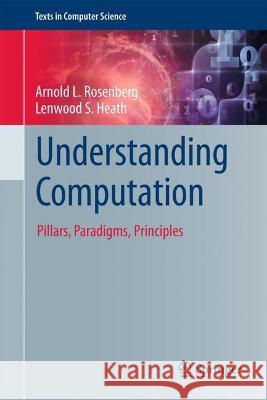
Understanding Computation: Pillars, Paradigms, Principles Rosenberg, Arnold L. 9783031100543 Springer International Publishing - książkaWidoczna okładka, to zdjęcie poglądowe, a rzeczywista szata graficzna może różnić się od prezentowanej.

Understanding Computation: Pillars, Paradigms, Principles

ISBN-13: 9783031100543 / Angielski / Twarda / 2022

Arnold L. Rosenberg;Lenwood S. Heath
cena 403,47 zł
(netto: 384,26 VAT:  5%)

Najniższa cena z 30 dni: 385,52 zł
Termin realizacji zamówienia:
ok. 22 dni roboczych
Bez gwarancji dostawy przed świętami

Darmowa dostawa!
inne wydania

Computation theory is a discipline that uses mathematical concepts and tools to expose the nature of "computation" and to explain a broad range of computational phenomena: Why is it harder to perform some computations than others?  Are the differences in difficulty that we observe inherent, or are they artifacts of the way we try to perform the computations?  How does one reason about such questions?This unique textbook strives to endow students with conceptual and manipulative tools necessary to make computation theory part of their professional lives. The work achieves this goal by means of three stratagems that set its approach apart from most other texts on the subject.For starters, it develops the necessary mathematical concepts and tools from the concepts' simplest instances, thereby helping students gain operational control over the required mathematics. Secondly, it organizes development of theory around four "pillars," enabling students to see computational topics that have the same intellectual origins in physical proximity to one another. Finally, the text illustrates the "big ideas" that computation theory is built upon with applications of these ideas within "practical" domains in mathematics, computer science, computer engineering, and even further afield.Suitable for advanced undergraduate students and beginning graduates, this textbook augments the "classical" models that traditionally support courses on computation theory with novel models inspired by "real, modern" computational topics,such as  crowd-sourced computing, mobile computing, robotic path planning, and volunteer computing.Arnold L. Rosenberg is Distinguished Univ. Professor Emeritus at University of Massachusetts, Amherst, USA. Lenwood S. Heath is Professor at Virgina Tech, Blacksburg, USA.            

Kategorie:
Informatyka, Bazy danych
Kategorie BISAC:
Computers > Computer Science
Wydawca:
Springer International Publishing
Seria wydawnicza:
Texts in Computer Science
Język:
Angielski
ISBN-13:
9783031100543
Rok wydania:
2022
Waga:
1.04 kg
Wymiary:
23.5 x 15.5
Oprawa:
Twarda
Dodatkowe informacje:
Wydanie ilustrowane

Preface.-  I: Introduction.- 1 Introducing Computation Theory.- 2 Introducing the Book.- II: Pillar S: STATE.- 3 Pure State-Based Computational Models.- 4 The Myhill-Nerode Theorem: Implications and Applications.- 5 Online Turing Machines and the Implications of Online Computing.- 6 Pumping: Computational Pigeonholes in Finitary Systems.- 7 Mobility in Computing: An FA Navigates a Mesh.- 8 The Power of Cooperation: Teams of MFAs on a Mesh.- III: Pillar E: ENCODING.- 9 Countability and Uncountability: The Precursors of ENCODING.- 10 Computability Theory.- 11 A Church-Turing Zoo of Computational Models.- 12 Pairing Functions as Encoding Mechanisms.- IV: Pillar N: NONDETERMINISM.- 13 Nondeterminism as Unbounded Parallelism.- 14 Nondeterministic Finite Automata.- 15 Nondeterminism as Unbounded Search.- 16 Complexity Theory.- V: Pillar P: PRESENTATION/SPECIFICATION.- 17 The Elements of Formal Language Theory.- A A Chapter-Long Text on Discrete Mathematics.- B Selected Exercises, by Chapter.- List of ACRONYMS and SYMBOLS.- References.- Index.

Arnold L. Rosenberg is a distinguished university professor emeritus at the University of Massachusetts, Amherst.  He earlier held full-time positions as a professor at Duke and as a Research Staff member at the IBM Watson Research Center.  He has held research positions at Northeastern University and Colorado State University. He has been a visiting professor at the University of Toronto, a Lady Davis visiting professor at the Technion (Israel Inst. of Technology), and a Fulbright Senior Research Scholar at the University of Paris-South.  In 1996, he was elected a fellow of the ACM for his work on graph-theoretic models of computation, with a focus on theoretical studies of parallel algorithms and architectures, VLSI design and layout, and data structures. In 1997, he was elected a fellow of the IEEE for his fundamental contributions to theoretical aspects of computer science and engineering.

Lenwood S. Heath is a professor in the Department of Computer Science at Virginia Tech. His research interests include theoretical computer science, algorithms, graph theory, computational biology and bioinformatics, computational genomics, complex networks, and computational epidemiology. He completed a Ph.D. in computer science (1985) at the University of North Carolina, Chapel Hill, an M.S. in mathematics (1976) at the University of Chicago, and a B.S. in mathematics (1975) at the University of North Carolina, Chapel Hill. Before joining the faculty at Virginia Tech in 1987, he was an instructor of applied mathematics and member of the Laboratory of Computer Science at MIT. He is a member of SIAM, a member of the ACM, and a lifetime senior member of the IEEE. He is a managing editor of the Journal of Interconnection Networks 


Computation theory is a discipline that uses mathematical concepts and tools to expose the nature of "computation" and to explain a broad range of computational phenomena: Why is it harder to perform some computations than others?  Are the differences in difficulty that we observe inherent, or are they artifacts of the way we try to perform the computations?  How does one reason about such questions?

This unique textbook strives to endow students with conceptual and manipulative tools necessary to make computation theory part of their professional lives. The work achieves this goal by means of three stratagems that set its approach apart from most other texts on the subject.

For starters, it develops the necessary mathematical concepts and tools from the concepts' simplest instances, thereby helping students gain operational control over the required mathematics. Secondly, it organizes development of theory around four "pillars," enabling students to see computational topics that have the same intellectual origins in physical proximity to one another. Finally, the text illustrates the "big ideas" that computation theory is built upon with applications of these ideas within "practical" domains in mathematics, computer science, computer engineering, and even further afield.

Suitable for advanced undergraduate students and beginning graduates, this textbook augments the "classical" models that traditionally support courses on computation theory with novel models inspired by "real, modern" computational topics,such as  crowd-sourced computing, mobile computing, robotic path planning, and volunteer computing.

Arnold L. Rosenberg is Distinguished Univ. Professor Emeritus at University of Massachusetts, Amherst, USA. Lenwood S. Heath is Professor at Virgina Tech, Blacksburg, USA.            



Udostępnij

Facebook - konto krainaksiazek.pl


Opinie o Krainaksiazek.pl na Opineo.pl

Partner Mybenefit

Krainaksiazek.pl w programie rzetelna firma Krainaksiaze.pl - płatności przez paypal

Czytaj nas na:

Facebook - krainaksiazek.pl
  • książki na zamówienie
  • granty
  • książka na prezent
  • kontakt
  • pomoc
  • opinie
  • regulamin
  • polityka prywatności

Zobacz:

  • Księgarnia czeska

  • Wydawnictwo Książkowe Klimaty

1997-2025 DolnySlask.com Agencja Internetowa

© 1997-2022 krainaksiazek.pl
     
KONTAKT | REGULAMIN | POLITYKA PRYWATNOŚCI | USTAWIENIA PRYWATNOŚCI
Zobacz: Księgarnia Czeska | Wydawnictwo Książkowe Klimaty | Mapa strony | Lista autorów
KrainaKsiazek.PL - Księgarnia Internetowa

Polityka prywatnosci - link
Krainaksiazek.pl - płatnośc Przelewy24
Przechowalnia Przechowalnia





