• Wyszukiwanie zaawansowane
  • Kategorie
  • Kategorie BISAC
  • Książki na zamówienie
  • Promocje
  • Granty
  • Książka na prezent
  • Opinie
  • Pomoc
  • Załóż konto
  • Zaloguj się

Uncertainty: The Soul of Modeling, Probability & Statistics » książka

zaloguj się | załóż konto
Logo Krainaksiazek.pl

koszyk

konto

szukaj
topmenu
Księgarnia internetowa
Szukaj
Książki na zamówienie
Promocje
Granty
Książka na prezent
Moje konto
Pomoc
 
 
Wyszukiwanie zaawansowane
Pusty koszyk
Bezpłatna dostawa dla zamówień powyżej 20 złBezpłatna dostawa dla zamówień powyżej 20 zł

Kategorie główne

• Nauka
 [2950560]
• Literatura piękna
 [1849509]

  więcej...
• Turystyka
 [71097]
• Informatyka
 [151150]
• Komiksy
 [35848]
• Encyklopedie
 [23178]
• Dziecięca
 [617388]
• Hobby
 [139064]
• AudioBooki
 [1657]
• Literatura faktu
 [228597]
• Muzyka CD
 [383]
• Słowniki
 [2855]
• Inne
 [445295]
• Kalendarze
 [1464]
• Podręczniki
 [167547]
• Poradniki
 [480102]
• Religia
 [510749]
• Czasopisma
 [516]
• Sport
 [61293]
• Sztuka
 [243352]
• CD, DVD, Video
 [3414]
• Technologie
 [219456]
• Zdrowie
 [101002]
• Książkowe Klimaty
 [124]
• Zabawki
 [2311]
• Puzzle, gry
 [3459]
• Literatura w języku ukraińskim
 [254]
• Art. papiernicze i szkolne
 [8079]
Kategorie szczegółowe BISAC

Uncertainty: The Soul of Modeling, Probability & Statistics

ISBN-13: 9783319819587 / Angielski / Miękka / 2018 / 258 str.
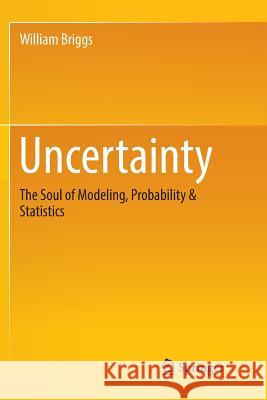
William Briggs
Uncertainty: The Soul of Modeling, Probability & Statistics Briggs, William 9783319819587 Springer - książkaWidoczna okładka, to zdjęcie poglądowe, a rzeczywista szata graficzna może różnić się od prezentowanej.

Uncertainty: The Soul of Modeling, Probability & Statistics

ISBN-13: 9783319819587 / Angielski / Miękka / 2018 / 258 str.

William Briggs
cena 342,14
(netto: 325,85 VAT:  5%)

Najniższa cena z 30 dni: 308,41
Termin realizacji zamówienia:
ok. 22 dni roboczych
Dostawa w 2026 r.

Darmowa dostawa!
Kategorie:
Nauka, Matematyka
Kategorie BISAC:
Mathematics > Filozofia i historia matematyki
Mathematics > Prawdopodobieństwo i statystyka
Philosophy > Epistemology
Wydawca:
Springer
Język:
Angielski
ISBN-13:
9783319819587
Rok wydania:
2018
Wydanie:
Softcover Repri
Ilość stron:
258
Waga:
0.39 kg
Wymiary:
23.39 x 15.6 x 1.5
Oprawa:
Miękka
Wolumenów:
01
Dodatkowe informacje:
Wydanie ilustrowane


"Briggs, an adjunct professor of statistics at Cornell University, cautions his readers to carefully examine the uncertain reliability of such conclusions when these tools are used. His challenging premises are thoroughly supported by philosophical explanations as to why these traditional approaches need to be questioned. ... Briggs provides fully fleshed out reasoning, impressive support, precisely worded insight, and graphical illustrations, as appropriate, to justify his stand. ... Summing Up: Recommended. Upper-division undergraduates and above; faculty and professionals." (N. W. Schillow, Choice, Vol. 54 (6), February, 2017)

"This is a book about probability and probabilistic reasoning. It is more philosophy than mathematics, but it does have mathematical content and it relies in some measure on mathematical reasoning. ... This book is worth a look by anyone who teaches probability and statistics." (William J. Satzer, MAA Reviews, August, 2016)

"[This book] is not for sissies, true, but its clear-headed (i.e., Aristotelian) approach to the subject of truth (which, in the end, is what exercises in probability and statistical analysis are all about, notwithstanding what they tell you in school) is refreshing: a long, cool drink of plain speaking about intellectual topics that, in these hot and humid days, is as enlivening as it is enlightening." (Roger Kimball, The New Criterion's Critic's Notebook, newcriterion.com, August, 2016)

"This book has the potential to turn the world of evidence-based medicine upside down. It boldly asserts that with regard to everything having to do with evidence, we're doing it all wrong: probability, statistics, causality, modeling, deciding, communicating-everything. ... the book is full of humor and a delight to read and re-read." (Jane M. Orient, Journal of American Physicians and Surgeons, Vol. 21 (3), 2016)

1.  Truth, Argument, Realism

1.1. Truth

1.2. Realism

1.3. Epistemology

1.4. Necessary & Conditional Truth

1.5. Science & Scientism

1.6. Faith

1.7. Belief & Knowlege

2.  Logic

2.1. Language

2.2. Logic Is Not Empirical

2.3. Syllogistic Logic

2.4. Syllogisms

2.5. Informality

2.6. Fallacy

3.  Induction and Intellection

3.1. Metaphysics

3.2. Types of Induction

3.3. Grue

4.  What Probability Is

4.1. Probability Is Conditional

4.2. Relevance

4.3. The Proportional Syllogism

4.4. Details

4.5. Assigning Probability

4.6. Weight of Probability

4.7. Probability Usually Is Not a Number

4.8. Probability Can Be a Number

5.  What Probability Is Not

5.1. Probability Is Not Physical

5.2. Probability & Essence

5.3. Probability Is Not Subjective

5.4. Probability Is Not Only Relative Frequency

5.5. Probability Is Not Always a Number Redux

6.  Chance and Randomness

6.1. Randomness

6.2. Not a Cause

6.3. Experimental Design & Randomization

6.4. Nothing Is Distributed

6.5. Quantum Mechanics

6.6. Simulations

6.7. Truly Random & Information Theory

7.  Causality

7.1. What Is Cause Like?

7.2. Causal Models

7.3. Paths

7.4. Once a Cause, Always a Cause

7.5. Falsifiability

7.6. Explanation

7.7. Under-Determination

8.  Probability Models

8.1. Model Form

8.2. Relevance & Importance

8.3. Independence versus Irrelevance

8.4. Bayes

8.5. The Problem and Origin of Parameters

8.6. Exchangeability and Parameters

8.7. Mystery of Parameters

9.  Statistical and Physical Models <

9.1. The Idea

9.2. The Best Model

9.3. Second-Best Models

9.4. Relevance and Importance

9.5. Measurement

9.6. Hypothesis Testing

9.7. Die, P-Value, Die, Die, Die

9.8. Implementing Statistical Models

9.9. Model Goodness

9.10. Decisions

10.  Modeling Goals, Strategies, and Mistakes 

10.1. Regression

10.2. Risk

10.3. Epidemiologist Fallacy

10.4. Quantifying the Unquantifiable

10.5. Time Series

10.6. The Future

William M. Briggs, PhD, is Adjunct Professor of Statistics at Cornell University.  Having earned both his PhD in Statistics and MSc in Atmospheric Physics from Cornell University, he served as the editor of the American Meteorological Society journal and has published over 60 papers.  He studies the philosophy of science, the use and misuses of uncertainty - from truth to modeling.  Early in life, he began his career as a cryptologist for the Air Force, then slipped into weather and climate forecasting, and later matured into an epistemologist.  Currently, he has a popular, long-running blog on the subjects written about here, with about 70,000 - 90,000 monthly readers.


This book presents a philosophical approach to probability and probabilistic thinking, considering the underpinnings of probabilistic reasoning and modeling, which effectively underlie everything in data science. The ultimate goal is to call into question many standard tenets and lay the philosophical and probabilistic groundwork and infrastructure for statistical modeling. It is the first book devoted to the philosophy of data aimed at working scientists and calls for a new consideration in the practice of probability and statistics to eliminate what has been referred to as the "Cult of Statistical Significance".

The book explains the philosophy of these ideas and not the mathematics, though there are a handful of mathematical examples. The topics are logically laid out, starting with basic philosophy as related to probability, statistics, and science, and stepping through the key probabilistic ideas and concepts, and ending with statistical models.

Its jargon-free approach asserts that standard methods, such as out-of-the-box regression, cannot help in discovering cause. This new way of looking at uncertainty ties together disparate fields — probability, physics, biology, the “soft” sciences, computer science — because each aims at discovering cause (of effects). It broadens the understanding beyond frequentist and Bayesian methods to propose a Third Way of modeling.

  • Presents a complete argument showing why probability should be treated as a part of logic
  • Broadens understanding beyond frequentist and Bayesian methods, proposing a Third Way of modeling
  • Proposes that p-values should die, and along with them, hypothesis testing

William M. Briggs, PhD, is Adjunct Professor of Statistics at Cornell University. Having earned both his PhD in Statistics and MSc in Atmospheric Physics from Cornell University, he served as the editor of the American Meteorological Society journal and has published over 60 papers. He studies the philosophy of science, the use and misuses of uncertainty - from truth to modeling. Early in life, he began his career as a cryptologist for the Air Force, then slipped into weather and climate forecasting, and later matured into an epistemologist. Currently, he has a popular, long-running blog on the subjects written about here, with about 70,000 - 90,000 monthly readers.


Udostępnij

Facebook - konto krainaksiazek.pl


Opinie o Krainaksiazek.pl na Opineo.pl

Partner Mybenefit

Krainaksiazek.pl w programie rzetelna firma Krainaksiaze.pl - płatności przez paypal

Czytaj nas na:

Facebook - krainaksiazek.pl
  • książki na zamówienie
  • granty
  • książka na prezent
  • kontakt
  • pomoc
  • opinie
  • regulamin
  • polityka prywatności

Zobacz:

  • Księgarnia czeska

  • Wydawnictwo Książkowe Klimaty

1997-2025 DolnySlask.com Agencja Internetowa

© 1997-2022 krainaksiazek.pl
     
KONTAKT | REGULAMIN | POLITYKA PRYWATNOŚCI | USTAWIENIA PRYWATNOŚCI
Zobacz: Księgarnia Czeska | Wydawnictwo Książkowe Klimaty | Mapa strony | Lista autorów
KrainaKsiazek.PL - Księgarnia Internetowa

Polityka prywatnosci - link
Krainaksiazek.pl - płatnośc Przelewy24
Przechowalnia Przechowalnia






