• Wyszukiwanie zaawansowane
  • Kategorie
  • Kategorie BISAC
  • Książki na zamówienie
  • Promocje
  • Granty
  • Książka na prezent
  • Opinie
  • Pomoc
  • Załóż konto
  • Zaloguj się

UPC: Distributed Shared Memory Programming » książka

zaloguj się | załóż konto
Logo Krainaksiazek.pl

koszyk

konto

szukaj
topmenu
Księgarnia internetowa
Szukaj
Książki na zamówienie
Promocje
Granty
Książka na prezent
Moje konto
Pomoc
 
 
Wyszukiwanie zaawansowane
Pusty koszyk
Bezpłatna dostawa dla zamówień powyżej 20 złBezpłatna dostawa dla zamówień powyżej 20 zł

Kategorie główne

• Nauka
 [2946600]
• Literatura piękna
 [1856966]

  więcej...
• Turystyka
 [72221]
• Informatyka
 [151456]
• Komiksy
 [35826]
• Encyklopedie
 [23190]
• Dziecięca
 [619653]
• Hobby
 [140543]
• AudioBooki
 [1577]
• Literatura faktu
 [228355]
• Muzyka CD
 [410]
• Słowniki
 [2874]
• Inne
 [445822]
• Kalendarze
 [1744]
• Podręczniki
 [167141]
• Poradniki
 [482898]
• Religia
 [510455]
• Czasopisma
 [526]
• Sport
 [61590]
• Sztuka
 [243598]
• CD, DVD, Video
 [3423]
• Technologie
 [219201]
• Zdrowie
 [101638]
• Książkowe Klimaty
 [124]
• Zabawki
 [2473]
• Puzzle, gry
 [3898]
• Literatura w języku ukraińskim
 [254]
• Art. papiernicze i szkolne
 [8170]
Kategorie szczegółowe BISAC

UPC: Distributed Shared Memory Programming

ISBN-13: 9780471220480 / Angielski / Twarda / 2005 / 252 str.

Tarek El-Ghazawi; William Carlson; Katherine Yelick
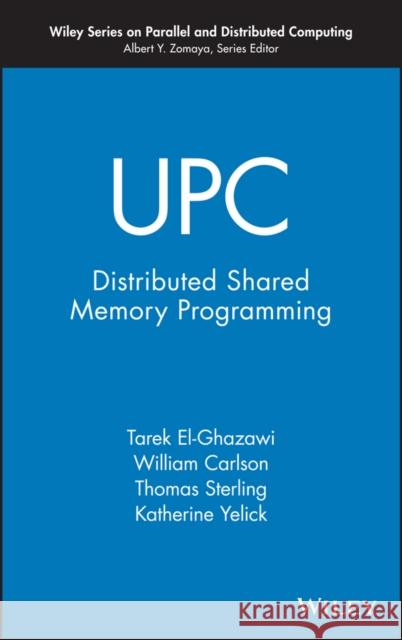
UPC: Distributed Shared Memory Programming El-Ghazawi, Tarek 9780471220480 Wiley-Interscience - książkaWidoczna okładka, to zdjęcie poglądowe, a rzeczywista szata graficzna może różnić się od prezentowanej.

UPC: Distributed Shared Memory Programming

ISBN-13: 9780471220480 / Angielski / Twarda / 2005 / 252 str.

Tarek El-Ghazawi; William Carlson; Katherine Yelick
cena 691,49 zł
(netto: 658,56 VAT:  5%)

Najniższa cena z 30 dni: 685,82 zł
Termin realizacji zamówienia:
ok. 30 dni roboczych
Bez gwarancji dostawy przed świętami

Darmowa dostawa!

This is the first book to explain the language Unified Parallel C and its use. Authors El-Ghazawi, Carlson, and Sterling are among the developers of UPC, with close links with the industrial members of the UPC consortium. Their text covers background material on parallel architectures and algorithms, and includes UPC programming case studies. This book represents an invaluable resource for the growing number of UPC users and applications developers. More information about UPC can be found at: http: //upc.gwu.edu/

An Instructor Support FTP site is available from the Wiley editorial department.

Kategorie:
Informatyka, Internet
Kategorie BISAC:
Computers > Languages - General
Computers > Computer Engineering
Wydawca:
Wiley-Interscience
Seria wydawnicza:
Wiley Series on Parallel and Distributed Computing
Język:
Angielski
ISBN-13:
9780471220480
Rok wydania:
2005
Numer serii:
000107225
Ilość stron:
252
Waga:
0.49 kg
Wymiary:
24.03 x 16.26 x 1.78
Oprawa:
Twarda
Wolumenów:
01
Dodatkowe informacje:
Bibliografia
Wydanie ilustrowane

"This book is a good introduction to the UPC programming philosophy." ( Computing Reviews.com, February 15, 2006)

Preface vii

1. Introductory Tutorial 1

1.1 Getting Started 1

1.2 Private and Shared Data 3

1.3 Shared Arrays and Affinity of Shared Data 6

1.4 Synchronization and Memory Consistency 8

1.5 Work Sharing 10

1.6 UPC Pointers 11

1.7 Summary 14

Exercises 14

2. Programming View and UPC Data Types 17

2.1 Programming Models 17

2.2 UPC Programming Model 20

2.3 Shared and Private Variables 21

2.4 Shared and Private Arrays 23

2.5 Blocked Shared Arrays 25

2.6 Compiling Environments and Shared Arrays 30

2.7 Summary 30

Exercises 31

3. Pointers and Arrays 33

3.1 UPC Pointers 33

3.2 Pointer Arithmetic 35

3.3 Pointer Casting and Usage Practices 38

3.4 Pointer Information and Manipulation Functions 40

3.5 More Pointer Examples 43

3.6 Summary 47

Exercises 47

4. Work Sharing and Domain Decomposition 49

4.1 Basic Work Distribution 50

4.2 Parallel Iterations 51

4.3 Multidimensional Data 54

4.4 Distributing Trees 62

4.5 Summary 71

Exercises 71

5. Dynamic Shared Memory Allocation 73

5.1 Allocating a Global Shared Memory Space Collectively 73

5.2 Allocating Multiple Global Spaces 78

5.3 Allocating Local Shared Spaces 82

5.4 Freeing Allocated Spaces 89

5.5 Summary 90

Exercises 90

6. Synchronization and Memory Consistency 91

6.1 Barriers 92

6.2 Split–Phase Barriers 94

6.3 Locks 99

6.4 Memory Consistency 108

6.5 Summary 113

Exercises 114

7. Performance Tuning and Optimization 115

7.1 Parallel System Architectures 116

7.2 Performance Issues in Parallel Programming 120

7.3 Role of Compilers and Run–Time Systems 122

7.4 UPC Hand Optimization 123

7.5 Case Studies 128

7.6 Summary 135

Exercises 135

8. UPC Libraries 137

8.1 UPC Collective Library 137

8.2 UPC–IO Library 141

8.3 Summary 146

References 147

Appendix A: UPC Language Specifications, v1.1.1 149

Appendix B: UPC Collective Operations Specifications, v1.0 183

Appendix C: UPC–IO Specifications, v1.0 203

Appendix D: How to Compile and Run UPC Programs 243

Appendix E: Quick UPC Reference 245

Index 251

Tarek El–Ghazawi received his PhD in electrical and computer engineering from New Mexico State University. Currently, he is an associate professor in the Electrical and Computer Engineering??Department at the George Washington University. His research? interests are in high–performance computing, computer architecture, reconfigurable computing, embedded systems, and experimental performance. He has over 70 technical journal and conference publications in these areas. He has served as the principal investigator for over two dozen funded research projects, and his research has been supported by NASA, DoD, NSF and industry. He has served as a guest editor for the IEEE concurrency and was an Associate Editor for the International Journal of Parallel and Distributed Computing and Networking. El–Ghazawi has also served as a visiting scientist at NASA GSFC and NASA Ames Research Center. He is a senior member of the IEEE and a member of the advisory board for the IEEE Task Force on Cluster Computing.

William Carlson received his PhD in Electrical Engineering from Purdue University. From 1988 to 1990, he was an assistant professor at the University of Wisconsin–Madision. His research interestes include performance evaluation of advanced computer architectures, operating systems, languages and compilers for parallel and distributed computers.

Thomas Sterling received his PhD as a Hertz Fellow from the Massachusetts Institute of Technology. His research interests include parallel computer architecture, system software and evaluation. He holds six patents, is the co–author of several books and has published dozens of papers in the field of parallel Computing.

Katherine Yelick received her? PhD in Electrical Engineering and Computer Science from the Massachusetts Institute of Technology. Her research interests include parallel computing, memory hierarchy optimizations, programming languages and compilers. Currently, she is a Professor of Computer Science at the University of California, Berkeley.

A must–have for UPC programmers and applications developers

This publication provides an in–depth interpretation of UPC language specifications for use in highly parallel systems. With its extensive use of examples, UPC programming case studies, and illustrations, it offers new insights into developing efficient and effective UPC applications such as high–speed signal processing and pattern recognition. As an added feature, readers have access to an ftp site containing an electronic copy of the full code and can make files for all the examples given in the text.

The book provides all the information and guidance needed to use this powerful new programming language:

  • Chapter 1 provides a quick tutorial of the major features of the UPC language
  • Chapter 2 presents the UPC programming model and describes how shared and nonshared data are declared and used
  • Chapter 3 covers the critically important concept of pointers in UPC, identifying the types, declarations, and usage of the various UPC pointers and how they work with arrays
  • Chapter 4 explains how data and work can be distributed in UPC such that data locality is exploited through efficient data declarations and work–sharing constructs
  • Chapter 5 provides extensive treatment of dynamic memory allocation in the shared space
  • Chapter 6 covers thread and data synchronization, explaining the effective mechanisms provided by UPC for mutual exclusion, barriers, and memory consistency control
  • Chapter 7 offers programmers tools needed to write efficient applications
  • Chapter 8 introduces two UPC standard libraries: the collective operations library and the parallel I/O library
  • Appendices feature the UPC v1.1.1 specification; UPC v1.0 collective library specifications; UPC–IO v1.0 specifications; information on how to compile and run UPC programs; and a quick UPC reference card

UPC is ubiquitous. It is supported on parallel computers from HP, Cray, SGI, IBM, as well as on computer clusters. This is the authoritative source for learning how to master this programming language; El–Ghazawi, Carlson, and Yelick are among the developers of UPC.

Carlson, William TAREK EL-GHAZAWI, PHD, is Professor, Electrical an... więcej >


Udostępnij

Facebook - konto krainaksiazek.pl


Opinie o Krainaksiazek.pl na Opineo.pl

Partner Mybenefit

Krainaksiazek.pl w programie rzetelna firma Krainaksiaze.pl - płatności przez paypal

Czytaj nas na:

Facebook - krainaksiazek.pl
  • książki na zamówienie
  • granty
  • książka na prezent
  • kontakt
  • pomoc
  • opinie
  • regulamin
  • polityka prywatności

Zobacz:

  • Księgarnia czeska

  • Wydawnictwo Książkowe Klimaty

1997-2025 DolnySlask.com Agencja Internetowa

© 1997-2022 krainaksiazek.pl
     
KONTAKT | REGULAMIN | POLITYKA PRYWATNOŚCI | USTAWIENIA PRYWATNOŚCI
Zobacz: Księgarnia Czeska | Wydawnictwo Książkowe Klimaty | Mapa strony | Lista autorów
KrainaKsiazek.PL - Księgarnia Internetowa

Polityka prywatnosci - link
Krainaksiazek.pl - płatnośc Przelewy24
Przechowalnia Przechowalnia