• Wyszukiwanie zaawansowane
  • Kategorie
  • Kategorie BISAC
  • Książki na zamówienie
  • Promocje
  • Granty
  • Książka na prezent
  • Opinie
  • Pomoc
  • Załóż konto
  • Zaloguj się

Tunable Laser Diodes and Related Optical Sources » książka


zaloguj się | załóż konto
Logo Krainaksiazek.pl

koszyk

konto

szukaj
topmenu
Księgarnia internetowa
Szukaj
Książki na zamówienie
Promocje
Granty
Książka na prezent
Moje konto
Pomoc
 
 
Wyszukiwanie zaawansowane
Pusty koszyk
Bezpłatna dostawa dla zamówień powyżej 20 złBezpłatna dostawa dla zamówień powyżej 20 zł

Kategorie główne

• Nauka
 [2946600]
• Literatura piękna
 [1856966]

  więcej...
• Turystyka
 [72221]
• Informatyka
 [151456]
• Komiksy
 [35826]
• Encyklopedie
 [23190]
• Dziecięca
 [619653]
• Hobby
 [140543]
• AudioBooki
 [1577]
• Literatura faktu
 [228355]
• Muzyka CD
 [410]
• Słowniki
 [2874]
• Inne
 [445822]
• Kalendarze
 [1744]
• Podręczniki
 [167141]
• Poradniki
 [482898]
• Religia
 [510455]
• Czasopisma
 [526]
• Sport
 [61590]
• Sztuka
 [243598]
• CD, DVD, Video
 [3423]
• Technologie
 [219201]
• Zdrowie
 [101638]
• Książkowe Klimaty
 [124]
• Zabawki
 [2473]
• Puzzle, gry
 [3898]
• Literatura w języku ukraińskim
 [254]
• Art. papiernicze i szkolne
 [8170]
Kategorie szczegółowe BISAC

Tunable Laser Diodes and Related Optical Sources

ISBN-13: 9780471208167 / Angielski / Twarda / 2004 / 408 str.
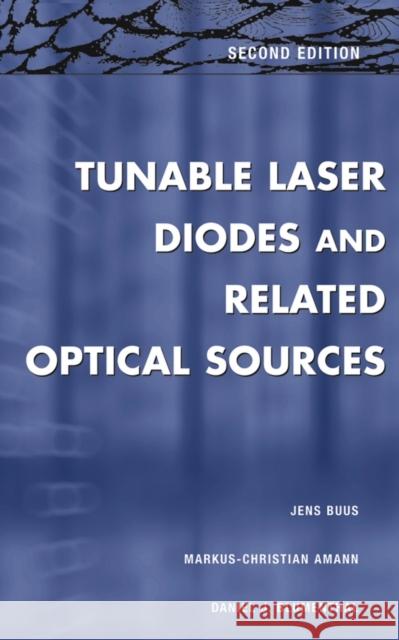
Jens Buus; Markus-Christian Amann; Daniel J. Blumenthal
Tunable Laser Diodes and Related Optical Sources Jens Buus Markus-Christian Amann Daniel J. Blumenthal 9780471208167 IEEE Computer Society Press - książkaWidoczna okładka, to zdjęcie poglądowe, a rzeczywista szata graficzna może różnić się od prezentowanej.

Tunable Laser Diodes and Related Optical Sources

ISBN-13: 9780471208167 / Angielski / Twarda / 2004 / 408 str.

Jens Buus; Markus-Christian Amann; Daniel J. Blumenthal
cena 574,81 zł
(netto: 547,44 VAT:  5%)

Najniższa cena z 30 dni: 568,93 zł
Termin realizacji zamówienia:
ok. 30 dni roboczych
Bez gwarancji dostawy przed świętami

Darmowa dostawa!

The phenomenal growth in Internet traffic has lead to a huge increase in demand for data transmission capacity on a worldwide level. As a result, wavelength division multiplexing (WDM) technology emerged, which makes it possible to transmit a large number of optical channels on a single optical fiber. An equally significant development occurred in optical networks, where switching and routing of signals takes place in the optical domain. This technology places special demands on the optical sources (lasers) used in the system. This text offers a description of the optical sources (equipment and devices) designed to meet these demands.
Sources for DWDM Systems is intended for the engineers and graduate students working on optical networks. There is currently a nearly explosive interest in optical networks and the components required for such networks, but there is presently no single work which covers the variety of optical sources which may be used. This book will cover a particular component, tunable lasers, which is the next "big thing" in DWDM.
The primary market are engineers developing tuneable lasers for optical networks, as well as graduate students enrolled in the optical engineering curriculum, especially: optical communication, semiconductor lasers, optical networks, and/or components for optical networks.


Kategorie:
Technologie
Kategorie BISAC:
Technology & Engineering > Telecommunications
Technology & Engineering > Electrical
Technology & Engineering > Fiber Optics
Wydawca:
IEEE Computer Society Press
Język:
Angielski
ISBN-13:
9780471208167
Rok wydania:
2004
Ilość stron:
408
Waga:
0.65 kg
Wymiary:
15.54 x 23.83 x 2.41
Oprawa:
Twarda
Wolumenów:
01
Dodatkowe informacje:
Wydanie ilustrowane

Foreword.

Preface.

1 Introduction.

2 Fundamental Laser Diode Characteristics.

2.1 Optical Gain in Semiconductors.

2.2 Semiconductor Heterostructures.

2.2.1 Carrier Confinement.

2.2.2 Optical Confinement.

2.2.3 Material Systems.

2.3 Waveguiding and Transverse Laser Modes.

2.3.1 The Slab Waveguide.

2.3.2 Lateral Waveguiding.

2.4 Laser Structures.

2.5 The Fabry Perot Laser.

2.6 The Rate Equations.

2.6.1 Stationary Solution of the Rate Equations.

2.6.2 Laser Spectrum and Side–Mode Suppression.

2.6.3 Small–Signal Modulation Behavior.

2.7 Quantum Well Laser Diodes.

3 Single–Mode Laser Diodes.

3.1 Mode Selectivity Requirements.

3.2 Wave Propagation in Periodic Structures.

3.2.1 Alternative Derivation of the Coupled–Mode Equations.

3.2.2 Solution of the Coupled–Mode Equations.

3.3 Distributed Bragg–Reflector Lasers.

3.3.1 Magnitude and Phase of Reflection.

3.3.2 Grating Shapes.

3.3.3 DBR Laser Structures.

3.4 Distributed–Feedback Lasers.

3.4.1 DFB Laser With Nonreflecting Facets.

3.4.2 DFB Lasers With Reflecting Facets.

3.4.3 Phase–Shifted and Gain–Coupled DFB Lasers.

3.5 Laser Fabrication and Tolerances.

3.5.1 Wavelength Dependence on Structural Parameters.

3.5.2 Thermal Properties under CW Operation.

3.6 Spectral Linewidth.

4 Basic Concepts of Tunable Laser Diodes.

4.1 Continuous, Discontinuous, and Quasicontinuous Tuning Schemes.

4.2 Tuning of Cavity Gain Characteristic.

4.3 Tuning of Comb–Mode Spectrum.

4.4 Simultaneous Tuning of Cavity Gain and Comb–Mode Spectrum.

4.5 Electronic Wavelength Control.

4.5.1 The Free–Carrier Plasma Effect.

4.5.2 The Quantum–Confined Stark Effect.

4.5.3 Thermal Tuning.

4.6 Integration Techniques.

4.7 Dynamic Behavior.

5 Wavelength–Tunable Single–Mode Laser Diodes.

5.1 Longitudinally Integrated Structures.

5.1.1 Two–Section DBR Laser.

5.1.2 Three–Section DBR Laser.

5.1.3 Multisection DFB Laser.

5.2 Transversely Integrated Structures.

5.2.1 Tunable Twin–Guide DFB Laser.

5.2.2 Striped Heater DFB Laser.

5.3 Integration Technology.

5.4 Physical Limitations on the Continuous Tuning Range.

5.5 Tuning Dynamics and Modulation.

6 Linewidth Broadening.

6.1 Injection Recombination Shot Noise in the Tuning Region.

6.2 Impedance and Thermal Noise of Bias Source.

6.3 Spatial Correlation.

6.4 1/f Noise.

6.5 Fluctuations of Bias Source.

7 Widely Tunable Monolithic Laser Diodes.

7.1 The Vernier Effect.

7.2 DBR–type Laser Structures.

7.2.1 Sampled–Grating DBR Lasers.

7.2.2 Superstructure–Grating DBR Lasers.

7.2.3 Digital Supermode DBR Lasers.

7.2.4 Superimposed and Binary Gratings.

7.3 Interferometric Structures.

7.3.1 Lateral Integration: The Y–Laser.

7.3.2 Transverse Integration: The VMZ Laser.

7.4 Codirectionally Coupled Laser Diodes.

7.4.1 Theory for Codirectional Coupling.

7.4.2 Tuning and Mode Spacing.

7.4.3 Longitudinally Integrated Structures.

7.4.4 Transversely Integrated Structures.

7.5 Combination of Techniques.

7.5.1 The Grating–Coupled Sampled–Reflector Laser.

7.5.2 The Modulated–Grating Y–structure Laser.

7.6 Comparison of Widely Tunable Monolithic Laser Structures.

8 Practical Issues Related to Monolithic Tunable Laser Diodes.

8.1 Characterization and Control.

8.1.1 DFB and DBR Lasers.

8.1.2 Widely Tunable Lasers.

8.2 Wavelength Stability and Aging.

8.3 Modulation and Wavelength–Switching Dynamics.

8.3.1 Modulation and Transmission.

8.3.2 Wavelength Switching.

8.4 Monolithic Integration.

9 Related DWDM Sources.

9.1 External–Cavity Lasers.

9.1.1 External Grating and External Filter Cavities.

9.1.2 MEMS External Cavities.

9.1.3 Hybrid Structures.

9.2 Vertical–Cavity Lasers.

9.2.1 VCSEL Basics.

9.2.2 Tunable VCSELs.

9.3 Laser Arrays.

9.3.1 Multistripe Arrays.

9.3.2 Selectable Arrays.

9.3.3 DBR Arrays.

9.3.4 Phased Arrays.

9.4 Technology Summary.

9.5 Fiber and Waveguide Lasers.

9.6 Tunable Pulse Sources and Comb Generators.

10 Communications Applications and Requirements.

10.1 Wavelength Tunability.

10.1.1 Tuning Speed and Latency.

10.1.2 Tuning Continuity.

10.1.3 Tuning Uniformity.

10.1.4 Tuning Stability and Accuracy.

10.1.5 Other Design Considerations.

10.2 Functions and Components.

10.2.1 Tunable Transmitters and Transponders.

10.2.2 Tunable Wavelength Converters with Regeneration Capability.

10.2.3 Optical Wavelength Switches.

10.3 Communications Applications.

10.3.1 Point–to–Point Links and Networks.

10.3.2 Fixed–Wavelength Networks.

10.3.3 Reconfigurable Networks.

10.3.4 Optical–Protection Switching.

10.3.5 Optical–Burst Switching.

10.3.6 Photonic–Packet Switching.

11 Other Applications.

11.1 Optical Frequency–Modulated Continuous–Wave Radar.

11.2 Optical Components Characterization.

11.3 Trace–Gas Sensing, Environmental Analysis, and Spectroscopy.

11.4 Heterodyne Techniques.

11.5 Optical Spectrum and Network Analysis.

11.6 Anemometry.

Appendix A: Refractive Index of InGaAsP.

Appendix B: The Slab Waveguide.

Appendix C: Transfer Matrices.

Appendix D: Thermal Response of a Laser Diode.

D.1 Pulse Response in the Time Domain.

D.2 Response in the Frequency Domain.

Appendix E: Theory for General Reflectors.

Appendix F: Codirectional Coupling.

List of Symbols.

List of Acronyms.

Index.

About the Authors.

JENS BUUS, PhD, is a fellow of the IEEE whose research has made numerous contributions to the understanding of the properties of semiconductor lasers and optical waveguides. He holds five patents and has written two earlier books. A popular speaker, Dr. Buus has presented tutorials and short courses at major conferences, including: ECOC, OFC, EFOC, and the IEEE International Semiconductor Laser Conference.

MARKUS–CHRISTIAN AMANN, PhD, is Professor of Electrical Engineering at the Walter Schottky Institute of the Technical University of Munich, Germany. In addition to over 200 publications, conference papers and book chapters, he is a frequent tutorial speaker and short–course presenter on semiconductor lasers, and has served on numerous conference committees such as CLEO, IEEE Semiconductor Laser Conference, IEEE LEOS annual meeting, ECIO and APOC. His present research areas are wavelength–tunable laser diodes, long–wavelength surface–emitting lasers, and microwave semiconductors.

DANIEL J. BLUMENTHAL, PhD, is Professor of Electrical Engineering at the University of California at Santa Barbara. In addition to being a Fellow of the IEEE/LEOS and member of the OSA, Professor Blumenthal is also an associate editor for IEEE Photonics Technology Letters and has served as associate and guest editor for several other IEEE publications. Along with publishing several hundred journal articles, conference presentations, magazine articles, and book chapters, he has served as chairman or on the organizing committees of numerous conferences, including OFC, ECOC, OSA Topical Meeting on Photonics in Switching and CLEO. Professor Blumenthal′s current research areas include optical wavelength conversion and regeneration, optical packet switching and photonic integration.

An essential introduction to the powerful new developments in optoelectronics

Tunable laser diodes, characterized by their unique ability to "tune in"to different wavelengths, thus significantly improving the efficiency of the switch, are rapidly becoming key components for advanced optical communication. Tunable Laser Diodes and Related Optical Sources, Second Edition is a much–needed single reference covering the range of optical networks and the components they require, with emphasis on tunable lasers. Written by respected experts in this groundbreaking technology, this resource covers fundamentals not only of tunable laser diodes, but also modern laser diodes in general, from theory to applications.

Highlights include:

  • Basic properties of semiconductor lasers
  • Essential properties for single–mode laser diodes
  • Principles, design and practice of tunable laser diodes
  • Optical components related to tunable lasers and non–semiconductor tunable lasers
  • Application areas like optical communication, radar, environmental sensing, reflectometry, and circuit analysis

Designed for engineers developing tunable lasers for optical networks, as well as graduate students enrolled in the optical engineering curriculum, Tunable Laser Diodes and Related Optical Sources, Second Edition promises to be the definitive resource on this groundbreaking optoelectronics technology.

Buus, Jens JENS BUUS, PhD, is a fellow of the IEEE whose rese... więcej >
Amann, Markus-Christian Amann is Professor of Electrical Engineering at th... więcej >


Udostępnij

Facebook - konto krainaksiazek.pl


Opinie o Krainaksiazek.pl na Opineo.pl

Partner Mybenefit

Krainaksiazek.pl w programie rzetelna firma Krainaksiaze.pl - płatności przez paypal

Czytaj nas na:

Facebook - krainaksiazek.pl
  • książki na zamówienie
  • granty
  • książka na prezent
  • kontakt
  • pomoc
  • opinie
  • regulamin
  • polityka prywatności

Zobacz:

  • Księgarnia czeska

  • Wydawnictwo Książkowe Klimaty

1997-2025 DolnySlask.com Agencja Internetowa

© 1997-2022 krainaksiazek.pl
     
KONTAKT | REGULAMIN | POLITYKA PRYWATNOŚCI | USTAWIENIA PRYWATNOŚCI
Zobacz: Księgarnia Czeska | Wydawnictwo Książkowe Klimaty | Mapa strony | Lista autorów
KrainaKsiazek.PL - Księgarnia Internetowa

Polityka prywatnosci - link
Krainaksiazek.pl - płatnośc Przelewy24
Przechowalnia Przechowalnia






