• Wyszukiwanie zaawansowane
  • Kategorie
  • Kategorie BISAC
  • Książki na zamówienie
  • Promocje
  • Granty
  • Książka na prezent
  • Opinie
  • Pomoc
  • Załóż konto
  • Zaloguj się

Trust Theory: A Socio-Cognitive and Computational Model » książka


zaloguj się | załóż konto
Logo Krainaksiazek.pl

koszyk

konto

szukaj
topmenu
Księgarnia internetowa
Szukaj
Książki na zamówienie
Promocje
Granty
Książka na prezent
Moje konto
Pomoc
 
 
Wyszukiwanie zaawansowane
Pusty koszyk
Bezpłatna dostawa dla zamówień powyżej 20 złBezpłatna dostawa dla zamówień powyżej 20 zł

Kategorie główne

• Nauka
 [2946600]
• Literatura piękna
 [1856966]

  więcej...
• Turystyka
 [72221]
• Informatyka
 [151456]
• Komiksy
 [35826]
• Encyklopedie
 [23190]
• Dziecięca
 [619653]
• Hobby
 [140543]
• AudioBooki
 [1577]
• Literatura faktu
 [228355]
• Muzyka CD
 [410]
• Słowniki
 [2874]
• Inne
 [445822]
• Kalendarze
 [1744]
• Podręczniki
 [167141]
• Poradniki
 [482898]
• Religia
 [510455]
• Czasopisma
 [526]
• Sport
 [61590]
• Sztuka
 [243598]
• CD, DVD, Video
 [3423]
• Technologie
 [219201]
• Zdrowie
 [101638]
• Książkowe Klimaty
 [124]
• Zabawki
 [2473]
• Puzzle, gry
 [3898]
• Literatura w języku ukraińskim
 [254]
• Art. papiernicze i szkolne
 [8170]
Kategorie szczegółowe BISAC

Trust Theory: A Socio-Cognitive and Computational Model

ISBN-13: 9780470028759 / Angielski / Twarda / 2010 / 386 str.
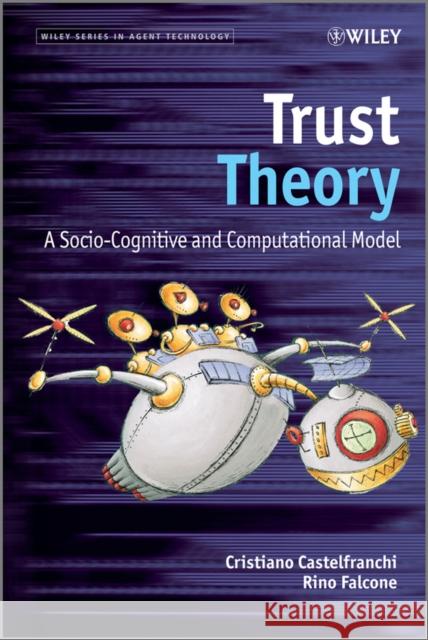
Cristiano Castelfranchi; Christiano Castelfranchi; Rino Falcone
Trust Theory: A Socio-Cognitive and Computational Model Castelfranchi, Christiano 9780470028759 John Wiley & Sons - książkaWidoczna okładka, to zdjęcie poglądowe, a rzeczywista szata graficzna może różnić się od prezentowanej.

Trust Theory: A Socio-Cognitive and Computational Model

ISBN-13: 9780470028759 / Angielski / Twarda / 2010 / 386 str.

Cristiano Castelfranchi; Christiano Castelfranchi; Rino Falcone
cena 641,11 zł
(netto: 610,58 VAT:  5%)

Najniższa cena z 30 dni: 503,48 zł
Termin realizacji zamówienia:
ok. 16-18 dni roboczych
Bez gwarancji dostawy przed świętami

Darmowa dostawa!

This book provides an introduction, discussion, and formal-based modelling of trust theory and its applications in agent-based systems

This book gives an accessible explanation of the importance of trust in human interaction and, in general, in autonomous cognitive agents including autonomous technologies. The authors explain the concepts of trust, and describe a principled, general theory of trust grounded on cognitive, cultural, institutional, technical, and normative solutions. This provides a strong base for the author's discussion of role of trust in agent-based systems supporting human-computer interaction and distributed and virtual organizations or markets (multi-agent systems). Key Features:

  • Provides an accessible introduction to trust, and its importance and applications in agent-based systems
  • Proposes a principled, general theory of trust grounding on cognitive, cultural, institutional, technical, and normative solutions.
  • Offers a clear, intuitive approach, and systematic integration of relevant issues
  • Explains the dynamics of trust, and the relationship between trust and security
  • Offers operational definitions and models directly applicable both in technical and experimental domains
  • Includes a critical examination of trust models in economics, philosophy, psychology, sociology, and AI
This book will be a valuable reference for researchers and advanced students focused on information and communication technologies (computer science, artificial intelligence, organizational sciences, and knowledge management etc.), as well as Web-site and robotics designers, and for scholars working on human, social, and cultural aspects of technology. Professionals of ecommerce systems and peer-to-peer systems will also find this text of interest.

Kategorie:
Technologie
Kategorie BISAC:
Technology & Engineering > Telecommunications
Computers > Information Technology
Technology & Engineering > Operations Research
Wydawca:
John Wiley & Sons
Seria wydawnicza:
Wiley Series in Agent Technology
Język:
Angielski
ISBN-13:
9780470028759
Rok wydania:
2010
Numer serii:
000311617
Ilość stron:
386
Waga:
0.79 kg
Wymiary:
24.89 x 17.27 x 2.54
Oprawa:
Twarda
Wolumenów:
01
Dodatkowe informacje:
Bibliografia

"I highly recommend this book to anyone who wants to delve deep into the concept of trust, in particular for use in computational applications and social simulations to strengthen awareness of complexity, complications and conundrums of trust." (JASSS, 2011)

"Castelfranchi and Falcone′s (both Italian National Research Council) is the first book providing an overview of the field of modeling trust and computational models of trust." (Book News, September 2010)

Foreword.

Introduction.

1 Definitions of Trust: From Conceptual Components to the General Core.

1.1 A Content Analysis.

1.2 Missed Components and Obscure Links.

1.3 Intentional Action and Lack of Controllability: Relying on What is Beyond Our Power.

1.4 Two Intertwined Notions of Trust: Trust as Attitude vs. Trust as Act.

1.5 A Critique of Some Significant Definitions of Trust.

References.

2 Socio–Cognitive Model of Trust: Basic Ingredients.

2.1 A Five–Part Relation and a Layered Model.

2.2 Trust as Mental Attitude: a Belief–Based and Goal–Based Model.

2.3 Expectations: Their Nature and Cognitive Anatomy.

2.4 No Danger : Negative or Passive or Defensive Trust.

2.5 Weakening the Belief–Base: Implicit Beliefs, Acceptances, and Trust by–Default.

2.6 From Disposition to Action.

2.7 Can we Decide to Trust?.

2.8 Risk, Investment and Bet.

2.9 Trust and Delegation.

2.10 The Other Parts of the Relation: the Delegated Task and the Context.

2.11 Genuine Social Trust: Trust and Adoption.

2.12 Resuming the Model.

References.

3 Socio–Cognitive Model of Trust: Quantitative Aspects.

3.1 Degrees of Trust: a Principled Quantification of Trust.

3.2 Relationships between Trust in Beliefs and Trust in Action and Delegation.

3.3 A Belief–Based Degree of Trust.

3.4 To Trust or Not to Trust: Degrees of Trust and Decision to Trust.

3.5 Positive Trust is not Enough: a Variable Threshold for Risk Acceptance/Avoidance.

3.6 Generalizing the Trust Decision to a Set of Agents.

3.7 When Trust is Too Few or Too Much.

3.8 Conclusions.

References.

4 The Negative Side: Lack of Trust, Implicit Trust, Mistrust, Doubts and Diffidence.

4.1 From Lack of Trust to Diffidence: Not Simply a Matter of Degree.

4.2 Lack of Trust.

4.3 The Complete Picture.

4.4 In Sum.

4.5 Trust and Fear.

4.6 Implicit and by Default Forms of Trust.

4.7 Insufficient Trust.

4.8 Trust on Credit: The Game of Ignorance.

References.

5 The Affective and Intuitive Forms of Trust: The Confidence We Inspire.

5.1 Two Forms of Evaluation .

5.2 The Dual Nature of Valence: Cognitive Evaluations Versus Intuitive Appraisal.

5.3 Evaluations.

5.4 Appraisal.

5.5 Relationships Between Appraisal and Evaluation.

5.6 Trust as Feeling.

5.7 Trust Disposition as an Emotion and Trust Action as an Impulse.

5.8 Basing Trust on the Emotions of the Other.

5.9 The Possible Affective Base of Generalized Trust and Trust Atmosphere .

5.10 Layers and Paths.

5.11 Conclusions About Trust and Emotions.

References.

6 Dynamics of Trust.

6.1 Mental Ingredients in Trust Dynamics.

6.2 Experience as an Interpretation Process: Causal Attribution for Trust.

6.3 Changing the Trustee s Trustworthiness.

6.4 The Dynamics of Reciprocal Trust and Distrust.

6.5 The Diffusion of Trust: Authority, Example, Contagion, Web of Trust.

6.6 Trust Through Transfer and Generalization.

6.7 The Relativity of Trust: Reasons for Trust Crisis.

6.8 Concluding Remarks.

References.

7 Trust, Control and Autonomy: A Dialectic Relationship.

7.1 Trust and Control: A Complex Relationship.

7.2 Adjusting Autonomy and Delegation on the Basis of Trust in Y.

7.3 Conclusions.

References.

8 The Economic Reductionism and Trust (Ir)rationality.

8.1 Irrational Basis for Trust?

8.2 Is Trust an Optimistic and Irrational Attitude and Decision?

8.3 Is Trust Just the Subjective Probability of the Favorable Event?

8.4 Trust in Game Theory: from Opportunism to Reciprocity.

8.5 Trust Game: A Procuste s Bed for Trust Theory.

8.6 Does Trust Presuppose Reciprocity?

8.7 The Varieties of Trust Responsiveness.

8.8 Trusting as Signaling.

8.9 Concluding Remarks.

References.

9 The Glue of Society.

9.1 Why Trust is the Glue of Society .

9.2 Trust and Social Order.

9.3 How the Action of Trust Acquires the Social Function of Creating Trust.

9.4 From Micro to Macro: a Web of Trust.

9.5 Trust and Contracts.

9.6 Is Trust Based on Norms?

9.7 Trust: The Catalyst of Institutions.

References.

10 On the Trustee s Side: Trust As Relational Capital.

10.1 Trust and Relational Capital.

10.2 Cognitive Model of Being Trusted.

10.3 Dynamics of Relational Capital.

10.4 From Trust Relational Capital to Reputational Capital.

10.5 Conclusions.

References.

11 A Fuzzy Implementation for the Socio–Cognitive Approach to Trust.

11.1 Using a Fuzzy Approach.

11.2 Scenarios.

11.3 Belief Sources.

11.4 Building Belief Sources.

11.5 Implementation with Nested FCMs.

11.6 Converging and Diverging Belief Sources.

11.7 Homogeneous and Heterogeneous Sources.

11.8 Modeling Beliefs and Sources.

11.9 Overview of the Implementation.

11.10 Description of the Model.

11.11 Running the Model.

11.12 Experimental Setting.

11.13 Learning Mechanisms.

11.14 Contract Nets for Evaluating Agent Trustworthiness.

References.

12 Trust and Technology.

12.1 Main Difference Between Security and Trust.

12.2 Trust Models and Technology.

12.3 Concluding Remarks.

References .

13 Concluding Remarks and Pointers.

13.1 Against Reductionism .

13.2 Neuro–Trust and the Need for a Theoretical Model.

13.3 Trust, Institutions, Politics (Some Pills of Reflection).

References.

Index.

This book provides an introduction, discussion, and formal–based modelling of trust theory and its applications in agent–based systems

This book gives an accessible explanation of the importance of trust in human interaction and, in general, in autonomous cognitive agents including autonomous technologies. The authors explain the concepts of trust, and describe a principled, general theory of trust grounded on cognitive, cultural, institutional, technical, and normative solutions. This provides a strong base for the author s discussion of role of trust in agent–based systems supporting human–computer interaction and distributed and virtual organizations or markets (multi–agent systems).

Key Features:

  • Provides an accessible introduction to trust, and its importance and applications in agent–based systems
  • Proposes a principled, general theory of trust grounding on cognitive, cultural, institutional, technical, and normative solutions
  • Offers a clear, intuitive approach, and systematic integration of relevant issues
  • Explains the dynamics of trust, and the relationship between trust and security
  • Offers operational definitions and models directly applicable both in technical and experimental domains
  • Includes a critical examination of trust models in economics, philosophy, psychology, sociology, and AI


This book will be a valuable reference for researchers and advanced students focused on information and communication technologies (computer science, artificial intelligence, organizational sciences, and knowledge management etc.), as well as Web–site and robotics designers, and for scholars working on human, social, and cultural aspects of technology. Professionals of ecommerce systems and peer–to–peer systems will also find this text of interest.


Udostępnij

Facebook - konto krainaksiazek.pl


Opinie o Krainaksiazek.pl na Opineo.pl

Partner Mybenefit

Krainaksiazek.pl w programie rzetelna firma Krainaksiaze.pl - płatności przez paypal

Czytaj nas na:

Facebook - krainaksiazek.pl
  • książki na zamówienie
  • granty
  • książka na prezent
  • kontakt
  • pomoc
  • opinie
  • regulamin
  • polityka prywatności

Zobacz:

  • Księgarnia czeska

  • Wydawnictwo Książkowe Klimaty

1997-2025 DolnySlask.com Agencja Internetowa

© 1997-2022 krainaksiazek.pl
     
KONTAKT | REGULAMIN | POLITYKA PRYWATNOŚCI | USTAWIENIA PRYWATNOŚCI
Zobacz: Księgarnia Czeska | Wydawnictwo Książkowe Klimaty | Mapa strony | Lista autorów
KrainaKsiazek.PL - Księgarnia Internetowa

Polityka prywatnosci - link
Krainaksiazek.pl - płatnośc Przelewy24
Przechowalnia Przechowalnia





