• Wyszukiwanie zaawansowane
  • Kategorie
  • Kategorie BISAC
  • Książki na zamówienie
  • Promocje
  • Granty
  • Książka na prezent
  • Opinie
  • Pomoc
  • Załóż konto
  • Zaloguj się

Trends in Teaching Experimentation in the Life Sciences » książka


zaloguj się | załóż konto
Logo Krainaksiazek.pl

koszyk

konto

szukaj
topmenu
Księgarnia internetowa
Szukaj
Książki na zamówienie
Promocje
Granty
Książka na prezent
Moje konto
Pomoc
 
 
Wyszukiwanie zaawansowane
Pusty koszyk
Bezpłatna dostawa dla zamówień powyżej 20 złBezpłatna dostawa dla zamówień powyżej 20 zł

Kategorie główne

• Nauka
 [2948695]
• Literatura piękna
 [1824038]

  więcej...
• Turystyka
 [70868]
• Informatyka
 [151073]
• Komiksy
 [35227]
• Encyklopedie
 [23181]
• Dziecięca
 [621575]
• Hobby
 [138961]
• AudioBooki
 [1642]
• Literatura faktu
 [228651]
• Muzyka CD
 [371]
• Słowniki
 [2933]
• Inne
 [445341]
• Kalendarze
 [1243]
• Podręczniki
 [164416]
• Poradniki
 [479493]
• Religia
 [510449]
• Czasopisma
 [502]
• Sport
 [61384]
• Sztuka
 [243086]
• CD, DVD, Video
 [3417]
• Technologie
 [219673]
• Zdrowie
 [100865]
• Książkowe Klimaty
 [124]
• Zabawki
 [2168]
• Puzzle, gry
 [3372]
• Literatura w języku ukraińskim
 [260]
• Art. papiernicze i szkolne
 [7838]
Kategorie szczegółowe BISAC

Trends in Teaching Experimentation in the Life Sciences

ISBN-13: 9783030985943 / Angielski / Miękka / 2023
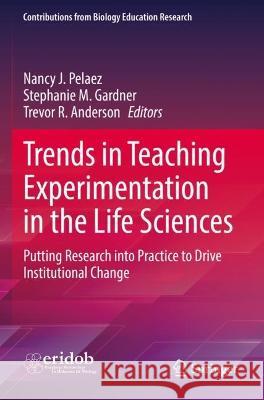
Trends in Teaching Experimentation in the Life Sciences  9783030985943 Springer International Publishing - książkaWidoczna okładka, to zdjęcie poglądowe, a rzeczywista szata graficzna może różnić się od prezentowanej.

Trends in Teaching Experimentation in the Life Sciences

ISBN-13: 9783030985943 / Angielski / Miękka / 2023

cena 522,07
(netto: 497,21 VAT:  5%)

Najniższa cena z 30 dni: 501,19
Termin realizacji zamówienia:
ok. 22 dni roboczych.

Darmowa dostawa!
inne wydania

This book is a guide for educators on how to develop and evaluate evidence-based strategies for teaching biological experimentation to thereby improve existing and develop new curricula. It unveils the flawed assumptions made at the classroom, department, and institutional level about what students are learning and what help they might need to develop competence in biological experimentation.Specific case studies illustrate a comprehensive list of key scientific competencies that unpack what it means to be a competent experimental life scientist. It includes explicit evidence-based guidelines for educators regarding the teaching, learning, and assessment of biological research competencies. The book also provides practical teacher guides and exemplars of assignments and assessments. It contains a complete analysis of the variety of tools developed thus far to assess learning in this domain.This book contributes to the growth of public understanding of biological issues including scientific literacy and the crucial importance of evidence-based decision-making around public policy. It will be beneficial to life science instructors, biology education researchers and science administrators who aim to improve teaching in life science departments.Chapters 6, 12, 14 and 22 are available open access under a Creative Commons Attribution 4.0 International License via link.springer.com.


Kategorie:
Podręczniki
Kategorie BISAC:
Science > Study & Teaching
Education > Curricula
Education > Testing & Measurement
Wydawca:
Springer International Publishing
Seria wydawnicza:
Contributions from Biology Education Research
Język:
Angielski
ISBN-13:
9783030985943
Rok wydania:
2023
Waga:
0.90 kg
Wymiary:
23.5 x 15.5
Oprawa:
Miękka
Dodatkowe informacje:
Wydanie ilustrowane

Part I. Vision and Initiation Phase: Envisioning What, When, and How Students Learn about Biological Experimentation 

Chapter 1. The problem with teaching experimentation: Development and use of a framework to define fundamental competencies for biological experimentation (Nancy Pelaez, Stephanie Gardner, and Trevor Anderson)

Chapter 2. Using data to identify anticipated learning outcomes for new and existing curricula (Kathleen A. Bowe and Stefan M. Irby)

Chapter 3. ACE-Bio experimentation competencies across the biology curriculum: When should we teach different competencies and concepts? (Megan F. Cole and Christopher W. Beck)

Chapter 4. Integrating the five core concepts of biology into course syllabi to advance student science epistemology and experimentation skills (Kyriaki Chatzikyriakidou and Melissa McCartney)

Part II. Operationalizing and Planning: Designing Instruction to Promote Learning of Biological Experimentation

Chapter 5. Backward designing a lab course to promote authentic research experience according to students’ gains in research abilities (Zhiyong Cheng, Trevor R. Anderson, and Nancy Pelaez)

Chapter 6. Using the ACE-Bio Competencies resource as a course planning tool to guide students in independent research (Aeisha Thomas)

Chapter 7. Experiments in data mining: Using digitized natural history collections to introduce students to data science (Debra L. Linton, Elizabeth Ellwood, Lisa D. White, Natalie F. Douglas, Anna K. Monfils)

Chapter 8. A framework for teaching and learning graphing in undergraduate biology (Stephanie M. Gardner, Aakanksha Angra, and Joseph A. Harsh)

Part III. Implementation and Student Engagement: Guiding Learners to Do Experiments and Use Representations in Biological Research

Chapter 9. Teaching undergraduate students how to identify a gap in the literature: Design of a visual map assignment to develop a grant proposal research question (Anne E. Kruchten and Jenean H. O’Brien)

Chapter 10. Virtual Microscope: Using simulated equipment to teach experimental techniques and processes (Cecilia I. Casali, Rocio A. Moreira Szokalo, Bruno J. Santacreu, Lucila G. Pescio, Laura Bonofiglio, Daniela J. Romero, Nicolás O. Favale)

Chapter 11. Introductory biology students engage in guided inquiry: Professional practice experiences develop their scientific process and experimentation competencies (Porché Spence)

Chapter 12. Feedback and discourse as a critical skill for the development of experimentation competencies (Janet M Batzli, Michelle A Harris, Dennis Lee and Heidi A Horn)

Chapter 13. Engaging students with experimentation in an introductory biology laboratory module (Annwesa Dasgupta, Swapnalee Sarmah, James A. Marrs, and Kathleen A. Marrs)

Part IV. Assessment, Evaluation, and Grading What Students Learn about Biological Experimentation

Chapter 14. Comparison of published assessments of biological experimentation as mapped to the ACE-Bio Competence areas (Anna J. Zelaya, Lawrence S. Blumer, and Christopher W. Beck)

Chapter 15. Research Across Curriculum Rubric (RAC-R): An adaptable rubric for the evaluation of journal article style lab reports (Karla B. Kinkade and Kristy J. Wilson)

Chapter 16. Assessing undergraduate research, a high impact practice: Using aligned outcomes to detail student achievement to multiple stakeholders (Jill Rulfs and Jessica Caron)

Chapter 17. Assessment of evidentiary reasoning in undergraduate biology: A lit review and application of the Conceptual Analysis of Disciplinary Evidence (CADE) framework (Shiyao Liu, Chao Cai, Chaonan Liu, Ala Samarapungavan, Stephanie M. Gardner, Kari L Clase, and Nancy Pelaez) 

Part V. Complementary Frameworks for Guiding Students' Experimentation Practice

Chapter 18. Hybrid labs: How students use computer models to motivate and make meaning from experiments (Julia Gouvea, Aditi Wagh, Robert Hayes and Matt Simon)

Chapter 19. Electronic laboratory notebook use supports good experimental practice and facilitates data sharing, archiving and analysis (Michael Buckholt and Jill Rulfs)

Chapter 20. Growing innovation and collaboration through assessment and feedback: A toolkit for assessing and developing students’ soft skills in biological experimentation (Sarah Beno and Diane C. Tucker)

Chapter 21. Biological reasoning according to members of the faculty developer network for undergraduate biology education: Insights from the Conceptual Analysis of Disciplinary Evidence (CADE) framework (Chaonan Liu, Nancy Pelaez, Shiyao Liu, Ala Samarapungavan, Stephanie M. Gardner, Kari L Clase, and Deborah Allen)

Part VI. Approaches to Biological Experimentation Instruction of Relevance to Biology Education Programs in General

Chapter 22. Teaching successful student collaboration within the context of biological experimentation (Kathryn M.S. Johnson, Heather R. Pelzel, and Namoonga M. Mantina)

Chapter 23. Biochemistry and art: Incorporating drawings, paintings, music, and media into teaching biological science (Latisha R. Jefferies and Shanae S. Jefferies)

Chapter 24. Strategies for targeting the learning of complex skills like experimentation to different student levels: The intermediate constraint hypothesis (Eli Meir)

Chapter 25. Implementing innovations in undergraduate biology experimentation education (Trevor Anderson and Nancy Pelaez)

Index

Dr. Nancy Pelaez is a Professor Emerita of Biology who founded the Biology Education Area as one of six research focus area in the Department of Biological Sciences at Purdue University. She holds a B.S. in Biology summa cum laude from Tulane University, a k-12 California teaching credential in both Life Science and Physical Science from Mills College, and a Ph.D. in Physiology and Biophysics from Indiana University School of Medicine as a Howard Hughes Medical Institute fellow. With more than 45 refereed publications in the field, Pelaez, who was elected Chair of Section Q (Education) for the American Association for the Advancement of Science (AAAS), has been honored with the American Physiological Society Guyton Educator of the Year Award, a Fulbright Award to Vienna, Austria, and as AAAS Fellow.

Dr. Stephanie M. Gardner is an Associate Professor in the Department of Biological Sciences at Purdue University. She earned her doctorate in Physiology from the University of Wisconsin-Madison and conducted her postdoctoral training in Neuroscience at Johns Hopkins School of Medicine. As a Visiting Assistant Professor at Dickinson College and Purdue University, her research interests shifted toward biology education. Her research group examines how students and faculty engage in science practices including mechanistic reasoning and creating visualizations to understand and communicate data and experimental concepts. Dr. Gardner leads professional development workshops around inclusive and innovative instruction for faculty and graduate students. She is the co-director of the CURE - Purdue faculty development program to increase access to research for more and diverse undergraduate students. She has served on several biology education research journal editorial boards including as a monitoring editor at CBE-Life Sciences Education since 2018.

Dr. Trevor R. Anderson is a biochemistry education researcher and Professor Emeritus of Chemistry in the Divisions of Chemical Education and Biochemistry in the Department of Chemistry at Purdue University. He was also a Senior Research Associate in the School of Life Science, University of KwaZulu-Natal, South Africa. He published in the areas of biochemistry student reasoning and visualization and has been invited to convene and present numerous plenary and keynote talks and workshops to the international scientific community. Central to his faculty development activities has been his workshops on scholarship, his design of curriculum change models, and his authorship of the Bridging-the-Gap series in Biochemistry & Molecular Biology Education (BAMBEd), aimed at encouraging scholarship in teaching and learning through the application of educational research to teaching practice. For 22 years, he served on the Education Committee of the International Union of Biochemistry and Molecular Biology (IUBMB) and the editorial board of BAMBEd.

This book is a guide for educators on how to develop and evaluate evidence-based strategies for teaching biological experimentation to thereby improve existing and develop new curricula. It unveils the flawed assumptions made at the classroom, department, and institutional level about what students are learning and what help they might need to develop competence in biological experimentation.

Specific case studies illustrate a comprehensive list of key scientific competencies that unpack what it means to be a competent experimental life scientist. It includes explicit evidence-based guidelines for educators regarding the teaching, learning, and assessment of biological research competencies. The book also provides practical teacher guides and exemplars of assignments and assessments. It contains a complete analysis of the variety of tools developed thus far to assess learning in this domain.

This book contributes to the growth of public understanding of biological issues including scientific literacy and the crucial importance of evidence-based decision-making around public policy. It will be beneficial to life science instructors, biology education researchers and science administrators who aim to improve teaching in life science departments.

Chapters 6, 12, 14 and 22 are available open access under a Creative Commons Attribution 4.0 International License via link.springer.com.




Udostępnij

Facebook - konto krainaksiazek.pl


Opinie o Krainaksiazek.pl na Opineo.pl

Partner Mybenefit

Krainaksiazek.pl w programie rzetelna firma Krainaksiaze.pl - płatności przez paypal

Czytaj nas na:

Facebook - krainaksiazek.pl
  • książki na zamówienie
  • granty
  • książka na prezent
  • kontakt
  • pomoc
  • opinie
  • regulamin
  • polityka prywatności

Zobacz:

  • Księgarnia czeska

  • Wydawnictwo Książkowe Klimaty

1997-2026 DolnySlask.com Agencja Internetowa

© 1997-2022 krainaksiazek.pl
     
KONTAKT | REGULAMIN | POLITYKA PRYWATNOŚCI | USTAWIENIA PRYWATNOŚCI
Zobacz: Księgarnia Czeska | Wydawnictwo Książkowe Klimaty | Mapa strony | Lista autorów
KrainaKsiazek.PL - Księgarnia Internetowa

Polityka prywatnosci - link
Krainaksiazek.pl - płatnośc Przelewy24
Przechowalnia Przechowalnia



