• Wyszukiwanie zaawansowane
  • Kategorie
  • Kategorie BISAC
  • Książki na zamówienie
  • Promocje
  • Granty
  • Książka na prezent
  • Opinie
  • Pomoc
  • Załóż konto
  • Zaloguj się

Transport Mechanisms in Membrane Separation Processes » książka


zaloguj się | załóż konto
Logo Krainaksiazek.pl

koszyk

konto

szukaj
topmenu
Księgarnia internetowa
Szukaj
Książki na zamówienie
Promocje
Granty
Książka na prezent
Moje konto
Pomoc
 
 
Wyszukiwanie zaawansowane
Pusty koszyk
Bezpłatna dostawa dla zamówień powyżej 20 złBezpłatna dostawa dla zamówień powyżej 20 zł

Kategorie główne

• Nauka
 [2952079]
• Literatura piękna
 [1850969]

  więcej...
• Turystyka
 [71058]
• Informatyka
 [151066]
• Komiksy
 [35579]
• Encyklopedie
 [23181]
• Dziecięca
 [620496]
• Hobby
 [139036]
• AudioBooki
 [1646]
• Literatura faktu
 [228729]
• Muzyka CD
 [379]
• Słowniki
 [2932]
• Inne
 [445708]
• Kalendarze
 [1409]
• Podręczniki
 [164793]
• Poradniki
 [480107]
• Religia
 [510956]
• Czasopisma
 [511]
• Sport
 [61267]
• Sztuka
 [243299]
• CD, DVD, Video
 [3411]
• Technologie
 [219640]
• Zdrowie
 [100984]
• Książkowe Klimaty
 [124]
• Zabawki
 [2281]
• Puzzle, gry
 [3363]
• Literatura w języku ukraińskim
 [258]
• Art. papiernicze i szkolne
 [8020]
Kategorie szczegółowe BISAC

Transport Mechanisms in Membrane Separation Processes

ISBN-13: 9781461366362 / Angielski / Miękka / 2012 / 219 str.
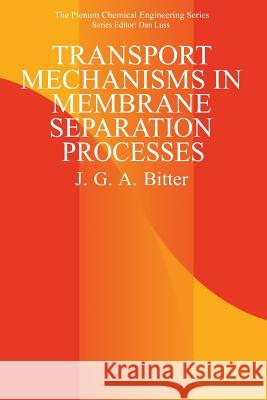
J. G. a. Bitter
Transport Mechanisms in Membrane Separation Processes J. G. a. Bitter 9781461366362 Springer - książkaWidoczna okładka, to zdjęcie poglądowe, a rzeczywista szata graficzna może różnić się od prezentowanej.

Transport Mechanisms in Membrane Separation Processes

ISBN-13: 9781461366362 / Angielski / Miękka / 2012 / 219 str.

J. G. a. Bitter
cena 201,24
(netto: 191,66 VAT:  5%)

Najniższa cena z 30 dni: 192,74
Termin realizacji zamówienia:
ok. 22 dni roboczych
Dostawa w 2026 r.

Darmowa dostawa!

The present book contains a comparison of existing theoretical models developed in order to describe membrane separation processes. In general, the permeation equations resulting from these models give inaccurate predictions of the mutual effects of the permeants involved, due to the simplifications adopted in their derivation. It is concluded that an optimum description of transport phenomena in tight (diffusion-type) membranes is achieved with the "solution-diffusion" model. According to this model each component of a fluid mixture to be separated dissolves in the membrane and passes through by diffusion in response to its gradient in the chemical potential. A modified Flory-Huggins equation has been derived to calculate the solubility of the permeants in the membrane material. Contrary to the original Flory-Huggins equation, the modified equation accounts for the large effect on solubility of crystallinity and elastic strain of the polymer chains by swelling. The equilibrium sorption of liquids computed with this equation was found to be in good agreement with experimental results. Also, the sorption of gases in both rubbery and glassy polymers could be described quan- titatively with the modified Flory-Huggins equation without any need of the arbitrary Langmuir term, as required in the conventional "dual-mode" sorption model. Furthermore, fewer parameters are required than with the at least identical accuracy.


Kategorie:
Technologie
Kategorie BISAC:
Science > Chemistry - Industrial & Technical
Technology & Engineering > Chemical & Biochemical
Wydawca:
Springer
Seria wydawnicza:
Plenum Chemical Engineering
Język:
Angielski
ISBN-13:
9781461366362
Rok wydania:
2012
Wydanie:
Softcover Repri
Numer serii:
000032806
Ilość stron:
219
Waga:
0.36 kg
Wymiary:
22.9 x 15.2
Oprawa:
Miękka
Wolumenów:
01

1. Introduction.- 2. Types of Membrane Separation Processes, Mechanisms of Separation.- 2.1. Porous Membranes.- 2.2. Liquid Membranes.- 2.3. Tight Membranes.- 2.4. Selection of Membrane Separation Processes and Mechanisms.- 3. Survey of Membrane Separation Models.- 3.1. Irreversible Thermodynamics.- 3.2. Preferential Sorption-Capillary Flow Theory.- 3.3. The Solution-Diffusion Model.- 3.4. Viscous Flow Models; Accounting for Imperfections.- 3.5. Models for the Separation of Gas (Vapor) Mixture.- 3.6. Concentration Polarization.- 3.7. Blocking, Fouling, and Poisoning.- 4. Comparison of Membrane Permeation Models.- 4.1. Liquid Separations.- 4.2. Gas Separations.- 4.3. A New Permeation Model for Gases and Liquids.- 5. Basic Diffusion Equation.- 5.1. Introduction.- 5.2. The Maxwell-Stefan Equation.- 5.3. Equation of Darken, Prager, and Crank.- 5.4. The Modified Maxwell-Stefan Equation.- 6. Solubility of Permeants in Semi-Crystalline and Crosslinked Polymers.- 6.1. Solubility of Liquids in Polymers.- 6.2. Modified Equation for the Partial Molar Entropy of Mixing.- 6.3. Partial Molar Enthalpy of Mixing.- 6.4. The Modified Flory-Huggins Equation.- 6.5. Solubility of Gases in Polymers.- 6.6. The Modified Flory-Huggins Equation for Gases.- 7. Comparison and Experimental Check of the Solubility Equations.- 7.1. Swelling of Polyolefins.- 7.2. Swelling of Natural Rubber in Binary Solvent Mixtures.- 7.3. Swelling of Cellulose Diacetate in Mixtures of Ethanol and Water.- 7.4. Solubility of N2O, CO2, and C2H4 in PMMA.- 7.5. Solubility of CO2 and CH4 in Polysulfone.- 8. Prediction of Diffusivity in Multi-Component Mixtures.- 8.1. Basic Diffusivity.- 8.2. Concentrated Solute Diffusivity.- 8.3. Estimation of Diffusion Coefficients.- 8.4. Mixture Viscosity.- 8.5. Prediction of Diffusivity from Mixture Viscosity.- 9. New Permeability Equations.- 9.1. Introduction.- 9.2. Effect of Crystallinity and Swelling on Permeability.- 9.3. Specific Diffusion Rate.- 9.4. Simplified Calculation Procedure of Membrane Permeation.- 9.5. Stress Distributions Inside Membranes.- 9.6. Effect of Pressure Gradients Inside Membranes on Permeation.- 9.7. Permeability Equation for Gases.- 10. Permeation Experiments (Program and Procedures).- 10.1. Membranes Tested.- 10.2. Pervaporation Experiments.- 10.3. Reverse Osmosis Experiments.- 10.4. Dialysis Experiments.- 11. Results of Permeation Experiments.- 11.1. Effect of Permeation Time on Flux and Selectivity.- 11.2. Effect of Composition and External Driving Force on Flux and Selectivity.- 12. Experimental Check of the Permeation Equations.- 12.1. Concentration Dependence of the Mean Diffusivity.- 12.2. Prediction of Selectivity in Pervaporation.- 12.3. Comparison of Calculated and Measured Permeation in Reverse Osmosis.- 12.4. Comparison of Calculated and Measured Permeation by Dialysis.- 12.5. Mutual Effect of Hydrocarbons on their Permeability.- 12.6. Pervaporation of Ethyl Alcohol/Water Mixtures through Cellulose Diacetate Membranes.- 12.7. Permeability of Gases in Polysulfone.- 12.8. Permeability of Mixtures of CO2 and CH4 in Polyisoprene.- 13. Optimum Choice of Polymers for Membrane Preparation.- 14. Discussion and Conclusions.- Appendix I. Irreversible Processes Near Equilibrium.- I.1. Introduction.- I.2. Theory of Near-Equilibrium Processes.- I.3. Entropy Production in Irreversible Flow Processes.- I.4. Rate of Entropy Production; Dissipation Function.- I.5. Phenomenological Equations.- I.6. Requirements of the Phenomenological Coefficients.- I.7. Application of IT/OR/ORR in Membranes; The Kedem-Katchalsky Mode.- Appendix II. Derivation of the Concentration Polarization Equation of Gases.- II.1. Continuity Equation.- II.2. Transport Equation for Tight Membranes.- II.3. Experiments and Results.- Appendix III. Derivation of The Maxwell-Stefan Equation.- Appendix IV. Derivation of the Modified Maxwell-Stefan Equation.- Appendix V. Theory of the Entropy of Mixing.- V.1. Derivation of the Entropy Equation.- V.2. Entropy of Elastic Strain.- Appendix VI. Partial Molar Mixing Enthalpy of Multicomponent Mixtures.- Appendix VII. Solubility Equation for Gases in Polymers.- Appendix VIII. Evaluation and Estimation of Swelling Parameters.- VIII.1. Crystallinity.- VIII.2. Coordination Number.- VIII.3. Partial Molar Volume.- VIII.4. Partial Molar Heat of Mixing.- VIII.5. Activity of Permeants and Permeant Mixtures.- VIII.6. Elastic Strain Factor.- Appendix IX. Self-Diffusivity in Multicomponent Mixtures.- Appendix X. Viscosity of Multicomponent Mixtures.- Appendix XI. Estimation of the Geometric Diffusion Resistance.- Appendix XII. Approximate Solution of the General Differential Equation of Membrane Permeation.- Appendix XIII. Derivation of the Gas Permeation Equation.- List of Symbols.- References.


Udostępnij

Facebook - konto krainaksiazek.pl


Opinie o Krainaksiazek.pl na Opineo.pl

Partner Mybenefit

Krainaksiazek.pl w programie rzetelna firma Krainaksiaze.pl - płatności przez paypal

Czytaj nas na:

Facebook - krainaksiazek.pl
  • książki na zamówienie
  • granty
  • książka na prezent
  • kontakt
  • pomoc
  • opinie
  • regulamin
  • polityka prywatności

Zobacz:

  • Księgarnia czeska

  • Wydawnictwo Książkowe Klimaty

1997-2025 DolnySlask.com Agencja Internetowa

© 1997-2022 krainaksiazek.pl
     
KONTAKT | REGULAMIN | POLITYKA PRYWATNOŚCI | USTAWIENIA PRYWATNOŚCI
Zobacz: Księgarnia Czeska | Wydawnictwo Książkowe Klimaty | Mapa strony | Lista autorów
KrainaKsiazek.PL - Księgarnia Internetowa

Polityka prywatnosci - link
Krainaksiazek.pl - płatnośc Przelewy24
Przechowalnia Przechowalnia





