• Wyszukiwanie zaawansowane
  • Kategorie
  • Kategorie BISAC
  • Książki na zamówienie
  • Promocje
  • Granty
  • Książka na prezent
  • Opinie
  • Pomoc
  • Załóż konto
  • Zaloguj się

Translating Euclid: Designing a Human-Centered Mathematics » książka


zaloguj się | załóż konto
Logo Krainaksiazek.pl

koszyk

konto

szukaj
topmenu
Księgarnia internetowa
Szukaj
Książki na zamówienie
Promocje
Granty
Książka na prezent
Moje konto
Pomoc
 
 
Wyszukiwanie zaawansowane
Pusty koszyk
Bezpłatna dostawa dla zamówień powyżej 20 złBezpłatna dostawa dla zamówień powyżej 20 zł

Kategorie główne

• Nauka
 [2948695]
• Literatura piękna
 [1824038]

  więcej...
• Turystyka
 [70868]
• Informatyka
 [151073]
• Komiksy
 [35227]
• Encyklopedie
 [23181]
• Dziecięca
 [621575]
• Hobby
 [138961]
• AudioBooki
 [1642]
• Literatura faktu
 [228651]
• Muzyka CD
 [371]
• Słowniki
 [2933]
• Inne
 [445341]
• Kalendarze
 [1243]
• Podręczniki
 [164416]
• Poradniki
 [479493]
• Religia
 [510449]
• Czasopisma
 [502]
• Sport
 [61384]
• Sztuka
 [243086]
• CD, DVD, Video
 [3417]
• Technologie
 [219673]
• Zdrowie
 [100865]
• Książkowe Klimaty
 [124]
• Zabawki
 [2168]
• Puzzle, gry
 [3372]
• Literatura w języku ukraińskim
 [260]
• Art. papiernicze i szkolne
 [7838]
Kategorie szczegółowe BISAC

Translating Euclid: Designing a Human-Centered Mathematics

ISBN-13: 9783031010729 / Angielski / Miękka / 2013 / 244 str.
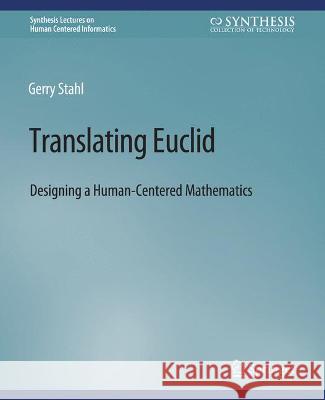
Gerry Stahl
Translating Euclid: Designing a Human-Centered Mathematics GERRY STAHL   9783031010729 Springer International Publishing AG - książkaWidoczna okładka, to zdjęcie poglądowe, a rzeczywista szata graficzna może różnić się od prezentowanej.

Translating Euclid: Designing a Human-Centered Mathematics

ISBN-13: 9783031010729 / Angielski / Miękka / 2013 / 244 str.

Gerry Stahl
cena 160,61
(netto: 152,96 VAT:  5%)

Najniższa cena z 30 dni: 154,18
Termin realizacji zamówienia:
ok. 22 dni roboczych.

Darmowa dostawa!

Translating Euclid reports on an effort to transform geometry for students from a stylus-and-clay-tablet corpus of historical theorems to a stimulating computer-supported collaborative-learning inquiry experience. The origin of geometry was a turning point in the pre-history of informatics, literacy, and rational thought. Yet, this triumph of human intellect became ossified through historic layers of systematization, beginning with Euclid's organization of the Elements of geometry. Often taught by memorization of procedures, theorems, and proofs, geometry in schooling rarely conveys its underlying intellectual excitement. The recent development of dynamic-geometry software offers an opportunity to translate the study of geometry into a contemporary vernacular. However, this involves transformations along multiple dimensions of the conceptual and practical context of learning. Translating Euclid steps through the multiple challenges involved in redesigning geometry education to take advantage of computer support. Networked computers portend an interactive approach to exploring dynamic geometry as well as broadened prospects for collaboration. The proposed conception of geometry emphasizes the central role of the construction of dependencies as a design activity, integrating human creation and mathematical discovery to form a human-centered approach to mathematics. This book chronicles an iterative effort to adapt technology, theory, pedagogy and practice to support this vision of collaborative dynamic geometry and to evolve the approach through on-going cycles of trial with students and refinement of resources. It thereby provides a case study of a design-based research effort in computer-supported collaborative learning from a human-centered informatics perspective.


Kategorie:
Informatyka
Kategorie BISAC:
Mathematics > Prawdopodobieństwo i statystyka
Computers > Human-Computer Interaction (HCI)
Computers > Computer Architecture
Wydawca:
Springer International Publishing AG
Język:
Angielski
ISBN-13:
9783031010729
Rok wydania:
2013
Dostępne języki:
Ilość stron:
244
Waga:
0.42 kg
Wymiary:
23.5 x 19.05 x 1.3
Oprawa:
Miękka
Dodatkowe informacje:
Wydanie ilustrowane

Acknowledgments.- Background.- Vision: The Cognitive Potential of Collaborative Dynamic Geometry.- History: The Origin of Geometry.- Philosophy: The Obfuscation of Geometry.- Mathematics: Demythologizing Geometry.- Technology: Deconstructing Geometry.- Collaboration: Group Geometry.- Research: Analyzing Geometry.- Theory: Resources for Geometry.- Pedagogy: Designing Geometry.- Practice: Doing Geometry.- Design-Based Research: Human-Centered Geometry.- Author Indes.- Bibliography.- Author's Biography.

My life began when I first encountered geometry in high school. From that moment on, I devoured books on mathematics, physics, and cosmology. I wondered, like Pythagoras, about the place of mathematical objects in the universe. This led me (via the logicians) to philosophy. I could not wait to explore these topics as an undergrad at MIT. Once there, however, I became discouraged about the contemporary approach to math and physics education, as well as the militaristic uses being made of them. I turned increasingly to philosophy, moving away from positivism to its critique by 20th century continental thought. Upon graduation, I went to Heidelberg for a year to study German philosophy during the exhilarating 1960s, later spending two years at the Frankfurt School. Meanwhile, I completed a doctoral dissertation on Marx and Heidegger at Northwestern. Back in Philadelphia, I briefly tried my hand at teaching remedial high school math at an urban public school. However, I soon found systems programming to be a less frustrating way to earn a living. I also engaged in union and community organizing, learning how to bring federal grants into the neighborhoods for local development. When the first personal computers appeared, I ran a service to help non-profit organizations computerize. Eventually, I decided to fill in my computer science background at the University of Colorado in Boulder, where I earned a doctorate in artificial intelligence and cognitive science. My research work after graduation is documented in Group Cognition (MIT Press, 2006). Following a year abroad at a CSCW lab outside Bonn, I went to the College of Information Science at Drexel to teach HCI and CSCL in 2002. In collaboration with many colleagues, I started the VMT Project, which is reported on in Studying Virtual Math Teams (Springer, 2009). My specialty is Computer-Supported Collaborative Learning. I founded the International Journal of CSCL and have been active in the CSCL Conference series. My most recent ideas, discoveries, and wonderings are brought together in Translating Euclid.


Udostępnij

Facebook - konto krainaksiazek.pl


Opinie o Krainaksiazek.pl na Opineo.pl

Partner Mybenefit

Krainaksiazek.pl w programie rzetelna firma Krainaksiaze.pl - płatności przez paypal

Czytaj nas na:

Facebook - krainaksiazek.pl
  • książki na zamówienie
  • granty
  • książka na prezent
  • kontakt
  • pomoc
  • opinie
  • regulamin
  • polityka prywatności

Zobacz:

  • Księgarnia czeska

  • Wydawnictwo Książkowe Klimaty

1997-2026 DolnySlask.com Agencja Internetowa

© 1997-2022 krainaksiazek.pl
     
KONTAKT | REGULAMIN | POLITYKA PRYWATNOŚCI | USTAWIENIA PRYWATNOŚCI
Zobacz: Księgarnia Czeska | Wydawnictwo Książkowe Klimaty | Mapa strony | Lista autorów
KrainaKsiazek.PL - Księgarnia Internetowa

Polityka prywatnosci - link
Krainaksiazek.pl - płatnośc Przelewy24
Przechowalnia Przechowalnia






