• Wyszukiwanie zaawansowane
  • Kategorie
  • Kategorie BISAC
  • Książki na zamówienie
  • Promocje
  • Granty
  • Książka na prezent
  • Opinie
  • Pomoc
  • Załóż konto
  • Zaloguj się

Towards an Ecology of World Languages » książka

zaloguj się | załóż konto
Logo Krainaksiazek.pl

koszyk

konto

szukaj
topmenu
Księgarnia internetowa
Szukaj
Książki na zamówienie
Promocje
Granty
Książka na prezent
Moje konto
Pomoc
 
 
Wyszukiwanie zaawansowane
Pusty koszyk
Bezpłatna dostawa dla zamówień powyżej 20 złBezpłatna dostawa dla zamówień powyżej 20 zł

Kategorie główne

• Nauka
 [2948695]
• Literatura piękna
 [1824038]

  więcej...
• Turystyka
 [70868]
• Informatyka
 [151073]
• Komiksy
 [35227]
• Encyklopedie
 [23181]
• Dziecięca
 [621575]
• Hobby
 [138961]
• AudioBooki
 [1642]
• Literatura faktu
 [228651]
• Muzyka CD
 [371]
• Słowniki
 [2933]
• Inne
 [445341]
• Kalendarze
 [1243]
• Podręczniki
 [164416]
• Poradniki
 [479493]
• Religia
 [510449]
• Czasopisma
 [502]
• Sport
 [61384]
• Sztuka
 [243086]
• CD, DVD, Video
 [3417]
• Technologie
 [219673]
• Zdrowie
 [100865]
• Książkowe Klimaty
 [124]
• Zabawki
 [2168]
• Puzzle, gry
 [3372]
• Literatura w języku ukraińskim
 [260]
• Art. papiernicze i szkolne
 [7838]
Kategorie szczegółowe BISAC

Towards an Ecology of World Languages

ISBN-13: 9780745629568 / Angielski / Miękka / 2006 / 304 str.
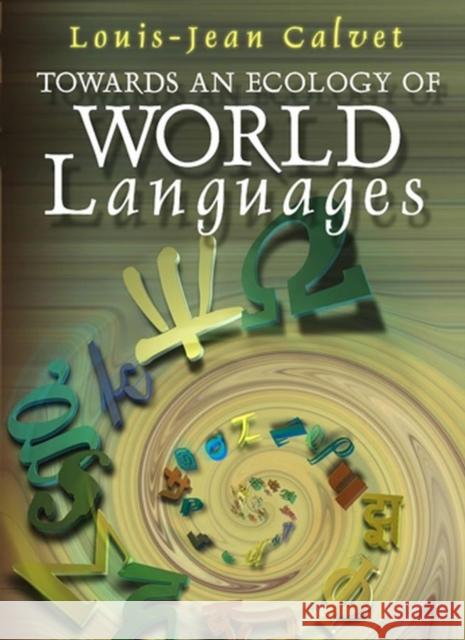
Calvet Louis-Jean Calvet; Andrew Brown
Towards an Ecology of World Languages Louis-Jean Calvet Andrew Brown 9780745629568 Polity Press - książkaWidoczna okładka, to zdjęcie poglądowe, a rzeczywista szata graficzna może różnić się od prezentowanej.

Towards an Ecology of World Languages

ISBN-13: 9780745629568 / Angielski / Miękka / 2006 / 304 str.

Calvet Louis-Jean Calvet; Andrew Brown
cena 97,70
(netto: 93,05 VAT:  5%)

Najniższa cena z 30 dni: 96,51
Termin realizacji zamówienia:
ok. 30 dni roboczych.

Darmowa dostawa!
inne wydania

In this essential new book Louis-Jean Calvet argues that what we call 'languages' are in fact abstractions invented by linguists as a convenient tool to label the subject-matter of their science. Calvet contends that languages are "alive" and therefore can and should only be approached ecologically.


Kategorie:
Nauka, Językoznawstwo
Kategorie BISAC:
Language Arts & Disciplines > Linguistics - General
Wydawca:
Polity Press
Język:
Angielski
ISBN-13:
9780745629568
Rok wydania:
2006
Ilość stron:
304
Waga:
0.45 kg
Wymiary:
23.16 x 18.08 x 2.31
Oprawa:
Miękka
Wolumenów:
01
Dodatkowe informacje:
Bibliografia
Wydanie ilustrowane

"A treasure–trove addition in the realm of ecolinguistics ... of interest not only to professional linguists it is also a highly recommended textbook for students of linguistics."

Jan Blommaert and Pan Lin, Journal of Sociolinguistics

"This is an important book, original in its conception, provocative in its argument, accessible in its content. Given the growing interest in language diversity, the publication of this book in English will be of great value for students and scholars alike."

Humphrey Tonkin, University of Hartford

"Calvet s ideas are great, and are as relevant today as ever."

David Crystal, University of Wales

Acknowledgements INTRODUCTION: practices and representations 1. The ecology of languages The need for identity and its linguistic manifestations: endogenous and exogenous relexifications The graphic environment Dramatic change in a specific linguistic ecology: the example of Australia The political frontier and the ecolinguistic system The influence of the horse on European languages 98 A false conception of linguistic ecology: Bickerton′s simulation project Conclusions 2. The galaxy of languages Constellations of languages The galactic model and linguistic policy: the example of the European Community The Hindi constellation The Bambara constellation The galaxy of writing systems Conclusions 3. Regulation and change: the homeostatic model An example of internal regulation: vernacular variants of French Of ships and languages: from Christopher Columbus to lingua franca Vernacularization as ecological acclimatization:varieties of French in Africa African argots and the ecolinguistic niche; the example of Bukavu Conclusions: acclimatization and acclimatation 4. Linguistic representations and change Linguistic insecurity and representations: a historical approach Some theoretical problems: a first approach Some problems of description Conclusions 5. Transmission and change The transmission of first languages and the myth of the mother tongue The case of creoles: upheaval in the ecolinguistic niche and linguistic change The transmission of gravitational systems Conclusion: evolution and revolution 6. Five case studies One name for several languages: Arabic schizoglossia Several names for one language: the example of Kituba One, two or three languages? The example of Serbo–Croat Kraemer: the invention of French in the socioprofessional context An ecological niche: the Island of St–Barthélemy CONCLUSION: Inventing language, giving it a name Notes Bibliography Index

Louis–Jean Calvet is Professor of Linguistics at the University of Provence, Aix–en–Provence.

There are around 5,000 languages spoken across the world today, but the languages that coexist in our multilingual world have varied functions and fulfil various roles. Some are spoken by small groups, a village or a tribe; others, much less numerous, are spoken by hundreds of millions of speakers. Certain languages, like English, French and Chinese, are highly valued, while others are largely ignored. Even if all languages are equal in the eyes of the linguist, the world s languages are in fact fundamentally unequal. All languages do not have the same value, and their inequality is at the heart of the way they are organized across the world.

In this major book Louis–Jean Calvet, one of the foremost sociolinguists working today, develops an ecological approach to language in order to analyse the changing structure of the world language system. The ecological approach to language begins from actual linguistic practices and studies the relations between these practices and their social, political and economic environment. The practices which constitute languages, on the one hand, and their environment, on the other, form a linguistic ecosystem in which languages coexist, multiply and influence one another. Using a rich panoply of examples from across the world, Calvet elaborates the ecological approach and shows how it can shed light on the changing forms of language use in the world today.

This path–breaking book will be of great value to students and scholars in linguistics and sociolinguistics and to anyone concerned with the fate of languages in our increasingly globalized world.

Calvet, Louis-Jean, Calvet Louis-Jean Calvet, auteur de nombreux ouvrages sur... więcej >
Brown, Andrew Brown-Institute of Education, University of London... więcej >


Udostępnij

Facebook - konto krainaksiazek.pl


Opinie o Krainaksiazek.pl na Opineo.pl

Partner Mybenefit

Krainaksiazek.pl w programie rzetelna firma Krainaksiaze.pl - płatności przez paypal

Czytaj nas na:

Facebook - krainaksiazek.pl
  • książki na zamówienie
  • granty
  • książka na prezent
  • kontakt
  • pomoc
  • opinie
  • regulamin
  • polityka prywatności

Zobacz:

  • Księgarnia czeska

  • Wydawnictwo Książkowe Klimaty

1997-2026 DolnySlask.com Agencja Internetowa

© 1997-2022 krainaksiazek.pl
     
KONTAKT | REGULAMIN | POLITYKA PRYWATNOŚCI | USTAWIENIA PRYWATNOŚCI
Zobacz: Księgarnia Czeska | Wydawnictwo Książkowe Klimaty | Mapa strony | Lista autorów
KrainaKsiazek.PL - Księgarnia Internetowa

Polityka prywatnosci - link
Krainaksiazek.pl - płatnośc Przelewy24
Przechowalnia Przechowalnia







