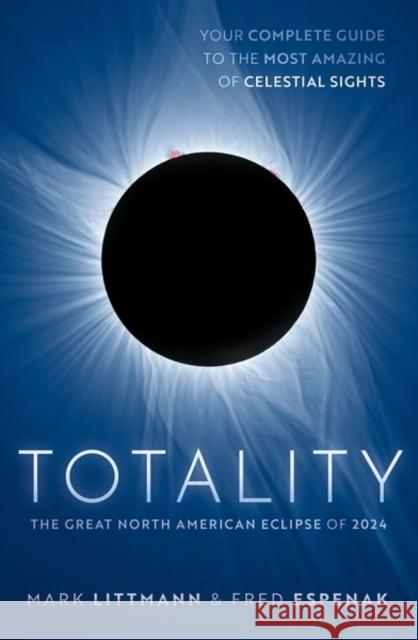
Total solar eclipses have terrified and fascinated people for millennia. Littman and Espenak describe the history and science of solar eclipses, with stories about how eclipse enthusiasts were affected by these spectacular events. If you haven't seen a total solar eclipse, this book will prepare you for the experience of a lifetime.
Mark Littmann teaches science writing at the University of Tennessee, where he holds three distinguished professorships. Mark received a B.S. in chemistry and literature at MIT, an M.A. in creative writing at Hollins College, and a Ph.D. in English at Northwestern University. Mark's books about solar eclipses, giant meteor storms, Halley's Comet, and the discovery of the outer planets have won four national awards. Mark's plays include Halley and Newton, how Edmond Halley made Isaac Newton famous, and Little Lessons for Lina, about Caroline Herschel, the first woman professional astronomer. Before coming to the University of Tennessee in 1991, Mark taught astronomy at Loyola College in Maryland and the University of Utah. In Salt Lake City, he directed the Hansen Planetarium from 1965 to 1983. He wrote and produced 35 planetarium programs, some still performed worldwide. The International Astronomical Union honored Mark by naming Asteroid 303265 after him.
Fred Espenak is the most widely recognized name in solar eclipses. He is an astrophysicist emeritus at NASA's Goddard Space Flight Center, where he published over a dozen book on solar eclipses. His Five Millennium Canons of solar and lunar eclipses are seminal works for researchers, archaeologists, and historians. Fred writes regularly on eclipses and is well known for his eclipse photography. His image of the 2006 eclipse was featured on a U.S. postage stamp to commemorate the 2017 eclipse. He leads expeditions for solar eclipses around the world and has done so for over 40 years. The International Astronomical Union honored Fred and his eclipse work by naming Asteroid 14120 after him.