• Wyszukiwanie zaawansowane
  • Kategorie
  • Kategorie BISAC
  • Książki na zamówienie
  • Promocje
  • Granty
  • Książka na prezent
  • Opinie
  • Pomoc
  • Załóż konto
  • Zaloguj się

Time Series by Example » książka


zaloguj się | załóż konto
Logo Krainaksiazek.pl

koszyk

konto

szukaj
topmenu
Księgarnia internetowa
Szukaj
Książki na zamówienie
Promocje
Granty
Książka na prezent
Moje konto
Pomoc
 
 
Wyszukiwanie zaawansowane
Pusty koszyk
Bezpłatna dostawa dla zamówień powyżej 20 złBezpłatna dostawa dla zamówień powyżej 20 zł

Kategorie główne

• Nauka
 [2946600]
• Literatura piękna
 [1856966]

  więcej...
• Turystyka
 [72221]
• Informatyka
 [151456]
• Komiksy
 [35826]
• Encyklopedie
 [23190]
• Dziecięca
 [619653]
• Hobby
 [140543]
• AudioBooki
 [1577]
• Literatura faktu
 [228355]
• Muzyka CD
 [410]
• Słowniki
 [2874]
• Inne
 [445822]
• Kalendarze
 [1744]
• Podręczniki
 [167141]
• Poradniki
 [482898]
• Religia
 [510455]
• Czasopisma
 [526]
• Sport
 [61590]
• Sztuka
 [243598]
• CD, DVD, Video
 [3423]
• Technologie
 [219201]
• Zdrowie
 [101638]
• Książkowe Klimaty
 [124]
• Zabawki
 [2473]
• Puzzle, gry
 [3898]
• Literatura w języku ukraińskim
 [254]
• Art. papiernicze i szkolne
 [8170]
Kategorie szczegółowe BISAC

Time Series by Example

ISBN-13: 9780470540640 / Angielski / Twarda / 2011 / 400 str.
Soren Bisgaard; S?ren Bisgaard; Murat Kulahci
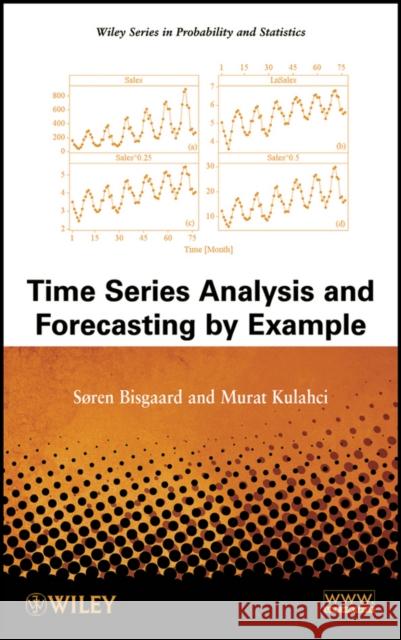
Time Series by Example Bisgaard, Søren 9780470540640 John Wiley & Sons - książkaWidoczna okładka, to zdjęcie poglądowe, a rzeczywista szata graficzna może różnić się od prezentowanej.

Time Series by Example

ISBN-13: 9780470540640 / Angielski / Twarda / 2011 / 400 str.

Soren Bisgaard; S?ren Bisgaard; Murat Kulahci
cena 650,50 zł
(netto: 619,52 VAT:  5%)

Najniższa cena z 30 dni: 645,16 zł
Termin realizacji zamówienia:
ok. 30 dni roboczych
Bez gwarancji dostawy przed świętami

Darmowa dostawa!

An intuition-based approach enables you to master time series analysis with ease

Time Series Analysis and Forecasting by Example provides the fundamental techniques in time series analysis using various examples. By introducing necessary theory through examples that showcase the discussed topics, the authors successfully help readers develop an intuitive understanding of seemingly complicated time series models and their implications. The book presents methodologies for time series analysis in a simplified, example-based approach. Using graphics, the authors discuss each presented example in detail and explain the relevant theory while also focusing on the interpretation of results in data analysis. Following a discussion of why autocorrelation is often observed when data is collected in time, subsequent chapters explore related topics, including:

  • Graphical tools in time series analysis
  • Procedures for developing stationary, non-stationary, and seasonal models
  • How to choose the best time series model
  • Constant term and cancellation of terms in ARIMA models
  • Forecasting using transfer function-noise models
The final chapter is dedicated to key topics such as spurious relationships, autocorrelation in regression, and multiple time series. Throughout the book, real-world examples illustrate step-by-step procedures and instructions using statistical software packages such as SAS(R), JMP, Minitab, SCA, and R. A related Web site features PowerPoint slides to accompany each chapter as well as the book's data sets. With its extensive use of graphics and examples to explain key concepts, Time Series Analysis and Forecasting by Example is an excellent book for courses on time series analysis at the upper-undergraduate and graduate levels. it also serves as a valuable resource for practitioners and researchers who carry out data and time series analysis in the fields of engineering, business, and economics.

Kategorie:
Nauka, Matematyka
Kategorie BISAC:
Mathematics > Probability & Statistics - Time Series
Wydawca:
John Wiley & Sons
Seria wydawnicza:
Wiley Series in Probability and Statistics
Język:
Angielski
ISBN-13:
9780470540640
Rok wydania:
2011
Numer serii:
000033279
Ilość stron:
400
Waga:
0.67 kg
Wymiary:
23.62 x 16.38 x 2.87
Oprawa:
Twarda
Wolumenów:
01
Dodatkowe informacje:
Bibliografia

It is a suitable text for courses on time series analysis at the (upper) undergraduate and graduate level. It can also serve as a guide for practitioners and researchers who carry out time series analysis in engineering, business and economics.   (Zentralblatt MATH, 2012)

"Time Series Analysis and Forecasting by Example is well recommended as a great introductory book for students transitioning from general statistics to time series as well as a good source book for intermediate level time series model builders." (Book Pleasures, 2012)

"They set out to provide an introduction that is easy to understand and use, and that draws heavily from examples to demonstrate the principles and techniques." (Book News, 1 October 2011)

Preface xi

1. Time Series Data: Examples and Basic Concepts 1

1.1 Introduction 1

1.2 Examples of Time Series Data 1

1.3 Understanding Autocorrelation 10

1.4 The World Decomposition 12

1.5 The Impulse Response Function 14

1.6 Superposition Principle 15

1.7 Parsimonious Models 18

Exercises 19

2. Visualizing Time Series Data Structures: Graphical Tools 21

2.1 Introduction 21

2.2 Graphical Analysis of Time Series 22

2.3 Graph Terminology 23

2.4 Graphical Perception 24

2.5 Principles of Graph Construction 28

2.6 Aspect Ratio 30

2.7 Time Series Plots 34

2.8 Bad Graphics 38

Exercises 46

3. Stationary Models 47

3.1 Basics of Stationary Time Series Models 47

3.2 Autoregressive Moving Average (ARMA) Models 54

3.3 Stationary and Invertibility of ARMA Models 62

3.4 Checking for Stationary using Variogram 66

3.5 Transformation of Data 69

Exercises 73

4. Nonstationary Models 79

4.1 Introduction 79

4.2 Detecting Nonstationarity 79

4.3 Antoregressive Integrated Moving Average (ARIMA) Models 83

4.4 Forecasting using ARIMA Models 91

4.5 Example 2: Concentration Measurements from a Chemical Process 93

4.6 The EWMA Forecast 103

Exercises 104

5. Seasonal Models 111

5.1 Seasonal Data 111

5.2 Seasonal ARIMA Models 116

5.3 Forecasting using Seasonal ARIMA Models 124

5.4 Example 2: Company X s Sales Data 126

Exercises 152

6. Time Series Model Selection 155

6.1 Introduction 155

6.2 Finding the BEST Model 155

6.3 Example: Internet Users Data 156

6.4 Model Selection Criteria 163

6.5 Impulse Response Function to Study the Differences in Models 166

6.6 Comparing Impulse Response Functions for Competing Models 169

6.7 ARIMA Models as Rational Approximations 170

6.8 AR Versus Arma Controversy 171

6.9 Final Thoughts on Model Selection 173

Appendix 6.1: How to Compute Impulse Response Functions with a Spreadsheet 173

Exercises 174

7. Additional Issues in ARIMA Models 177

7.1 Introduction 177

7.2 Linear Difference Equations 177

7.3 Eventual Forecast Function 183

7.4 Deterministic Trend Models 187

7.5 Yet Another Argument for Differencing 189

7.6 Constant Term in ARIMA Models 190

7.7 Cancellation of Terms in ARIMA Models 191

7.8 Stochastic Trend: Unit Root Nonstationary Processes 194

7.9 Overdifferencing and Underdifferencing 195

7.10 Missing Values in Time Series Data 197

Exercises 201

8. Transfer Function Models 203

8.1 Introduction 203

8.2 Studying Input–Output Relationships 203

8.3 Example 1: The Box–Jenkins Gas Furnace 204

8.4 Spurious Cross Correlations 207

8.5 Prewhitening 207

8.6 Identification of the Transfer Function 213

8.7 Modeling the Noise 215

8.8 The General Methodology for Transfer Function Models 222

8.9 Forecasting Using Transfer Function–Noise Models 224

8.10 Intervention Analysis 238

Exercises 261

9. Addition Topics 263

9.1 Spurious Relationships 263

9.2 Autocorrelation in Regression 271

9.3 Process Regime Changes 278

9.4 Analysis of Multiple Time Series 285

9.5 Structural Analysis of Multiple Time Series 296

Exercises 310

Appendix A. Datasets Used in the Examples 311

Appendix B. Datasets Used in the Exercises 327

Bibliography 361

Index 365 

The late Søren Bisgaard, PhD, was professor of technology management at the University of Massachusetts Amherst. Throughout his esteemed career, Dr. Bisgaard made significant research contributions in the areas of experimental design, operations management, time series analysis, and Lean Six Sigma. A Fellow of the American Statistical Association and the American Society for Quality, he was also one of the cofounders of the European Network for Business and Industrial Statistics (ESBIS) in 1999. Dr. Bisgaard was awarded many honors for his achievements in the field of statistics, including the Brumbaugh Award (1988, 1996, and 2008), the Shewhart Medal (2002), the William G. Hunter Award (2002), and the George Box Award (2004).

Murat Kulahci, PhD, is Associate Professor of Statistics in the Department of Informatics and Mathematical Modeling at the Technical University of Denmark. He has authored or coauthored over forty journal articles in the areas of time series analysis, design of experiments, and statistical process control and monitoring. Dr. Kulahci is coauthor of Introduction to Time Series Analysis and Forecasting (Wiley).

An intuition–based approach enables you to master time series analysis with ease

Time Series Analysis and Forecasting by Example provides the fundamental techniques in time series analysis using various examples. By introducing necessary theory through examples that showcase the discussed topics, the authors successfully help readers develop an intuitive understanding of seemingly complicated time series models and their implications.

The book presents methodologies for time series analysis in a simplified, example–based approach. Using graphics, the authors discuss each presented example in detail and explain the relevant theory while also focusing on the interpretation of results in data analysis. Following a discussion of why autocorrelation is often observed when data is collected in time, subsequent chapters explore related topics, including:

  • Graphical tools in time series analysis

  • Procedures for developing stationary, non–stationary, and seasonal models

  • How to choose the best time series model

  • Constant term and cancellation of terms in ARIMA models

  • Forecasting using transfer function–noise models

The final chapter is dedicated to key topics such as spurious relationships, autocorrelation in regression, and multiple time series. Throughout the book, real–world examples illustrate step–by–step procedures along with instructions for using statistical software packages such as SAS®, JMP®, Minitab®, SCA, and R. A related website features PowerPoint® slides that accompany each chapter as well as the book′s data sets.

With its extensive use of graphics and examples to explain key concepts, Time Series Analysis and Forecasting by Example is an excellent book for courses on time series analysis at the upper–undergraduate and graduate level. It also serves as a valuable resource for practitioners and researchers who carry out data and time series analysis in the fields of engineering, business, and economics.


Udostępnij

Facebook - konto krainaksiazek.pl


Opinie o Krainaksiazek.pl na Opineo.pl

Partner Mybenefit

Krainaksiazek.pl w programie rzetelna firma Krainaksiaze.pl - płatności przez paypal

Czytaj nas na:

Facebook - krainaksiazek.pl
  • książki na zamówienie
  • granty
  • książka na prezent
  • kontakt
  • pomoc
  • opinie
  • regulamin
  • polityka prywatności

Zobacz:

  • Księgarnia czeska

  • Wydawnictwo Książkowe Klimaty

1997-2025 DolnySlask.com Agencja Internetowa

© 1997-2022 krainaksiazek.pl
     
KONTAKT | REGULAMIN | POLITYKA PRYWATNOŚCI | USTAWIENIA PRYWATNOŚCI
Zobacz: Księgarnia Czeska | Wydawnictwo Książkowe Klimaty | Mapa strony | Lista autorów
KrainaKsiazek.PL - Księgarnia Internetowa

Polityka prywatnosci - link
Krainaksiazek.pl - płatnośc Przelewy24
Przechowalnia Przechowalnia






