• Wyszukiwanie zaawansowane
  • Kategorie
  • Kategorie BISAC
  • Książki na zamówienie
  • Promocje
  • Granty
  • Książka na prezent
  • Opinie
  • Pomoc
  • Załóż konto
  • Zaloguj się

Time Series Algorithms Recipes: Implement Machine Learning and Deep Learning Techniques with Python » książka


zaloguj się | załóż konto
Logo Krainaksiazek.pl

koszyk

konto

szukaj
topmenu
Księgarnia internetowa
Szukaj
Książki na zamówienie
Promocje
Granty
Książka na prezent
Moje konto
Pomoc
 
 
Wyszukiwanie zaawansowane
Pusty koszyk
Bezpłatna dostawa dla zamówień powyżej 20 złBezpłatna dostawa dla zamówień powyżej 20 zł

Kategorie główne

• Nauka
 [2949965]
• Literatura piękna
 [1857847]

  więcej...
• Turystyka
 [70818]
• Informatyka
 [151303]
• Komiksy
 [35733]
• Encyklopedie
 [23180]
• Dziecięca
 [617748]
• Hobby
 [139972]
• AudioBooki
 [1650]
• Literatura faktu
 [228361]
• Muzyka CD
 [398]
• Słowniki
 [2862]
• Inne
 [444732]
• Kalendarze
 [1620]
• Podręczniki
 [167233]
• Poradniki
 [482388]
• Religia
 [509867]
• Czasopisma
 [533]
• Sport
 [61361]
• Sztuka
 [243125]
• CD, DVD, Video
 [3451]
• Technologie
 [219309]
• Zdrowie
 [101347]
• Książkowe Klimaty
 [123]
• Zabawki
 [2362]
• Puzzle, gry
 [3791]
• Literatura w języku ukraińskim
 [253]
• Art. papiernicze i szkolne
 [7933]
Kategorie szczegółowe BISAC

Time Series Algorithms Recipes: Implement Machine Learning and Deep Learning Techniques with Python

ISBN-13: 9781484289778 / Angielski / Miękka / 2022 / 174 str.
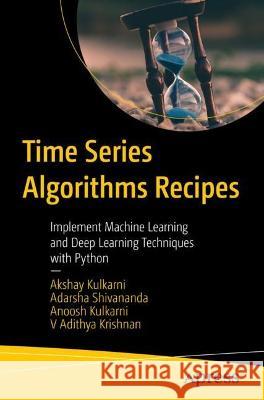
Akshay Kulkarni; Adarsha Shivananda; Anoosh Kulkarni
Time Series Algorithms Recipes: Implement Machine Learning and Deep Learning Techniques with Python Akshay Kulkarni Adarsha Shivananda Anoosh Kulkarni 9781484289778 Apress - książkaWidoczna okładka, to zdjęcie poglądowe, a rzeczywista szata graficzna może różnić się od prezentowanej.

Time Series Algorithms Recipes: Implement Machine Learning and Deep Learning Techniques with Python

ISBN-13: 9781484289778 / Angielski / Miękka / 2022 / 174 str.

Akshay Kulkarni; Adarsha Shivananda; Anoosh Kulkarni
cena 141,19 zł
(netto: 134,47 VAT:  5%)

Najniższa cena z 30 dni: 134,90 zł
Termin realizacji zamówienia:
ok. 22 dni roboczych
Bez gwarancji dostawy przed świętami

Darmowa dostawa!

This book teaches the practical implementation of various concepts for time series analysis and modeling with Python through problem-solution-style recipes, starting with data reading and preprocessing.It begins with the fundamentals of time series forecasting using statistical modeling methods like AR (autoregressive), MA (moving-average), ARMA (autoregressive moving-average), and ARIMA (autoregressive  integrated moving-average). Next, you'll learn univariate and multivariate modeling using different open-sourced packages like Fbprohet, stats model, and sklearn. You'll also gain insight into classic machine learning-based regression models like randomForest, Xgboost, and LightGBM for forecasting problems. The book concludes by demonstrating the implementation of deep learning models (LSTMs and ANN) for time series forecasting. Each chapter includes several code examples and illustrations.After finishing this book, you will have a foundational understanding of various concepts relating to time series and its implementation in Python.What You Will LearnImplement various techniques in time series analysis using Python.Utilize statistical modeling methods such as AR (autoregressive), MA (moving-average),  ARMA (autoregressive moving-average) and ARIMA (autoregressive  integrated moving-average) for time series forecastingUnderstand univariate and multivariate modeling for time series forecastingForecast using machine learning and deep learning techniques such as GBM and LSTM (long short-term memory)Who This Book Is ForData Scientists, Machine Learning Engineers, and software developers interested in time series analysis.

This book teaches the practical implementation of various concepts for time series analysis and modeling with Python through problem-solution-style recipes, starting with data reading and preprocessing. 

It begins with the fundamentals of time series forecasting using statistical modeling methods like AR (autoregressive), MA (moving-average), ARMA (autoregressive moving-average), and ARIMA (autoregressive  integrated moving-average). Next, you'll learn univariate and multivariate modeling using different open-sourced packages like Fbprohet, stats model, and sklearn. You'll also gain insight into classic machine learning-based regression models like randomForest, Xgboost, and LightGBM for forecasting problems. The book concludes by demonstrating the implementation of deep learning models (LSTMs and ANN) for time series forecasting. Each chapter includes several code examples and illustrations.
 
After finishing this book, you will have a foundational understanding of various concepts relating to time series and its implementation in Python.
 
What You Will Learn
  • Implement various techniques in time series analysis using Python.
  • Utilize statistical modeling methods such as AR (autoregressive), MA (moving-average),  ARMA (autoregressive moving-average) and ARIMA (autoregressive  integrated moving-average) for time series forecasting 
  • Understand univariate and multivariate modeling for time series forecasting
  • Forecast using machine learning and deep learning techniques such as GBM and LSTM (long short-term memory)
 
Who This Book Is For
Data Scientists, Machine Learning Engineers, and software developers interested in time series analysis.

Kategorie:
Informatyka, Bazy danych
Kategorie BISAC:
Computers > Artificial Intelligence - General
Computers > Languages - Python
Mathematics > Prawdopodobieństwo i statystyka
Wydawca:
Apress
Język:
Angielski
ISBN-13:
9781484289778
Rok wydania:
2022
Dostępne języki:
Ilość stron:
174
Waga:
0.27 kg
Wymiary:
23.39 x 15.6 x 1.04
Oprawa:
Miękka
Dodatkowe informacje:
Wydanie ilustrowane

Chapter 1: Getting Started with Time Series.
Chapter Goal: Exploring and analyzing the timeseries data, and preprocessing it, which includes feature engineering for model building.
No of pages: 25
Sub - Topics
1 Reading time series data
2 Data cleaning
3 EDA
4 Trend
5 Noise
6 Seasonality
7 Cyclicity
8 Feature Engineering
9 Stationarity


Chapter 2: Statistical Univariate Modelling
Chapter Goal: The fundamentals of time series forecasting with the use of statistical modelling methods like AR, MA, ARMA, ARIMA, etc.
 No of pages: 25
Sub - Topics
1 AR
2 MA
3 ARMA
4 ARIMA
5 SARIMA
6 AUTO ARIMA
7 FBProphet


Chapter 3: Statistical Multivariate Modelling
Chapter Goal: implementing multivariate modelling techniques like HoltsWinter and SARIMAX.
No of pages: 25
Sub - Topics: 
1 HoltsWinter 
2 ARIMAX
3 SARIMAX


Chapter 4: Machine Learning Regression-Based Forecasting.
Chapter Goal: Building and comparing multiple classical ML Regression algorithms for timeseries forecasting.
No of pages: 25
Sub - Topics: 
1 Random Forest
2 Decision Tree
3 Light GBM
4 XGBoost
5 SVM


Chapter 5: Forecasting Using Deep Learning.
Chapter Goal: Implementing advanced concepts like deep learning for time series forecasting from scratch.
No of pages: 25
Sub - Topics: 
1 LSTM 
2 ANN
3 MLP

Akshay Kulkarni is an AI and machine learning (ML) evangelist and a thought leader. He has consulted several Fortune 500 and global enterprises to drive AI and data science-led strategic transformations. He has been honoured as Google Developer Expert, and is an Author and a regular speaker at top AI and data science conferences (including Strata, O’Reilly AI Conf, and GIDS). He is a visiting faculty member for some of the top graduate institutes in India. In 2019, he has been also featured as one of the top 40 under 40 Data Scientists in India. In his spare time, he enjoys reading, writing, coding, and helping aspiring data scientists. He lives in Bangalore with his family.

Adarsha Shivananda is a Data science and MLOps Leader. He is working on creating worldclass MLOps capabilities to ensure continuous value delivery from AI. He aims to build a pool of exceptional data scientists within and outside of the organization to solve problems through training programs, and always wants to stay ahead of the curve. He has worked extensively in the pharma, healthcare, CPG, retail, and marketing domains. He lives in Bangalore and loves to read and teach data science.

Anoosh Kulkarni is a data scientist and a Senior AI consultant. He has worked with global clients across multiple domains and helped them solve their business problems using machine learning (ML), natural language processing (NLP), and deep learning.. Anoosh is passionate about guiding and mentoring people in their data science journey. He leads data science/machine learning meet-ups  and helps aspiring data scientists navigate their careers. He also conducts ML/AI workshops at universities and is actively involved in conducting webinars, talks, and sessions on AI and data science. He lives in Bangalore with his family.

V Adithya Krishnan is a data scientist and ML Ops Engineer. He has worked with various global clients across multiple domains and helped them to solve their business problems extensively using advanced Machine learning (ML) applications. He has experience across multiple fields of AI-ML, including, Time-series forecasting, Deep Learning, NLP, ML Operations, Image processing, and data analytics. Presently, he is working on  a state-of-the-art value observability suite for models in production, which includes continuous model and data monitoring along with the business value realized. He also published a paper at an IEEE conference, “Deep Learning Based Approach for Range Estimation," written in collaboration with the DRDO. He lives in Chennai with his family.


This book teaches the practical implementation of various concepts for time series analysis and modeling with Python through problem-solution-style recipes, starting with data reading and preprocessing. 


It begins with the fundamentals of time series forecasting using statistical modeling methods like AR (autoregressive), MA (moving-average), ARMA (autoregressive moving-average), and ARIMA (autoregressive  integrated moving-average). Next, you'll learn univariate and multivariate modeling using different open-sourced packages like Fbprohet, stats model, and sklearn. You'll also gain insight into classic machine learning-based regression models like randomForest, Xgboost, and LightGBM for forecasting problems. The book concludes by demonstrating the implementation of deep learning models (LSTMs and ANN) for time series forecasting. Each chapter includes several code examples and illustrations.
 
After finishing this book, you will have a foundational understanding of various concepts relating to time series and its implementation in Python.
 
You will:
  • Implement various techniques in time series analysis using Python.
  • Utilize statistical modeling methods such as AR (autoregressive), MA (moving-average),  ARMA (autoregressive moving-average) and ARIMA (autoregressive  integrated moving-average) for time series forecasting 
  • Understand univariate and multivariate modeling for time series forecasting
  • Forecast using machine learning and deep learning techniques such as GBM and LSTM (long short-term memory)




Udostępnij

Facebook - konto krainaksiazek.pl


Opinie o Krainaksiazek.pl na Opineo.pl

Partner Mybenefit

Krainaksiazek.pl w programie rzetelna firma Krainaksiaze.pl - płatności przez paypal

Czytaj nas na:

Facebook - krainaksiazek.pl
  • książki na zamówienie
  • granty
  • książka na prezent
  • kontakt
  • pomoc
  • opinie
  • regulamin
  • polityka prywatności

Zobacz:

  • Księgarnia czeska

  • Wydawnictwo Książkowe Klimaty

1997-2025 DolnySlask.com Agencja Internetowa

© 1997-2022 krainaksiazek.pl
     
KONTAKT | REGULAMIN | POLITYKA PRYWATNOŚCI | USTAWIENIA PRYWATNOŚCI
Zobacz: Księgarnia Czeska | Wydawnictwo Książkowe Klimaty | Mapa strony | Lista autorów
KrainaKsiazek.PL - Księgarnia Internetowa

Polityka prywatnosci - link
Krainaksiazek.pl - płatnośc Przelewy24
Przechowalnia Przechowalnia



