• Wyszukiwanie zaawansowane
  • Kategorie
  • Kategorie BISAC
  • Książki na zamówienie
  • Promocje
  • Granty
  • Książka na prezent
  • Opinie
  • Pomoc
  • Załóż konto
  • Zaloguj się

Thinking in Circles about Obesity: Applying Systems Thinking to Weight Management » książka


zaloguj się | załóż konto
Logo Krainaksiazek.pl

koszyk

konto

szukaj
topmenu
Księgarnia internetowa
Szukaj
Książki na zamówienie
Promocje
Granty
Książka na prezent
Moje konto
Pomoc
 
 
Wyszukiwanie zaawansowane
Pusty koszyk
Bezpłatna dostawa dla zamówień powyżej 20 złBezpłatna dostawa dla zamówień powyżej 20 zł

Kategorie główne

• Nauka
 [2952079]
• Literatura piękna
 [1850969]

  więcej...
• Turystyka
 [71058]
• Informatyka
 [151066]
• Komiksy
 [35579]
• Encyklopedie
 [23181]
• Dziecięca
 [620496]
• Hobby
 [139036]
• AudioBooki
 [1646]
• Literatura faktu
 [228729]
• Muzyka CD
 [379]
• Słowniki
 [2932]
• Inne
 [445708]
• Kalendarze
 [1409]
• Podręczniki
 [164793]
• Poradniki
 [480107]
• Religia
 [510956]
• Czasopisma
 [511]
• Sport
 [61267]
• Sztuka
 [243299]
• CD, DVD, Video
 [3411]
• Technologie
 [219640]
• Zdrowie
 [100984]
• Książkowe Klimaty
 [124]
• Zabawki
 [2281]
• Puzzle, gry
 [3363]
• Literatura w języku ukraińskim
 [258]
• Art. papiernicze i szkolne
 [8020]
Kategorie szczegółowe BISAC

Thinking in Circles about Obesity: Applying Systems Thinking to Weight Management

ISBN-13: 9780387094687 / Angielski / Miękka / 2009 / 468 str.
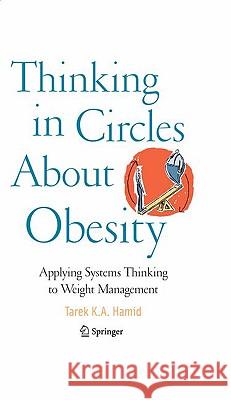
Tarek K. A. Hamid
Thinking in Circles about Obesity: Applying Systems Thinking to Weight Management Hamid, Tarek K. a. 9780387094687 Springer - książkaWidoczna okładka, to zdjęcie poglądowe, a rzeczywista szata graficzna może różnić się od prezentowanej.

Thinking in Circles about Obesity: Applying Systems Thinking to Weight Management

ISBN-13: 9780387094687 / Angielski / Miękka / 2009 / 468 str.

Tarek K. A. Hamid
cena 120,73
(netto: 114,98 VAT:  5%)

Najniższa cena z 30 dni: 115,63
Termin realizacji zamówienia:
ok. 22 dni roboczych
Dostawa w 2026 r.

Darmowa dostawa!

Today's children may well become the first generation of Americans whose life expectancy will be shorter than that of their parents. The culprit, public health experts agree, is obesity and its associated health problems. Heretofore, the strategy to slow obesity's galloping pace has been driven by what the philosopher Karl Popper calls ''the bucket theory of the mind. '' When minds are seen as containers and public understanding is viewed as being a function of how many scientific facts are known, the focus is naturally on how many scientific facts public minds contain. But the strategy has not worked. Despite all the diet books, the wide availability of reduced-calorie and reduced-fat foods, and the broad publicity about the obesity problem, America's waistline continues to expand. It will take more than food pyramid images or a new nutritional guideline to stem obesity's escalation. Albert Einstein once observed that the significant problems we face cannot be solved at the same level of thinking we were at when we created them, and that we would have to shift to a new level, a deeper level of thinking, tosolvethem. Thisbookarguesfor, andpresents, adifferent perspective for thinking about and addressing the obesity problem: a systems thinking perspective. While already commonplace in engineering and in business, the use of systems thinking in personal health is less widely adopted. Yet this is precisely the setting where complexities are most problematicandwherethestakesarehighest.


Kategorie:
Nauka, Psychologia
Kategorie BISAC:
Medical > Family & General Practice
Health & Fitness > Diet & Nutrition - Weight Loss
Medical > Preventive Medicine
Wydawca:
Springer
Język:
Angielski
ISBN-13:
9780387094687
Rok wydania:
2009
Wydanie:
2009
Ilość stron:
468
Waga:
0.65 kg
Wymiary:
22.86 x 15.24 x 2.29
Oprawa:
Miękka
Wolumenów:
01
Dodatkowe informacje:
Wydanie ilustrowane

From the reviews: "Systems thinking is a perspective and a set of conceptual tools that enable us to understand the structure and predict the behavior of complex systems. While already commonplace in engineering and in business, the use of systems thinking impersonal health is less widely adopted. Yet health is precisely the setting where dynamic complexity is most problematic and where the stakes are highest. Thinking in Circles about Obesity: Applying Systems Thinking to Weight Management, aims to fill this gap. The book applies systems thinking to personal health in a form that's accessible to the general reader with the hope that it would have a profound influence on how ordinary people think about and manage their health and well being." BehavioralHealthCentral.com, December 30, 2009 "Commonplace in engineering and in business, the use of systems thinking in personal health is less widely adopted. ... health is precisely the setting where dynamic complexity is most problematic and where the stakes are highest. Thinking in Circles About Obesity: Applying Systems Thinking to Weight Management ... aims to fill this gap. The book applies systems thinking to personal health in a form that's accessible to the general reader ... ." (The Systems Thinker, Vol. 20 (10), December/2009 - January/2010) "'Thinking in Circles About Obesity' and is by Tarek K. A. Hamid ... . I first saw the book reviewed while doing a Google Fast Flip search for 'obesity' and was intrigued by it. ... I have a copy and read ... I'm really excited by it. It's well-researched (with about 300+ endnotes and index), written for the lay person, and explains very well both how complex weight loss is and how we can better think about it." (Stephen Colbert, Weight Watchers, May, 2009)

Part I: Mismanaging the Obesity Threat 1. Like Boiled Frogs Part II: How We Changed Our Environment …And Now Our Environment Is Changing Us 2. Unbalanced Act 3. Human-Environment Interactions: Not One Way… and Not One-Way 4. Tilting the Energy Balance: More Energy In 5. Tilting the Energy Balance: Less Energy Out 6. Individual Differences 7. Is Ad-Lib Behavior Killing Us? Part III: We Can’t Manage What We Don’t Understand 8. The Energy Balance Equation: Reigning Intellectual Paradigm or Straitjacket? 9. What We Know That Ain’t So 10. Closing the Loops on Energy Balance: Energy Output Side 11. Closing the Loops on Energy Balance: Energy Input Side 12. Beyond Physiology: Closing the Behavior-Physiology Loop 13. Looking Back… Looking Forward Part IV: We Can’t Manage What We Mis-Predict 14. Learning by Doing 15. Give Us the tools, and We Will Finish the Job 16. A Microworld for Weight and Energy Regulation 17. Experiment 1: Assessing Weight Loss—Reality versus Fiction 18. Experiment 2: Going Ballistic—on a Diet 19. Experiment 3: Understanding Why 250 lbs [doesn't equal] 250 lbs 20. Experiment 4: Trading Treatment Options—Diet versus Exercise 21. PHDs for the Masses? (That’s Personal Health Decision support) Part V: Prevention… And Beyond 22. The Fat Lady... Models 23. The Third Path: Prevention 24. Location, Location, Location: Places to Intervene in Systems 25. It will Take More than Food Pyramids 26. MICROWORLDS R US 27. Beyond Prevention

Dr. Tarek K.A. Hamid is a trained system dynamicist (with a PhD from MIT, and a winner of the Forrester award for his first book). He has been a Professor of System Dynamics at the Naval Postgraduate School, in Monterey, CA since 1986, where he was awarded the Naval Postgraduate School's Faculty Performance Award, in recognition of meritorious faculty performance in both research and teaching.

In the mid 1990s he became extremely interested in the confluence of information and medical technologies, and saw it as one of the most promising new frontiers for system dynamics research and public policy. But he had a lot for me to learn. So, in 1997, he took an open-ended leave-of-absence and enrolled in the Master's Program at Stanford's Engineering Economic Systems & OR Dept., where he focused on decision analysis and medical decision-making. (Returning to become a master student, while already holding a PhD was certainly a "weird" experience—for him, and for his professors—but it was a lot of fun.) It was during his studies at Stanford that he began to see the natural fit between the obesity problem (as a dynamic system of energy regulation) and system dynamics. (Research was revealing that human bioenergetics belongs to the class of multi-loop nonlinear feedback systems—the same class of system that system dynamics aims to study.)

Upon graduation, he spent a year (1999-2000) as an affiliate at Stanford’s Medical Informatics Department (part of Stanford’s Medical School), where he worked on developing system dynamics models of human physiology and metabolism. In December 2001, he returned to his faculty position at the Naval Postgraduate School where he continues his research on medical decision making and modeling of human metabolism and energy regulation.

When not teaching or writing, Tarek is usually on the water. With his wife, Nadia, won first place in the 1999 San Francisco to Santa Barbara Yacht Race (Cruise Division) on their traditional Alden 45 sloop.

Thinking in Circles about Obesity: Applying Systems Thinking to Weight Management

Tarek K.A. Hamid, Operational and Information Sciences, Naval Postgraduate School, Monterey, California

Low-carb…low-fat…high-protein…high-fiber…Americans are food-savvy, label-conscious, calorie-aware—and still gaining weight in spite of all their good intentions. Worse still, today’s children run the risk of a shorter life expectancy than their parents.

Thinking in Circles About Obesity brings a healthy portion of critical thinking, spiced with on-target humor and lively graphics, to the obesity debate. Systems and medical physiology scholar Tarek Hamid unites systems (non-linear) thinking and information technology to provide powerful insights and practical strategies for managing our weight and our health. Hamid’s clear insights dispel dieters’ unrealistic expectations and illuminate dead-end behaviors to tap into a deeper understanding of how the body works, why it works that way, and how to better manage it. Included are innovative tools for:

• Understanding why diets almost always fall short of our expectations.

• Assessing weight gain, loss, and goals with greater accuracy.

• Abandoning one-size-fits-all solutions in lieu of personal solutions that do fit.

• Replacing outmoded linear thinking with feedback systems thinking.

• Getting the most health benefits from information technology.

•Making behavior and physiology work in sync instead of in opposition.

Given the current level of the weight crisis, the ideas in Thinking in Circles About Obesity have much to offer clinical and health psychologists, primary care physicians, public health professionals, parents, and lay readers. For those struggling with excess weight, this book charts a new path in health decision making, to see beyond calorie charts, body mass indexes, and silver bullets.


Udostępnij

Facebook - konto krainaksiazek.pl


Opinie o Krainaksiazek.pl na Opineo.pl

Partner Mybenefit

Krainaksiazek.pl w programie rzetelna firma Krainaksiaze.pl - płatności przez paypal

Czytaj nas na:

Facebook - krainaksiazek.pl
  • książki na zamówienie
  • granty
  • książka na prezent
  • kontakt
  • pomoc
  • opinie
  • regulamin
  • polityka prywatności

Zobacz:

  • Księgarnia czeska

  • Wydawnictwo Książkowe Klimaty

1997-2025 DolnySlask.com Agencja Internetowa

© 1997-2022 krainaksiazek.pl
     
KONTAKT | REGULAMIN | POLITYKA PRYWATNOŚCI | USTAWIENIA PRYWATNOŚCI
Zobacz: Księgarnia Czeska | Wydawnictwo Książkowe Klimaty | Mapa strony | Lista autorów
KrainaKsiazek.PL - Księgarnia Internetowa

Polityka prywatnosci - link
Krainaksiazek.pl - płatnośc Przelewy24
Przechowalnia Przechowalnia






