Termin realizacji zamówienia: ok. 22 dni roboczych.
Darmowa dostawa!
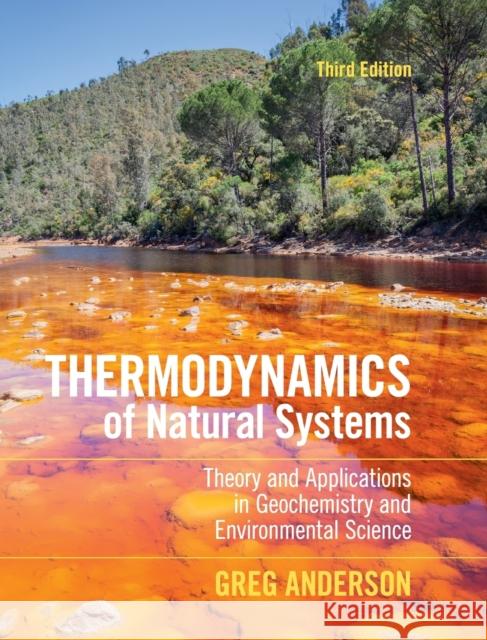
Fully updated, this streamlined new textbook is an accessible introduction to thermodynamics for Earth and environmental scientists, emphasising real-world problems.
'The beauty and power of this book is how Greg Anderson shows us, in rigorous yet practical and pictorial terms, how we can learn about the fundamental behaviour of our complex planet from classical thermodynamics alone. Anderson conveys this ... with fervor, with humor and with many calculated examples - which all emphasize that asking the right question is the key to meaningful simplification, and to answers that capture the essence of complex natural systems.' Christoph A. Heinrich, Eidgenössische Technische Hochschule Zürich, Switzerland
Preface; 1. What is thermodynamics?; 2. Defining our terms; 3. The First Law of Thermodynamics; 4. The Second Law of Thermodynamics; 5. Getting data; 6. Some simple applications; 7. Solutions; 8. Fugacity and activity; 9. The equilibrium constant; 10. Rock-water systems; 11. Redox reactions; 12. Phase diagrams; 13. Affinity and extent of reaction; Appendix A. Constants and numerical values; Appendix B. Standard state properties; Appendix C. Answers to exercises; References; Index; Online material: real solutions; The phase rule; Equations of state; Solid solutions; Electrolyte solutions; The Van't Hoff equilibrium box; Topics in mathematics.
Anderson, Greg
Greg Anderson is Professor Emeritus in the Department of Earth Sciences at the University of Toronto. He began his career as a mining engineer and exploration geologist before becoming interested in geochemistry. After completing his Ph.D. at Toronto, he spent five years at Pennsylvania State University doing experimental work on mineral solubilities. Afterward, he returned to Toronto, where he has since divided his time between studies of mineral systems, lead-zinc ore deposits, and theoretical geochemistry. He is the co-author of two other textbooks for Earth scientists, and in 2000 was awarded the Past Presidents' Medal (now named the Peacock Medal) by the Mineralogical Association of Canada for contributions to geochemistry.