• Wyszukiwanie zaawansowane
  • Kategorie
  • Kategorie BISAC
  • Książki na zamówienie
  • Promocje
  • Granty
  • Książka na prezent
  • Opinie
  • Pomoc
  • Załóż konto
  • Zaloguj się

Thermal Infrared Sensors » książka


zaloguj się | załóż konto
Logo Krainaksiazek.pl

koszyk

konto

szukaj
topmenu
Księgarnia internetowa
Szukaj
Książki na zamówienie
Promocje
Granty
Książka na prezent
Moje konto
Pomoc
 
 
Wyszukiwanie zaawansowane
Pusty koszyk
Bezpłatna dostawa dla zamówień powyżej 20 złBezpłatna dostawa dla zamówień powyżej 20 zł

Kategorie główne

• Nauka
 [2950560]
• Literatura piękna
 [1849509]

  więcej...
• Turystyka
 [71097]
• Informatyka
 [151150]
• Komiksy
 [35848]
• Encyklopedie
 [23178]
• Dziecięca
 [617388]
• Hobby
 [139064]
• AudioBooki
 [1657]
• Literatura faktu
 [228597]
• Muzyka CD
 [383]
• Słowniki
 [2855]
• Inne
 [445295]
• Kalendarze
 [1464]
• Podręczniki
 [167547]
• Poradniki
 [480102]
• Religia
 [510749]
• Czasopisma
 [516]
• Sport
 [61293]
• Sztuka
 [243352]
• CD, DVD, Video
 [3414]
• Technologie
 [219456]
• Zdrowie
 [101002]
• Książkowe Klimaty
 [124]
• Zabawki
 [2311]
• Puzzle, gry
 [3459]
• Literatura w języku ukraińskim
 [254]
• Art. papiernicze i szkolne
 [8079]
Kategorie szczegółowe BISAC

Thermal Infrared Sensors

ISBN-13: 9780470871928 / Angielski / Twarda / 2011 / 328 str.
¬Abar;¬Abar
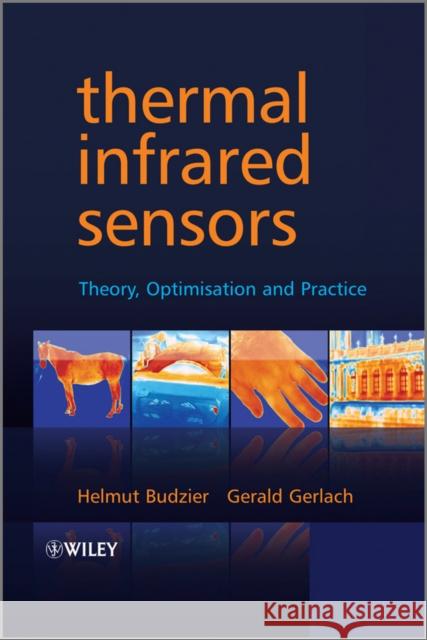
Thermal Infrared Sensors Budzier, Helmut 9780470871928 JOHN WILEY AND SONS LTD - książkaWidoczna okładka, to zdjęcie poglądowe, a rzeczywista szata graficzna może różnić się od prezentowanej.

Thermal Infrared Sensors

ISBN-13: 9780470871928 / Angielski / Twarda / 2011 / 328 str.

¬Abar;¬Abar
cena 479,43
(netto: 456,60 VAT:  5%)

Najniższa cena z 30 dni: 477,46
Termin realizacji zamówienia:
ok. 30 dni roboczych
Dostawa w 2026 r.

Darmowa dostawa!

The problems involved in designing optimal infrared (IR) measuring systems under given conditions are commensurately complex. The optical set-up and radiation conditions, the interaction between sensor and irradiation and the sensor itself, determine the operation of the sensor system. Simple calculations for solving these problems without any understanding of the causal relationships are not possible.

Thermal Infrared Sensors offers a concise explanation of the basic physical and photometric fundamentals needed for the consideration of these interactions. It depicts the basics of thermal IR sensor systems and explains the manifold causal relationships between the most important effects and influences, describing the relationships between sensor parameters such as thermal and special resolution, and application conditions. This book covers:

  • various types of thermal sensors, like thermoelectric sensor, pyroelectric sensors, microbolometers, micro-Golay cells and bimorphous sensors;
  • basic applications for thermal sensors;
  • noise - a limiting factor for thermal resolution and detectivity - including an outline of the mathematics and noise sources in thermal infrared sensors;
  • the properties of IR sensor systems in conjunction with the measurement environment and application conditions;
  • 60 examples showing calculations of real problems with real numbers, as they occur in many practical applications.
This is an essential reference for practicing design and optical engineers and users of infrared sensors and infrared cameras. With this book they will be able to transform the demonstrated solutions to their own problems, find ways to match their commercial IR sensors and cameras to their measurement conditions, and to tailor and optimise sensors and set-ups to particular IR measurement problems. The basic knowledge outlined in this book will give advanced undergraduate and graduate students a thorough grounding in this technology.

Kategorie:
Technologie
Kategorie BISAC:
Technology & Engineering > Electronics - General
Technology & Engineering > Electrical
Wydawca:
JOHN WILEY AND SONS LTD
Język:
Angielski
ISBN-13:
9780470871928
Rok wydania:
2011
Ilość stron:
328
Waga:
0.72 kg
Wymiary:
24.89 x 17.53 x 2.29
Oprawa:
Twarda
Wolumenów:
01
Dodatkowe informacje:
Bibliografia


Preface.

List of Examples.

List of Symbols.

Indices.

Abbreviations.

1 Introduction.

1.1 Infrared Radiation.

1.1.1 Technical Applications.

1.1.2 Classification of Infrared Radiation.

1.2 Historical Development.

1.3 Advantages of Infrared Measuring Technology.

1.4 Comparison of Thermal and Photonic Infrared Sensors.

1.5 Temperature and Spatial Resolution of Infrared Sensors.

1.6 Single–Element Sensors Versus Array Sensors.

References.

2 Radiometric Basics.

2.1 Effect of Electromagnetic Radiation on Solid–State Bodies.

2.1.1 Propagation of Radiation.

2.1.2 Propagation in Lossy Media.

2.1.3 Fields at Interfaces.

2.1.4 Transmission Through Thin Dielectric Layers.

2.2 Radiation Variables.–

2.2.1 Radiation–Field–Related Variables.

2.2.2 Emitter–Side Variables.

2.2.3 Receiver–Related Variables.

2.2.4 Spectral Variables.

2.2.5 Absorption, Reflection and Transmission.

2.2.6 Emissivity.

2.3 Radiation Laws.

References.

3 Photometric Basics.

3.1 Solid Angle.

3.1.1 Definition.

3.1.2 Solid Angle Calculations.

3.2 Basic Law of Photometry.

3.2.1 Definition.

3.2.2 Calculation Methods and Examples.

3.2.3 Numerical Solution of the Projected Solid Angle.

References.

4 Noise.

4.1 Mathematical Basics.

4.1.1 Introduction.

4.1.2 Time Functions.

4.1.3 Probability Functions.

4.1.4 Correlation Functions.

4.1.5 Spectral Functions.

4.1.6 Noise Analysis of Electronic Circuits.

4.2 Noise Source in Thermal Infrared Sensors.

4.2.1 Thermal Noise and tan .

4.2.2 Current Noise.

4.2.3 1/f Noise.

4.2.4 Radiation Noise.

4.2.5 Temperature Fluctuation Noise.

References.

5 Sensor Parameters.

5.1 Responsivity.

5.1.1 Introduction.

5.1.2 Black Responsivity.

5.1.3 Spectral Responsivity.

5.1.4 Signal Transfer Function.

5.1.5 Uniformity.

5.2 Noise–Equivalent Power NEP.

5.3 Detectivity.

5.4 Noise–Equivalent Temperature Difference.

5.5 Optical Parameters.

5.6 Modulation Transfer Function.

5.6.1 Definition.

5.6.2 Contrast.

5.6.3 Modulation Transfer Function of a Sensor.

5.6.4 Measuring the Modulation Transfer Function.

References.

6 Thermal Infrared Sensors.

6.1 Operating Principles.

6.2 Thermal Models.

6.2.1 Simple Thermal Model.

6.2.2 Thermal Layer Model.

6.3 Network Models for Thermal Sensors.

6.4 Thermoelectric Radiation Sensors.

6.4.1 Principle.

6.4.2 Thermal Resolution.

6.4.3 Design of Thermoelectric Sensors.

6.5 Pyroelectric Sensors.

6.5.1 Principle.

6.5.2 Thermal Resolution.

6.5.3 Design of Pyroelectric Sensors.

6.6 Microbolometers.

6.6.1 Principle.

6.6.2 Thermal Resolution.

6.6.3 Design of a Microbolometer Array.

6.6.4 Read–Out Electronics of Microbolometers.

6.7 Other Thermal Infrared Sensors.

6.7.1 Bimorphous Infrared Sensors.

6.7.2 Micro–GOLAY Cells.

6.8 Comparison of Thermal Sensors.

References.

7 Applications of Thermal Infrared Sensors.

7.1 General Considerations.

7.2 Pyrometry.

7.2.1 Design.

7.2.2 Emissivity of Real Emitters.

7.3 Thermal Imaging Cameras.

7.3.1 Design.

7.3.2 Calibration of Thermal Imaging Cameras.

7.4 Passive Infrared Motion Detector.

7.4.1 Design.

7.4.2 Infrared Optics.

7.4.3 Signal Processing.

7.5 Infrared Spectrometry.

7.5.1 Radiation Absorption of Gases.

7.5.2 Design of an Infrared Spectrometer.

7.6 Gas Analysis.

References.

Appendix A: Constants.

Appendix B: PLANCK?s Law of Radiation and Derived Laws.

Appendix C: Calculation of the Solid Angle of a Rectangular Area.

Further Reading and Sources.

Index.

Gerald Gerlach hat an der Technischen Universität Dresden Elektrotechnik studiert.
Nach seiner Promotion zum Doktor Ingenieur 1987 hat er 1991 habilitiert und ist seit 1993 Professor an der Fakultät Elektrotechnik der Technischen Universität Dresden. Er war mehrere Jahre Sprecher des Graduiertenkollegs "Sensorik" an der TU Dresden und ist seit 1996 Direktor des Instituts für Festkörperelektronik. Seit 2007 ist er Vorsitzender der VDI/VDE-Gesellschaft für Mess- und Automatisierungstechnik. Als Mitglied des wissenschaftlichen Beirats der Zeitschrift Technisches Messen und als langjähriger Fachgutachter der DFG und Vorsitzender des Arbeitskreises der Hochschullehrer für Messtechnik (AHMT) hat er nicht nur seiner Arbeit Inspiration geben können. Seit 2006 ist er Associate Editor des IEEE Sensors Journals. Helmut Budzier hat Elektrotechnik an der Technischen Universität Dresden studiert und 1987 seine Promotion zum Doktor Ingenieur auf dem Gebiet pyroelektrischer Sensoren abgelegt. Seit 1988 ist er wissenschaftlicher Mitarbeiter am Institut für Festkörperelektronik der TU Dresden und hat zahlreiche Forschungsprojekte auf den Gebieten der Sensorapplikation, Entwicklung von Thermografiesystemen und Infrarotmesstechnik geleitet.

The problems involved in designing optimal infrared (IR) measuring systems under given conditions are commensurately complex. The optical set–up and radiation conditions, the interaction between sensor and irradiation and the sensor itself, determine the operation of the sensor system. Simple calculations for solving these problems without any understanding of the causal relationships are not possible.

Thermal Infrared Sensors offers a concise explanation of the basic physical and photometric fundamentals needed for the consideration of these interactions. It depicts the basics of thermal IR sensor systems and explains the manifold causal relationships between the most important effects and influences, describing the relationships between sensor parameters such as thermal and special resolution, and application conditions.

This book covers:

  • various types of thermal sensors, like thermoelectric sensor, pyroelectric sensors, microbolometers, micro–Golay cells and bimorphous sensors;
  • basic applications for thermal sensors;
  • noise – a limiting factor for thermal resolution and detectivity – including an outline of the mathematics and noise sources in thermal infrared sensors;
  • the properties of IR sensor systems in conjunction with the measurement environment and application conditions;
  • 60 examples showing calculations of real problems with real numbers, as they occur in many practical applications.


This is an essential reference for practicing design and optical engineers and users of infrared sensors and infrared cameras. With this book they will be able to transform the demonstrated solutions to their own problems, find ways to match their commercial IR sensors and cameras to their measurement conditions, and to tailor and optimise sensors and set–ups to particular IR measurement problems. The basic knowledge outlined in this book will give advanced undergraduate and graduate students a thorough grounding in this technology.


Udostępnij

Facebook - konto krainaksiazek.pl


Opinie o Krainaksiazek.pl na Opineo.pl

Partner Mybenefit

Krainaksiazek.pl w programie rzetelna firma Krainaksiaze.pl - płatności przez paypal

Czytaj nas na:

Facebook - krainaksiazek.pl
  • książki na zamówienie
  • granty
  • książka na prezent
  • kontakt
  • pomoc
  • opinie
  • regulamin
  • polityka prywatności

Zobacz:

  • Księgarnia czeska

  • Wydawnictwo Książkowe Klimaty

1997-2025 DolnySlask.com Agencja Internetowa

© 1997-2022 krainaksiazek.pl
     
KONTAKT | REGULAMIN | POLITYKA PRYWATNOŚCI | USTAWIENIA PRYWATNOŚCI
Zobacz: Księgarnia Czeska | Wydawnictwo Książkowe Klimaty | Mapa strony | Lista autorów
KrainaKsiazek.PL - Księgarnia Internetowa

Polityka prywatnosci - link
Krainaksiazek.pl - płatnośc Przelewy24
Przechowalnia Przechowalnia





