• Wyszukiwanie zaawansowane
  • Kategorie
  • Kategorie BISAC
  • Książki na zamówienie
  • Promocje
  • Granty
  • Książka na prezent
  • Opinie
  • Pomoc
  • Załóż konto
  • Zaloguj się

Theory of Lift: Introductory Computational Aerodynamics in Matlab/Octave » książka


zaloguj się | załóż konto
Logo Krainaksiazek.pl

koszyk

konto

szukaj
topmenu
Księgarnia internetowa
Szukaj
Książki na zamówienie
Promocje
Granty
Książka na prezent
Moje konto
Pomoc
 
 
Wyszukiwanie zaawansowane
Pusty koszyk
Bezpłatna dostawa dla zamówień powyżej 20 złBezpłatna dostawa dla zamówień powyżej 20 zł

Kategorie główne

• Nauka
 [2948695]
• Literatura piękna
 [1824038]

  więcej...
• Turystyka
 [70868]
• Informatyka
 [151073]
• Komiksy
 [35227]
• Encyklopedie
 [23181]
• Dziecięca
 [621575]
• Hobby
 [138961]
• AudioBooki
 [1642]
• Literatura faktu
 [228651]
• Muzyka CD
 [371]
• Słowniki
 [2933]
• Inne
 [445341]
• Kalendarze
 [1243]
• Podręczniki
 [164416]
• Poradniki
 [479493]
• Religia
 [510449]
• Czasopisma
 [502]
• Sport
 [61384]
• Sztuka
 [243086]
• CD, DVD, Video
 [3417]
• Technologie
 [219673]
• Zdrowie
 [100865]
• Książkowe Klimaty
 [124]
• Zabawki
 [2168]
• Puzzle, gry
 [3372]
• Literatura w języku ukraińskim
 [260]
• Art. papiernicze i szkolne
 [7838]
Kategorie szczegółowe BISAC

Theory of Lift: Introductory Computational Aerodynamics in Matlab/Octave

ISBN-13: 9781119952282 / Angielski / Twarda / 2012 / 342 str.
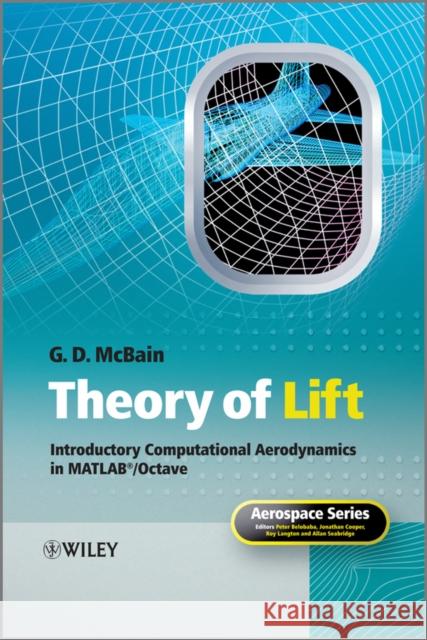
G. D. (University of Sydney) McBain
Theory of Lift: Introductory Computational Aerodynamics in Matlab/Octave G. D. (University of Sydney) McBain 9781119952282 John Wiley & Sons Inc - książkaWidoczna okładka, to zdjęcie poglądowe, a rzeczywista szata graficzna może różnić się od prezentowanej.

Theory of Lift: Introductory Computational Aerodynamics in Matlab/Octave

ISBN-13: 9781119952282 / Angielski / Twarda / 2012 / 342 str.

G. D. (University of Sydney) McBain
cena 437,96
(netto: 417,10 VAT:  5%)

Najniższa cena z 30 dni: 431,72
Termin realizacji zamówienia:
ok. 30 dni roboczych.

Darmowa dostawa!

Starting from a basic knowledge of mathematics and mechanics gained in standard foundation classes, Theory of Lift: Introductory Computational Aerodynamics in MATLAB/Octave takes the reader conceptually through from the fundamental mechanics of lift to the stage of actually being able to make practical calculations and predictions of the coefficient of lift for realistic wing profile and planform geometries. The classical framework and methods of aerodynamics are covered in detail and the reader is shown how they may be used to develop simple yet powerful MATLAB or Octave programs that accurately predict and visualise the dynamics of real wing shapes, using lumped vortex, panel, and vortex lattice methods. This book contains all the mathematical development and formulae required in standard incompressible aerodynamics as well as dozens of small but complete working programs which can be put to use immediately using either the popular MATLAB or free Octave computional modelling packages. Key features:

  • Synthesizes the classical foundations of aerodynamics with hands-on computation, emphasizing interactivity and visualization.
  • Includes complete source code for all programs, all listings having been tested for compatibility with both MATLAB and Octave.
  • Companion website (www.wiley.com/go/mcbain) hosting codes and solutions.
Theory of Lift: Introductory Computational Aerodynamics in MATLAB/Octave is an introductory text for graduate and senior undergraduate students on aeronautical and aerospace engineering courses and also forms a valuable reference for engineers and designers.

Kategorie:
Technologie
Kategorie BISAC:
Technology & Engineering > Aeronautics & Astronautics
Wydawca:
John Wiley & Sons Inc
Seria wydawnicza:
Aerospace
Język:
Angielski
ISBN-13:
9781119952282
Rok wydania:
2012
Numer serii:
000350977
Ilość stron:
342
Waga:
0.68 kg
Wymiary:
24.89 x 17.53 x 2.03
Oprawa:
Twarda
Wolumenów:
01
Dodatkowe informacje:
Bibliografia
Glosariusz/słownik

This book is a very useful digest of key points from the literature, carefully structured and presented with helpful pointers as to how the successive aerodynamical models can be implemented in the now so readily available interactive matrix computation systems.   (Aeronautical Journal, 1 August 2013)

Preface xvii

Series Preface xxiii

PART ONE PLANE IDEAL AERODYNAMICS

1 Preliminary Notions 3
1.2 Aircraft Geometry 5
1.3 Velocity 8
1.4 Properties of Air 8
1.5 Dimensional Theory 13
1.6 Example: NACA Report No. 502 18
1.7 Exercises 19
1.8 Further Reading 22

2 Plane Ideal Flow 25
2.1 Material Properties: The Perfect Fluid 25
2.2 Conservation of Mass 26
2.3 The Continuity Equation 26
2.4 Mechanics: The Euler Equations 27
2.5 Consequences of the Governing Equations 30
2.6 The Complex Velocity 35
2.7 The Complex Potential 41
2.8 Exercises 42
2.9 Further Reading 44

3 Circulation and Lift 47
3.1 Powers of z 47
3.2 Multiplication by a Complex Constant 53
3.3 Linear Combinations of Complex Velocities 54
3.4 Transforming the Whole Velocity Field 56
3.5 Circulation and Outflow 57
3.6 More on the Scalar Potential and Stream Function 61
3.7 Lift 62
3.8 Exercises 64
3.9 Further Reading 65

4 Conformal Mapping 67
4.1 Composition of Analytic Functions 67
4.2 Mapping with Powers of 68
4.3 Joukowsky s Transformation 71
4.4 Exercises 75
4.5 Further Reading 78

5 Flat Plate Aerodynamics 79
5.1 Plane Ideal Flow over a Thin Flat Plate 79
5.2 Application of Thin Aerofoil Theory to the Flat Plate 87
5.3 Aerodynamic Moment 89
5.4 Exercises 90
5.5 Further Reading 91

6 Thin Wing Sections 93
6.1 Thin Aerofoil Analysis 93
6.2 Thin Aerofoil Aerodynamics 98
6.3 Analytical Evaluation of Thin Aerofoil Integrals 101
6.4 Numerical Thin Aerofoil Theory 105
6.5 Exercises 109
6.6 Further Reading 109

7 Lumped Vortex Elements 111
7.1 The Thin Flat Plate at Arbitrary Incidence, Again 111
7.2 Using Two Lumped Vortices along the Chord 114
7.3 Generalization to Multiple Lumped Vortex Panels 117
7.4 General Considerations on Discrete Singularity Methods 117
7.5 Lumped Vortex Elements for Thin Aerofoils 119
7.6 Disconnected Aerofoils 123
7.7 Exercises 125
7.8 Further Reading 125

8 Panel Methods for Plane Flow 127
8.1 Development of the CUSSSP Program 127
8.2 Exercises 137
8.3 Further Reading 139
8.4 Conclusion to Part I: The Origin of Lift 139

PART TWO THREE–DIMENSIONAL IDEAL AERODYNAMICS

9 FiniteWings and Three–Dimensional Flow 143
9.1 Wings of Finite Span 143
9.2 Three–Dimensional Flow 145
9.3 Vector Notation and Identities 145
9.4 The Equations Governing Three–Dimensional Flow 149
9.5 Circulation 150
9.6 Exercises 154
9.7 Further Reading 155

10 Vorticity and Vortices 157
10.1 Streamlines, Stream Tubes, and Stream Filaments 157
10.2 Vortex Lines, Vortex Tubes, and Vortex Filaments 159
10.3 Helmholtz s Theorems 159
10.4 Line Vortices 160
10.5 Segmented Vortex Filaments 161
10.6 Exercises 166
10.7 Further Reading 167

11 Lifting Line Theory 169
11.1 Basic Assumptions of Lifting Line Theory 169
11.2 The Lifting Line, Horseshoe Vortices, and the Wake 169
11.3 The Effect of Downwash 173
11.4 The Lifting Line Equation 174
11.5 The Elliptic Lift Loading 178
11.6 Lift Incidence Relation 180
11.7 Realizing the Elliptic Lift Loading 182
11.8 Exercises 182
11.9 Further Reading 183

12 Nonelliptic Lift Loading 185
12.1 Solving the Lifting Line Equation 185
12.2 Numerical Convergence 188
12.3 Symmetric Spanwise Loading 189
12.4 Exercises 192

13 Lumped Horseshoe Elements 193
13.1 A Single Horseshoe Vortex 193
13.2 Multiple Horseshoes along the Span 195
13.3 An Improved Discrete Horseshoe Model 200
13.4 Implementing Horseshoe Vortices in Octave 203
13.5 Exercises 206
13.6 Further Reading 207

14 The Vortex Lattice Method 209
14.1 Meshing the Mean Lifting Surface of a Wing 209
14.2 A Vortex Lattice Method 212
14.3 Examples of Vortex Lattice Calculations 216
14.4 Exercises 220
14.5 Further Reading 221

PART THREE NONIDEAL FLOW IN AERODYNAMICS

15 Viscous Flow 225
15.1 Cauchy s First Law of Continuum Mechanics 225
15.2 Rheological Constitutive Equations 227
15.3 The Navier Stokes Equations 228
15.4 The No–Slip Condition and the Viscous Boundary Layer 228
15.5 Unidirectional Flows 229
15.6 A Suddenly Sliding Plate 230
15.7 Exercises 234
15.8 Further Reading 234

16 Boundary Layer Equations 237
16.1 The Boundary Layer over a Flat Plate 237
16.2 Momentum Integral Equation 241
16.3 Local Boundary Layer Parameters 243
16.4 Exercises 248
16.5 Further Reading 249

17 Laminar Boundary Layers 251
17.1 Boundary Layer Profile Curvature 251
17.2 Pohlhausen s Quartic Profiles 252
17.3 Thwaites s Method for Laminar Boundary Layers 254
17.4 Exercises 260
17.5 Further Reading 261

18 Compressibility 263
18.1 Steady–State Conservation of Mass 263
18.2 Longitudinal Variation of Stream Tube Section 265
18.3 Perfect Gas Thermodynamics 266
18.4 Exercises 270
18.5 Further Reading 271

19 Linearized Compressible Flow 273
19.1 The Nonlinearity of the Equation for the Potential 273
19.2 Small Disturbances to the Free–Stream 274
19.3 The Uniform Free–Stream 275
19.4 The Disturbance Potential 275
19.5 Prandtl Glauert Transformation 276
19.6 Application of the Prandtl Glauert Rule 279
19.7 Sweep 284
19.8 Exercises 285
19.9 Further Reading 285

Appendix A Notes on Octave Programming 287
A.1 Introduction 287
A.2 Vectorization 287
A.3 Generating Arrays 290
A.4 Indexing 291
A.5 Just–in–Time Compilation 291
A.6 Further Reading 292

References 292

Glossary 293

Nomenclature 305

Index 309

Dr. Geordie Drummond McBain, Australia
Geordie McBain is an engineering consultant based in Sydney, Australia. In 1995 he graduated top of his class from James Cook University with first class honours in mechanical engineering, earning him the Faculty Medal, and went on to receive his PhD there in 1999. In 2002 he was awarded a Sesquicentennial Postdoctoral Fellowship at the University of Sydney, researching fluid dynamics. During this period, he taught aerodynamics to students on the Aeronautical and Aerospace Engineering degree programmes.

Starting from a basic knowledge of mathematics and mechanics gained in standard foundation classes, Theory of Lift: Introductory Computational Aerodynamics in MATLAB/Octave takes the reader conceptually through from the fundamental mechanics of lift  to the stage of actually being able to make practical calculations and predictions of the coefficient of lift for realistic wing profile and planform geometries.

The classical framework and methods of aerodynamics are covered in detail and the reader is shown how they may be used to develop simple yet powerful MATLAB or Octave programs that accurately predict and visualise the dynamics of real wing shapes, using lumped vortex, panel, and vortex lattice methods.

This book contains all the mathematical development and formulae required in standard incompressible aerodynamics as well as dozens of small but complete working programs which can be put to use immediately using either the popular MATLAB or free Octave computional modelling packages.

Key features:

  • Synthesizes the classical foundations of aerodynamics with hands–on computation, emphasizing interactivity and visualization.
  • Includes complete source code for all programs, all listings having been tested for compatibility with both MATLAB and Octave.
  • Companion website (www.wiley.com/go/mcbain) hosting codes and solutions.

Theory of Lift: Introductory Computational Aerodynamics in MATLAB/Octave is an introductory text for graduate and senior undergraduate students on aeronautical and aerospace engineering courses and also forms a valuable reference for engineers and designers.


Udostępnij

Facebook - konto krainaksiazek.pl


Opinie o Krainaksiazek.pl na Opineo.pl

Partner Mybenefit

Krainaksiazek.pl w programie rzetelna firma Krainaksiaze.pl - płatności przez paypal

Czytaj nas na:

Facebook - krainaksiazek.pl
  • książki na zamówienie
  • granty
  • książka na prezent
  • kontakt
  • pomoc
  • opinie
  • regulamin
  • polityka prywatności

Zobacz:

  • Księgarnia czeska

  • Wydawnictwo Książkowe Klimaty

1997-2026 DolnySlask.com Agencja Internetowa

© 1997-2022 krainaksiazek.pl
     
KONTAKT | REGULAMIN | POLITYKA PRYWATNOŚCI | USTAWIENIA PRYWATNOŚCI
Zobacz: Księgarnia Czeska | Wydawnictwo Książkowe Klimaty | Mapa strony | Lista autorów
KrainaKsiazek.PL - Księgarnia Internetowa

Polityka prywatnosci - link
Krainaksiazek.pl - płatnośc Przelewy24
Przechowalnia Przechowalnia






