The Visualization of Spatial Social Structure » książka





The Visualization of Spatial Social Structure
ISBN-13: 9781119962939 / Angielski / Twarda / 2012 / 401 str.
The Visualization of Spatial Social Structure
ISBN-13: 9781119962939 / Angielski / Twarda / 2012 / 401 str.
(netto: 222,95 VAT: 5%)
Najniższa cena z 30 dni: 228,91
ok. 30 dni roboczych.
Darmowa dostawa!
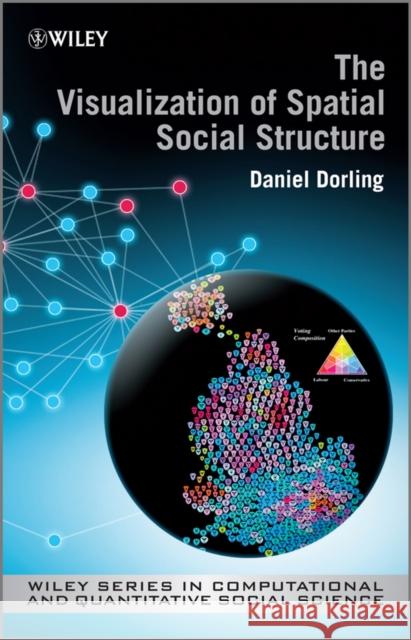
This title introduces new ways of thinking about how to look at social statistics. The author presents a combination of statistical focus and understanding of social structures and innovations in visualization, describing the rationale for, and development of, a new way of visualizing information in geographical research.
Wydanie ilustrowane
“One of the more enjoyable aspects of this book is that every section begins with an interesting quote from the literature, which adds up to 60+ quotes that readers may wish to consult for future reference. A final, light–hearted observation: each chapter is divided into exactly seven sections! In some cultures, this would be interpreted as an attempt to curry favor with fate. Readers will have to decide whether Dorling played a lucky hand in turning his doctoral dissertation into a book, two decades on.” (Journal of Regional Science, 1 October 2013)
List of figures xi
List of text boxes xxi
Preface xxiii
Introduction: Human cartography xxxv
1 Envisioning information 1
1.1 Visual thinking 1
1.2 Pictures over time 4
1.3 Beyond illustration 11
1.4 Texture and colour 13
1.5 Perspective and detail 16
1.6 Pattern and illusion 20
1.7 From mind to mind 24
2 People, spaces and places 31
2.1 Which people? 31
2.2 Why study places? 34
2.3 What are spaces? 40
2.4 Drawing lines 41
2.5 Picturing points 50
2.6 Population space 52
2.7 Adding time 56
3 Artificial reality 59
3.1 Imagining reality 59
3.2 Abstract spaces 60
3.3 Area cartograms 66
3.4 The nature of space 69
3.5 Producing illusions 77
3.6 Population space 81
3.7 Stretching spacetime 85
4 Honeycomb structure 95
4.1 Viewing society 95
4.2 Who the people are 97
4.3 Disparate origins 106
4.4 Lost opportunities 109
4.5 Work, industry and home 114
4.6 How people vote 120
4.7 The social landscape 123
5 Transforming the mosaic 131
5.1 Still images of change 131
5.2 Forming the structure 132
5.3 Structure transformed 136
5.4 Variable employment 138
5.5 House price inflation 143
5.6 Reshaping votes 148
5.7 Erosion and deposition 159
6 Cobweb of flows 167
6.1 What flow is 167
6.2 What flows there are 168
6.3 Unravelling the tangles 171
6.4 Drawing the vortices 177
6.5 Commuting chaos 184
6.6 Migration networks 185
6.7 A space of flows 194
7 On the surface 199
7.1 2D vision, 3D world 199
7.2 Surface definition 202
7.3 Depth cues 209
7.4 Landscape painting 210
7.5 Surface geometry 213
7.6 Travel time surface 220
7.7 Surface value 222
8 The wood and the trees 225
8.1 Sculptured characters 225
8.2 Circles, pies and rings 227
8.3 Bars and pyramids 230
8.4 Flocks of arrows 237
8.5 Trees and castles 238
8.6 Crowds of faces 239
8.7 Information overload 243
9 Volume visualization 251
9.1 The third dimension 251
9.2 Spaces, times and places 252
9.3 Spacetime continuum 259
9.4 Three–dimensional graphs 262
9.5 Flows through time 275
9.6 Volume rendering 279
9.7 Interactive visualization 280
10 Conclusion: Another geography 283
Endnote 297
Acknowledgements 299
Appendix: Drawing faces 301
References 305
Author Index 317
Subject Index 321
Note. The original thesis from which this book was derived had a further six appendices and a larger bibliography. Some can be found at www.dannydorling.org.
Appendix A: Circular Cartogram Algorithm
Appendix B: Parliamentary Constituencies 1955–1987 Continuity
Appendix C: Parliamentary Constituencies 1955–1987 Results
Appendix D: Average Housing Price by Constituency 1983–1989
Appendix E: Scottish Ward to Postcode Sector Look–up Table
Appendix F: Local Government Wards, 1981 and 1987
Daniel Dorling, Professor of Human Geography in the University of Sheffield, UK
Also Adjunct Professor in the Department of Geography, University of Canterbury, New Zealand and Visiting Professor in the Department of Social Medicine, University Bristol, UK.
Daniel Dorling′s research tries to show how far understanding the patterns to people′s lives can be enhanced using statistics about the population. Part of this research involves developing new techniques to analyse and popularise quantitative information about human geography, in particular introducing the use of novel cartographic techniques into geographical research. In 2006, Daniel started working with a group of researchers on a project to remap the world (www.worldmapper.com). Respected in academia as a leader in his field, a Google search on his name also reveals how prevalent his voice is within the mainstream media.
Daniel Dorling has published over 25 books and 400 papers. He is Honorary President of the Society of Cartographers.
How do you draw a map of 100,000 places, of more than a million flows of people, of changes over time and space, of different kinds of spaces, surfaces and volumes, from human travel time to landscapes of hopes, fears, migration, manufacturing and mortality? How do you turn the millions of numbers concerning some of the most important moments of our lives into images that allow us to appreciate the aggregate while still remembering the detail?
The visualization of spatial social structure means, literally, making visible the geographical patterns to the way our lives have come to be socially organised, seeing the geography in society. To a statistical readership visualization implies using data. More widely defined it implies freeing our imaginations.
The Visualization of Spatial Social Structure introduces the reader to new ways of thinking about how to look at social statistics, particularly those about people in places. The author presents a unique combination of statistical focus and understanding of social structures and innovations in visualization, describing the rationale for, and development of, a new way of visualizing information in geographical research. These methods are illustrated through extensive full colour graphics; revealing mistakes, techniques and discoveries which present a picture of a changing political and social geography. More complex aspects on the surface of social landscapes are revealed with sculptured symbols allowing us to see the relationships between the wood and the trees of social structure. Today′s software can be so flexible that these techniques can now be emulated without coding.
This book centres on a particular place and time; 1980s Britain, and a particular set of records; routine social statistics. A great deal of information about the 80s′ social geography of Britain is contained within databases such as the population censuses, surveys and administrative data. Following the release of the 2011 census, now is a good time to look back at the past to introduce many new visualization techniques that could be used by future researchers.




Czytaj nas na:
1997-2026 DolnySlask.com Agencja Internetowa
KrainaKsiazek.PL - Księgarnia Internetowa


