"The Urban Gardens of Havana offers an insightful, detailed, theoretically rigorous and imaginative account of the relationships between urban farmers, the state and nonhuman entities in Cuba ... ." (Sahib Singh, LSE Review of Books, blogs.lse.ac.uk, November 8, 2019)
Prologue: Whose Planet is it Anyway?
Chapter 1. Introduction: Step into my Garden
Anthropological Gardening
The Map into the Garden
Chapter 2. Intervening, Correcting, Rewarding
How It All Began
Revolutionary Fruits and Ideologized Vegetalbes
State Communism
The Prettiest Garden in Town
State Control of Society or Social Control of the State?
Conclusion
Chapter 3. The Garden
The Politics of the Garden
Small, Big, Wide and Narrow: The Urban Gardens of Havana
Intimate Experiences
Non-human Performances
The Human-Non-human Relationship
Caring Collaborations with Plants
Children of the Gardenland
A House is Not a Home
Reverberating Gardents
Tangling Them Together
Chapter 4. Living in a Non-human's World
The Nature We Live By
Becoming the Garden(er)
Freedom and Some Gentle Resistance
The Intimate Quality of Being
Bodily Learning
Gently, Contested, Entangled Freedoms?
Stories of Freedom
Entangling Concluding Remarks
Chapter 5. Conclusion: Finally, How Does Everything Grow Together?
Ola Plonska is an anthropologist and junior researcher affiliated with the department of social and cultural anthropology at the Vrije Universiteit Amsterdam, the Netherlands. She has published in journals such as the Journal for Cultural Research and is interested in human-nature relationships and the politics of food.
Younes Saramifar is the Post-doctoral Einstein Research Fellow at the Humboldt University of Berlin, Germany. His area of research is material culture of resistance movements and paramilitarism, as well as ecological crisis in precarious conditions of the Middle East.
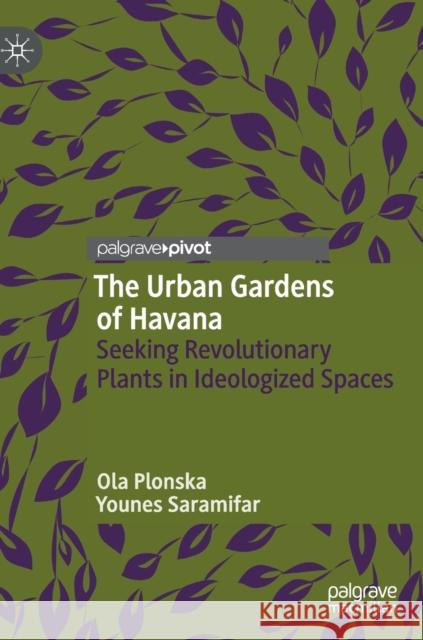
This book relates stories of everyday life revolving around small-scale urban gardens in Central Havana and focusing particularly on that of Marcelo, a seventy-four-year-old revolutionary and gardener. The urban gardens are contested spaces: though monitored and controlled by Cuban state institutions, they also offer possibilities of crafting life in resistance. The experiences the authors narrate are not ‘thick descriptions,’ linked to larger political issues, but rather rhizomatic observations that highlight the relationships between humans and non-humans within the nature-culture debate. Using these experiences, the authors argue that ‘the political’ reaches beyond the affairs of state and governance and should be seen as an all-encompassing part of life. The authors thereby invite the social sciences to focus on the microscopic and the day-to-day to illuminate how the political affairs of lives can be imagined differently.