The Trauma of Defeat: Ricarda Huch's Historiography During the Weimar Republic » książka





The Trauma of Defeat: Ricarda Huch's Historiography During the Weimar Republic
ISBN-13: 9783039107605 / Angielski / Miękka / 2005 / 222 str.
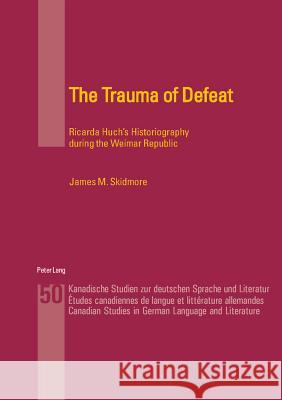
This is the first book-length study to consider Ricarda Huch s historical-political thought and assess Huch s place within the lively historiographical discourses of the 1920s. One of the most famous writers of her day, Huch (1864-1947) was known for her poetry, fiction, and histories of German Romanticism and the Thirty Years War. Like many of her generation Huch was shaken by Germany s defeat in the First World War, and this shock motivated her to use her historiography to address Germany s post-war situation. Convinced that the German nation possessed an identity best expressed by the ideals of Romanticism, Huch attributed Germany s decline to the westernization of German political culture; absolutism and centralization had replaced the theoretical perfection of the decentralized early Holy Roman Empire of the German Nation. Her Weimar histories of medieval and nineteenth-century Germany urged a defeated and traumatized nation to return to a path that had been abandoned during the Wilhelmine Empire. Topics explored include Huch s use of Nietzschean monumentalism, a comparison with popular historians of the period (e.g. E. Kantorowicz), the echoes of her political thought in her poetry and fiction, and her complex relationship to German nationalism."




Czytaj nas na:
KrainaKsiazek.PL - Księgarnia Internetowa


