• Wyszukiwanie zaawansowane
  • Kategorie
  • Kategorie BISAC
  • Książki na zamówienie
  • Promocje
  • Granty
  • Książka na prezent
  • Opinie
  • Pomoc
  • Załóż konto
  • Zaloguj się

The Sun: An Introduction » książka

zaloguj się | załóż konto
Logo Krainaksiazek.pl

koszyk

konto

szukaj
topmenu
Księgarnia internetowa
Szukaj
Książki na zamówienie
Promocje
Granty
Książka na prezent
Moje konto
Pomoc
 
 
Wyszukiwanie zaawansowane
Pusty koszyk
Bezpłatna dostawa dla zamówień powyżej 20 złBezpłatna dostawa dla zamówień powyżej 20 zł

Kategorie główne

• Nauka
 [2949965]
• Literatura piękna
 [1857847]

  więcej...
• Turystyka
 [70818]
• Informatyka
 [151303]
• Komiksy
 [35733]
• Encyklopedie
 [23180]
• Dziecięca
 [617748]
• Hobby
 [139972]
• AudioBooki
 [1650]
• Literatura faktu
 [228361]
• Muzyka CD
 [398]
• Słowniki
 [2862]
• Inne
 [444732]
• Kalendarze
 [1620]
• Podręczniki
 [167233]
• Poradniki
 [482388]
• Religia
 [509867]
• Czasopisma
 [533]
• Sport
 [61361]
• Sztuka
 [243125]
• CD, DVD, Video
 [3451]
• Technologie
 [219309]
• Zdrowie
 [101347]
• Książkowe Klimaty
 [123]
• Zabawki
 [2362]
• Puzzle, gry
 [3791]
• Literatura w języku ukraińskim
 [253]
• Art. papiernicze i szkolne
 [7933]
Kategorie szczegółowe BISAC

The Sun: An Introduction

ISBN-13: 9783540537960 / Angielski / Miękka / 1991 / 390 str.
Michael Stix
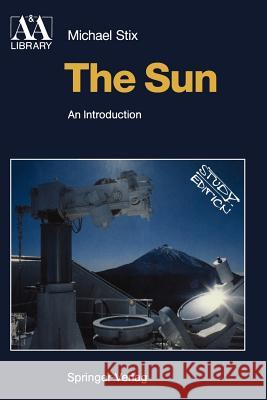
The Sun: An Introduction Michael Stix 9783540537960 Springer-Verlag Berlin and Heidelberg GmbH &  - książkaWidoczna okładka, to zdjęcie poglądowe, a rzeczywista szata graficzna może różnić się od prezentowanej.

The Sun: An Introduction

ISBN-13: 9783540537960 / Angielski / Miękka / 1991 / 390 str.

Michael Stix
cena 201,72
(netto: 192,11 VAT:  5%)

Najniższa cena z 30 dni: 192,74
Termin realizacji zamówienia:
ok. 22 dni roboczych
Bez gwarancji dostawy przed świętami

Darmowa dostawa!

As in all other fields of astronomy, progress in instrumentation and observational techniques has in recent years brought a wealth of new information about the sun. This introduction presents a complete overview of solar physics, of what we know and would like to know. The increasing number of observations of solar pheno- mena on neighbouring stars makes this book valuable not only for students specializing in solar physics but also for researchers interested in stellar structure and the solar-stellar connection.


Kategorie:
Nauka, Fizyka
Kategorie BISAC:
Science > Astronomia, przestrzeń i czas
Science > Astrofizyka
Science > Geofizyka
Wydawca:
Springer-Verlag Berlin and Heidelberg GmbH &
Seria wydawnicza:
Astronomy and Astrophysics Library
Język:
Angielski
ISBN-13:
9783540537960
Rok wydania:
1991
Dostępne języki:
Angielski
Wydanie:
Softcover Repri
Numer serii:
000030573
Ilość stron:
390
Waga:
0.62 kg
Wymiary:
23.523.5 x 15.5
Oprawa:
Miękka
Wolumenów:
01

1. Introduction: The Sun’s Distance, Mass, Radius, Luminosity ....- 1.1 Distance.- 1.2 Mass.- 1.3 Radius.- 1.4 Luminosity.- 1.5 Spectral Energy Distribution.- 1.5.1 Energy Flux and Intensity.- 1.5.2 The Visible.- 1.5.3 The Infrared.- 1.5.4 The Radio Spectrum.- 1.5.5 The Ultraviolet.- 1.5.6 Extreme Ultraviolet and X-Rays.- 1.5.7 Color Indices.- 1.6 Bibliographical Notes.- 2. Internal Structure.- 2.1 Construction of a Model.- 2.1.1 The Evolutionary Sequence.- 2.1.2 The Standard Model.- 2.2 Age and Pre-Main-Sequence Evolution.- 2.3 Model Ingredients.- 2.3.1 Conservation Laws.- 2.3.2 Energy Transport.- 2.3.3 The Equation of State.- 2.3.4 The Entropy.- 2.3.5 Nuclear Energy Sources.- 2.3.6 The Opacity.- 2.3.7 Boundary Conditions and Method of Solution.- 2.4 Results for a Standard Solar Model.- 2.4.1 General Evolution.- 2.4.2 Neutrinos.- 2.5 Non-Standard Models.- 2.5.1 The Low-Z Model.- 2.5.2 Rapidly Rotating Core.- 2.5.3 Internal Magnetic Field.- 2.5.4 The Internally Mixed Model.- 2.6 Bibliographical Notes.- 3. Tools for Solar Observation.- 3.1 Limitations.- 3.1.1 General Difficulties.- 3.1.2 Seeing: Description and Definitions.- 3.1.3 Seeing: How to Live with It.- 3.2 High-Resolution Telescopes.- 3.2.1 Image Scale.- 3.2.2 Mirrors for Fixed Telescopes.- 3.2.3 Telescopes with Long Primary Focus.- 3.2.4 Telescopes with Short Primary Focus.- 3.3 Spectrographs and Spectrometers.- 3.3.1 The Grating Spectrograph.- 3.3.2 The Fourier Transform Spectrometer.- 3.3.3 The Measurement of Line Shifts.- 3.4 Filters and Monochromators.- 3.4.1 The Lyot Filter.- 3.4.2 Tuning; the Universal Filter.- 3.4.3 A Double Monochromator.- 3.4.4 The Spectroheliograph.- 3.5 Magnetic Fields and Polarimetry.- 3.5.1 Zeeman Splitting.- 3.5.2 Polarized Light.- 3.5.3 Unno’s Equations.- 3.5.4 Solar Polarimeters.- 3.6 Special-Purpose Instruments.- 3.6.1 The Pyrheliometer.- 3.6.2 Neutrino Detectors.- 3.6.3 The Coronagraph.- 3.7 Bibliographical Notes.- 4. The Atmosphere.- 4.1 Radiative Transfer — Local Thermodynamic Equilibrium.- 4.1.1 The Equation of Transfer.- 4.1.2 Various Equilibria.- 4.1.3 Absorption Lines in LTE.- 4.2 Radiative Transfer — Statistical Equilibrium.- 4.2.1 Model Assumptions.- 4.2.2 Line Radiation and Einstein Coefficients.- 4.2.3 Continuum Radiation.- 4.2.4 Collisions.- 4.2.5 The Source Function.- 4.2.6 The Equations of Statistical Equilibrium.- 4.3 Atmospheric Models.- 4.3.1 Limb Darkening.- 4.3.2 Model Calculations in LTE.- 4.3.3 Models with Departures from LTE.- 4.4 The Chemical Composition of the Sun.- 4.4.1 Spectrum Synthesis.- 4.4.2 The Light Elements Li, Be, B.- 4.4.3 Helium.- 4.5 Bibliographical Notes.- 5. Oscillations.- 5.1 Observations.- 5.1.1 Five-Minute Oscillations.- 5.1.2 The p-Mode Ridges.- 5.1.3 Low-Degree p Modes.- 5.2 Linear Adiabatic Oscillations of a Non-rotating Sun.- 5.2.1 Basic Equations.- 5.2.2 Spherical Harmonic Representation.- 5.2.3 The Cowling Approximation.- 5.2.4 Local Treatment.- 5.2.5 Boundary Conditions.- 5.2.6 Asymptotic Results.- 5.3 Helioseismology.- 5.3.1 Direct Modelling.- 5.3.2 Inverse Theory: Internal Structure.- 5.3.3 Inverse Theory: Rotation.- 5.4 Excitation and Damping.- 5.4.1 The ? Mechanism.- 5.4.2 Stochastic Excitation by Convection.- 5.5 Bibliographical Notes.- 6. Convection.- 6.1 Stability.- 6.2 Mixing-Length Theory.- 6.2.1 The Local Formalism.- 6.2.2 Numerical Test Calculations.- 6.2.3 Overshoot; A Non-local Formalism.- 6.3 Granulation.- 6.3.1 The Observed Pattern.- 6.3.2 Models.- 6.3.3 Mean Line Profiles.- 6.4 Mesogranulation.- 6.5 Supergranulation.- 6.5.1 The Velocity Field and the Network.- 6.5.2 Convective Nature.- 6.5.3 Rotational Effects.- 6.6 Giant Cells.- 6.6.1 Tracer Results.- 6.6.2 Spectroscopic Results.- 6.7 Bibliographical Notes.- 7. Rotation.- 7.1 Axis of Rotation.- 7.2 Oblateness.- 7.2.1 Origin.- 7.2.2 Measurements.- 7.3 Rotational History.- 7.3.1 The Initial State.- 7.3.2 Torques.- 7.3.3 Rotating Models of the Sun.- 7.4 Surface Observations.- 7.4.1 The Angular Velocity.- 7.4.2 Meridional Circulation.- 7.4.3 Correlation of Flow Components.- 7.5 Models of a Rotating Convection Zone.- 7.5.1 Conservation of Angular Momentum.- 7.5.2 Mean-Field Models.- 7.5.3 Explicit Models.- 7.6 Bibliographical Notes.- 8. Magnetism.- 8.1 Fields and Conducting Matter.- 8.1.1 The Induction Equation.- 8.1.2 Electrical Conductivity on the Sun.- 8.1.3 Frozen Fields.- 8.1.4 The Magnetic Force.- 8.2 Flux Tubes.- 8.2.1 Concentration of Magnetic Flux.- 8.2.2 Observational Evidence for Flux Tubes.- 8.2.3 Vertical Thin Flux Tubes.- 8.2.4 Curved Thin Flux Tubes.- 8.2.5 Thermal Structure of Photospheric Tubes.- 8.3 Sunspots.- 8.3.1 Evolution and Classification.- 8.3.2 Sunspot Models.- 8.3.3 Spots and the “Solar Constant“.- 8.3.4 Dots and Grains.- 8.3.5 Oscillations in Sunspots.- 8.3.6 The Evershed Effect.- 8.4 The Solar Cycle.- 8.4.1 Global Magnetism.- 8.4.2 Mean-Field Electrodynamics.- 8.4.3 The Kinematic ?? Dynamo.- 8.4.4 The Solar Cycle as a Dynamic System.- 8.5 Bibliographical Notes.- 9. Chromosphere, Corona, and Solar Wind.- 9.1 Empirical Facts.- 9.1.1 The Chromosphere.- 9.1.2 The Transition Region.- 9.1.3 The Corona.- 9.1.4 The Wind.- 9.2 Consequences of High Temperature.- 9.2.1 Heat Conduction.- 9.2.2 Expansion.- 9.3 The Magnetic Field in the Outer Atmosphere.- 9.3.1 Magnetic Field Measurements.- 9.3.2 Potential Field Extrapolation.- 9.3.3 The Force-Free Field.- 9.3.4 Prominences.- 9.3.5 Magnetic Braking of Solar Rotation.- 9.4 The Energy Balance.- 9.4.1 Needs.- 9.4.2 Heating.- 9.5 Explosive Events.- 9.5.1 Flares and Other Eruptions.- 9.5.2 Release of Magnetic Energy.- 9.6 Bibliographical Notes.- List of Symbols.- References.

As in all other fields of astronomy, new observational techniques have yielded new results and also posed new questions. The Study Edition of this well-known book by M. Stix contains a complete survey of today's knowledge in solar physics and of the problems to be investigated.


Udostępnij

Facebook - konto krainaksiazek.pl


Opinie o Krainaksiazek.pl na Opineo.pl

Partner Mybenefit

Krainaksiazek.pl w programie rzetelna firma Krainaksiaze.pl - płatności przez paypal

Czytaj nas na:

Facebook - krainaksiazek.pl
  • książki na zamówienie
  • granty
  • książka na prezent
  • kontakt
  • pomoc
  • opinie
  • regulamin
  • polityka prywatności

Zobacz:

  • Księgarnia czeska

  • Wydawnictwo Książkowe Klimaty

1997-2025 DolnySlask.com Agencja Internetowa

© 1997-2022 krainaksiazek.pl
     
KONTAKT | REGULAMIN | POLITYKA PRYWATNOŚCI | USTAWIENIA PRYWATNOŚCI
Zobacz: Księgarnia Czeska | Wydawnictwo Książkowe Klimaty | Mapa strony | Lista autorów
KrainaKsiazek.PL - Księgarnia Internetowa

Polityka prywatnosci - link
Krainaksiazek.pl - płatnośc Przelewy24
Przechowalnia Przechowalnia






