• Wyszukiwanie zaawansowane
  • Kategorie
  • Kategorie BISAC
  • Książki na zamówienie
  • Promocje
  • Granty
  • Książka na prezent
  • Opinie
  • Pomoc
  • Załóż konto
  • Zaloguj się

The Strange Non-Death of Neo-Liberalism » książka


zaloguj się | załóż konto
Logo Krainaksiazek.pl

koszyk

konto

szukaj
topmenu
Księgarnia internetowa
Szukaj
Książki na zamówienie
Promocje
Granty
Książka na prezent
Moje konto
Pomoc
 
 
Wyszukiwanie zaawansowane
Pusty koszyk
Bezpłatna dostawa dla zamówień powyżej 20 złBezpłatna dostawa dla zamówień powyżej 20 zł

Kategorie główne

• Nauka
 [2950560]
• Literatura piękna
 [1849509]

  więcej...
• Turystyka
 [71097]
• Informatyka
 [151150]
• Komiksy
 [35848]
• Encyklopedie
 [23178]
• Dziecięca
 [617388]
• Hobby
 [139064]
• AudioBooki
 [1657]
• Literatura faktu
 [228597]
• Muzyka CD
 [383]
• Słowniki
 [2855]
• Inne
 [445295]
• Kalendarze
 [1464]
• Podręczniki
 [167547]
• Poradniki
 [480102]
• Religia
 [510749]
• Czasopisma
 [516]
• Sport
 [61293]
• Sztuka
 [243352]
• CD, DVD, Video
 [3414]
• Technologie
 [219456]
• Zdrowie
 [101002]
• Książkowe Klimaty
 [124]
• Zabawki
 [2311]
• Puzzle, gry
 [3459]
• Literatura w języku ukraińskim
 [254]
• Art. papiernicze i szkolne
 [8079]
Kategorie szczegółowe BISAC

The Strange Non-Death of Neo-Liberalism

ISBN-13: 9780745651200 / Angielski / Twarda / 2011 / 224 str.
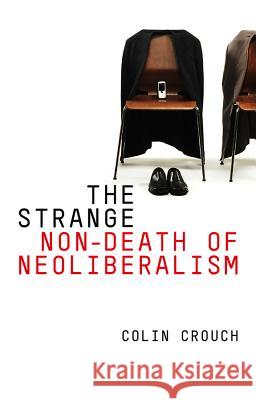
Colin Crouch
The Strange Non-Death of Neo-Liberalism Crouch, Colin 9780745651200 Polity Press - książkaWidoczna okładka, to zdjęcie poglądowe, a rzeczywista szata graficzna może różnić się od prezentowanej.

The Strange Non-Death of Neo-Liberalism

ISBN-13: 9780745651200 / Angielski / Twarda / 2011 / 224 str.

Colin Crouch
cena 255,15
(netto: 243,00 VAT:  5%)

Najniższa cena z 30 dni: 254,10
Termin realizacji zamówienia:
ok. 30 dni roboczych
Dostawa w 2026 r.

Darmowa dostawa!
inne wydania

Winner of the Friedrich Ebert Stiftung prize
The financial crisis seemed to present a fundamental challenge to neo-liberalism, the body of ideas that have constituted the political orthodoxy of most advanced economies in recent decades. Colin Crouch argues in this book that it will shrug off this challenge. The reason is that while neo-liberalism seems to be about free markets, in practice it is concerned with the dominance over public life of the giant corporation. This has been intensified, not checked, by the recent financial crisis and acceptance that certain financial corporations are 'too big to fail'. Although much political debate remains preoccupied with conflicts between the market and the state, the impact of the corporation on both these is today far more important. Several factors have brought us to this situation:

  • Most obviously, the lobbying power of firms whose donations are of growing importance to cash-hungry politicians and parties;
  • The weakening of competitive forces by firms large enough to shape and dominate their markets;
  • The power over public policy exercised by corporations enjoying special relationships with government as they contract to deliver public services;
  • The moral initiative that is grasped by enterprises that devise their own agendas of corporate social responsibility.
Both democratic politics and the free market are weakened by these processes, but they are largely inevitable and not always malign. Hope for the future, therefore, cannot lie in suppressing them in order to attain either an economy of pure markets or a socialist society. Rather it lies in dragging the giant corporation fully into political controversy. Here a key role is played by the small, cash-strapped campaigning groups who, with precious little help from established parties, seek to achieve corporate social accountability.

Kategorie:
Nauka, Historia
Kategorie BISAC:
Political Science > Ekonomia polityczna
Political Science > Public Policy - Economic Policy
Business & Economics > Government & Business
Wydawca:
Polity Press
Język:
Angielski
ISBN-13:
9780745651200
Rok wydania:
2011
Ilość stron:
224
Waga:
0.38 kg
Wymiary:
21.59 x 13.97 x 2.03
Oprawa:
Twarda
Wolumenów:
01
Dodatkowe informacje:
Bibliografia

"A highly approachable and illuminating argument in political economy ... The story is packed with thought–provoking reframings: financial irresponsibility is now a ′collective good′; and ′the idea of a "job"′ now seems very weird to me indeed."
The Guardian

"This highly accessible book makes its case persuasively."
Times Higher Education

"a valuable book that not only gives a very good overview of neo–liberalism and its failings, but also points to government errors and serves as a good primer in such things as imperfect information in markets."
Irish Journal of Sociology

"A rich and powerful book. It pushes towards an analysis of neoliberalism not as the set of liberalizing forces that it depicts itself as being, but rather as a grouping of impulses that have both hampered government and weakened market competition."
Crooked Timber

"An excellent contribution to the study of political economy that directly resolves the puzzle it has identified."
Transfer: European Review of Labour and Research

"A well–reasoned and tightly argued analysis of our present predicament. Although written for the intelligent general reader, rather than subject specialists, his insights constantly provoke and illuminate. Far from being merely a dry dissection of neoliberal theory, the book also addresses how to make corporations behave better."
LSE Politics Blog

"Takes forward and moves beyond Karl Polanyi’s (1957) analysis of state/market relationsto match the changing conditions of the twenty–first century."
Journal of Contemporary European Studies

"The most important work on the political economy of modern capitalism since Keynes, Kalecki and Schonfield."
Philippe C. Schmitter, European University Institute

"Colin Crouch shows how neoliberalism as embodied in large corporations brought about the Great Recession of 2007 and yet, ironically, they profited in wealth and power from it – at everyone else′s expense. A compelling read."
Michael Mann, University of California, Los Angeles

"An excellent contribution to the debate about neoliberalism. Crouch gives us a tightly reasoned and well balanced critique of the neoliberal philosophy that contributed significantly to the 2008 financial crisis. And his call for a more frank discussion in civil society of the moral and ethical assumptions behind neoliberalism is a refreshing addition to the traditional call for simply bringing the state back in to tame market forces."
John L. Campbell, Dartmouth College

Acknowledgements vi

Preface vii

About this Book xi

1 The Previous Career of Neoliberalism 1

2 The Market and Its Limitations 24

3 The Corporate Takeover of the Market 49

4 Private Firms and Public Business 71

5 Privatized Keynesianism: Debt in Place of Discipline 97

6 From Corporate Political Entanglement to Corporate Social Responsibility 125

7 Values and Civil Society 144

8 What′s Left of What′s Right? 162

References 181

Further Reading 184

Index 187

COLIN CROUCH is Professor of Governance and Public Management at Warwick Business School, Fellow of the British Academy, and expert consultant to the Directorate for Public Governance and Territorial Development, OECD. His previous publications include Post–Democracy.

The financial crisis seemed to present a fundamental challenge to neo liberalism, the body of ideas that have constituted the political orthodoxy of most advanced economies in recent decades. Colin Crouch argues in this book that it will shrug off this challenge. The reason is that while neo liberalism seems to be about free markets, in practice it is concerned with the dominance over public life of the giant corporation. This has been intensified, not checked, by the recent financial crisis and acceptance that certain financial corporations are ‘too big to fail′. Although much political debate remains preoccupied with conflicts between the market and the state, the impact of the corporation on both these is today far more important.

Several factors have brought us to this situation:

  • The lobbying power of firms whose donations are of growing importance to cash–hungry politicians and parties
  • The weakening of competitive forces by firms large enough to shape and dominate their markets
  • The moral initiative that is grasped by enterprises that devise their own agendas of corporate social responsibility

Both democratic politics and the free market are weakened by these processes, but they are largely inevitable and not always malign. Hope for the future, therefore, cannot lie in suppressing them in order to attain either an economy of pure markets or a socialist society. Rather it lies in dragging the giant corporation fully into political controversy.


Udostępnij

Facebook - konto krainaksiazek.pl


Opinie o Krainaksiazek.pl na Opineo.pl

Partner Mybenefit

Krainaksiazek.pl w programie rzetelna firma Krainaksiaze.pl - płatności przez paypal

Czytaj nas na:

Facebook - krainaksiazek.pl
  • książki na zamówienie
  • granty
  • książka na prezent
  • kontakt
  • pomoc
  • opinie
  • regulamin
  • polityka prywatności

Zobacz:

  • Księgarnia czeska

  • Wydawnictwo Książkowe Klimaty

1997-2025 DolnySlask.com Agencja Internetowa

© 1997-2022 krainaksiazek.pl
     
KONTAKT | REGULAMIN | POLITYKA PRYWATNOŚCI | USTAWIENIA PRYWATNOŚCI
Zobacz: Księgarnia Czeska | Wydawnictwo Książkowe Klimaty | Mapa strony | Lista autorów
KrainaKsiazek.PL - Księgarnia Internetowa

Polityka prywatnosci - link
Krainaksiazek.pl - płatnośc Przelewy24
Przechowalnia Przechowalnia






