• Wyszukiwanie zaawansowane
  • Kategorie
  • Kategorie BISAC
  • Książki na zamówienie
  • Promocje
  • Granty
  • Książka na prezent
  • Opinie
  • Pomoc
  • Załóż konto
  • Zaloguj się

The Social Psychology of Eating » książka


zaloguj się | załóż konto
Logo Krainaksiazek.pl

koszyk

konto

szukaj
topmenu
Księgarnia internetowa
Szukaj
Książki na zamówienie
Promocje
Granty
Książka na prezent
Moje konto
Pomoc
 
 
Wyszukiwanie zaawansowane
Pusty koszyk
Bezpłatna dostawa dla zamówień powyżej 20 złBezpłatna dostawa dla zamówień powyżej 20 zł

Kategorie główne

• Nauka
 [2946912]
• Literatura piękna
 [1852311]

  więcej...
• Turystyka
 [71421]
• Informatyka
 [150889]
• Komiksy
 [35717]
• Encyklopedie
 [23177]
• Dziecięca
 [617324]
• Hobby
 [138808]
• AudioBooki
 [1671]
• Literatura faktu
 [228371]
• Muzyka CD
 [400]
• Słowniki
 [2841]
• Inne
 [445428]
• Kalendarze
 [1545]
• Podręczniki
 [166819]
• Poradniki
 [480180]
• Religia
 [510412]
• Czasopisma
 [525]
• Sport
 [61271]
• Sztuka
 [242929]
• CD, DVD, Video
 [3371]
• Technologie
 [219258]
• Zdrowie
 [100961]
• Książkowe Klimaty
 [124]
• Zabawki
 [2341]
• Puzzle, gry
 [3766]
• Literatura w języku ukraińskim
 [255]
• Art. papiernicze i szkolne
 [7810]
Kategorie szczegółowe BISAC

The Social Psychology of Eating

ISBN-13: 9783031350696 / Angielski
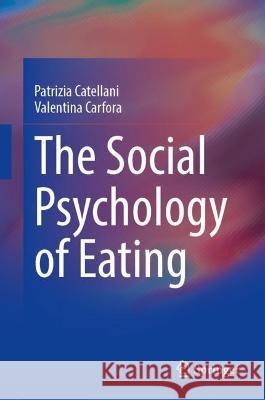
Patrizia Catellani;Valentina Carfora
The Social Psychology of Eating Patrizia Catellani Valentina Carfora  9783031350696 Springer International Publishing AG - książkaWidoczna okładka, to zdjęcie poglądowe, a rzeczywista szata graficzna może różnić się od prezentowanej.

The Social Psychology of Eating

ISBN-13: 9783031350696 / Angielski

Patrizia Catellani;Valentina Carfora
cena 563,56
(netto: 536,72 VAT:  5%)

Najniższa cena z 30 dni: 539,74
Termin realizacji zamówienia:
ok. 22 dni roboczych
Bez gwarancji dostawy przed świętami

Darmowa dostawa!
inne wydania

Our eating decisions are guided by several psychological dimensions: cognitive, emotional, value-based, social, and behavioural. The social psychology of eating helps us understand these dimensions and how we can promote healthy and sustainable eating to improve people's wellbeing. What is most important in deciding what we want to eat? What drives people to go vegan? Do we tend to eat more when we are nervous? Does it change our behavior when we sit at the table with others? Why do we put off starting the diet until the next week? How does online and offline communication influence our eating behaviour? Is it possible to help people change their eating habits thanks to artificial intelligence? These and other questions are answered in this book, with up-to-date literature references and pointers to the most promising developments in the field. An essential text for undergraduate and graduate students, as well as researchers in the fields of psychology and nutrition.


Kategorie:
Nauka, Psychologia
Kategorie BISAC:
Psychology > General
Wydawca:
Springer International Publishing AG
Język:
Angielski
ISBN-13:
9783031350696

Preface


1.            Area of study

1.1          The social psychology of eating

1.2          Food characteristics

1.3          Psychosocial dimension

1.4          Other micro-dimensions

1.5          Macro-dimensions


2.            Processes and stages of choice

2.1          Food choice process

2.2          Theory of planned behavior

2.3          The stages of the choice

2.4          Buying and transporting food

2.5          Preparing food

2.6          Serving food and eating it

2.7          Storing, accumulating, and wasting


3.            Cognitive factors

3.1          Food literacy

3.2          Motives

3.3          Attitudes


4.            Emotional factors

4.1          Emotional eating

4.2          Eating pleasure

4.3          Anticipated emotions


5.            Norms, identities, and values

5.1          Relational factors  and food choices

5.2          Social facilitation

5.3          Impression management and stereotypes

5.4          Modelling and social norms

5.5          Descriptive rules and food choices

5.6          Moderators of the descriptive norms

5.7          Is food shaping conscious or automatic?

5.8          Identity and food choice

5.9          Food values and choices


6.            Habits and behavior change

6.1          Past behavior and habits

6.2          Stages of change

6.3          Feeling effective

6.4          Strengthening knowledge and positive attitudes

6.5          Developing implementation intentions

6.6          Receiving extrinsic and intrinsic rewards

6.7          Establishing achievable goals

6.8          Self-monitoring


7.            Communicating healthy eating

7.1          Communication for change

7.2          Superficial or deep processing

7.3          Message source


8.            Types of messages

8.1          Giving information on health, well-being, environment

8.2          Activating sensory pleasure

8.3          Activating negative or positive emotions

8.4          Giving information or activating emotions?

8.5          Enable descriptive, injunctive, or dynamic norms

8.6          Activating goal setting and self-monitoring

8.7          Message valence

8.8          Factual or prefactual communication


9.            Characteristics of the recipient

9.1          Targeted communication

9.2          Receivers’ profiling criteria

9.3          Regulatory focus

9.4          Motives

9.5          Beliefs and attitudes

9.6          Self-efficacy 

9.7          Stages of change and past behavior


10.          Digital communication and artificial intelligence

10.1        Automatic communication strategies

10.2        Chatbots

10.3        Digital communication risks

10.4        Digital communication opportunities

Patrizia Catellani is a full professor of Social Psychology at the Catholic University of Milan, Italy. She is director of PsyLab (Psychology, Law and Policy Lab). She is a member of the Scientific Advisory Board of the European Social Survey (ESS) and of the PNRR Fostering Open Science in Social Science (FOSSR) research infrastructure. Her research focuses on reasoning, decision making, and communication in different social and political contexts. She has explored how food and health communication can be made more effective in promoting healthy and sustainable purchasing and consumption decisions. An extension of this research direction focuses on the integration of social psychology and artificial intelligence. The goal is to develop digital communication systems that promote health, well-being, and sustainability through personalized framing. Quick profiling is used to identify optimal communication strategies for behaviour change, taking into account individuals’ resources and motivations. Related research areas have explored the impact of prefactual communication aimed at promoting public policy, for example on climate change mitigation and adaptation, by strategically framing possible future scenarios to appeal to and persuade audiences. Other research areas explore how people develop different representations and alternative explanations of events with political, legal, or personal relevance. The focus is on counterfactual reasoning and communication (“If... then...”), and on the conditions that can promote a complete and truthful analysis of events or, conversely, a strategic representation of the past that highlights possible better or worse alternatives that are compatible with one’s own worldview. She is the author of some one hundred and thirty publications, including journal articles and books. The detailed profile and all activities can be found at www.patriziacatellani.com

 Valentina Carfora is a researcher in Social Psychology at the Catholic University of Milan, Italy, and a cognitive behavioural therapist. Her research activity focuses on predicting and promoting healthy and sustainable behaviours, especially related to food choices (e.g., reduced meat consumption, regular consumption of fruits and vegetables). Her main activity is concerned with: socio-cognitive models to explain healthy, environmental and purchasing behaviour; persuasive communication, with particular reference to assessing its effectiveness in changing behaviour (affective messages, cognitive messages, normative messages, self-monitoring messages); personal and social identity, by examining the processes of identity construction and their power to support behaviour change; the role of anticipatory emotions in predicting behaviour change; the role of social norms in promoting sustainable eating habits; the use of artificial intelligence to design tailored communication to promote healthy and sustainable behaviours. She has participated in and coordinated several research projects funded by the European Union, the Lombardy Region, the University of Naples "Federico II", and the Catholic University of Milan. She is the author of about 40 scientific publications, including journal articles and book chapters. She edited the eBook "Mind the Sustainable Food: New Insights in Food Psychology" published by Frontiers in Psychology (2021). She is also a member of the Associazione Italiana Psicologia (AIP) and the Associazione SIPSA (Società Italiana di Psicologia della Salute).


Our eating decisions are guided by several psychological dimensions: cognitive, emotional, value-based, social, and behavioural. The social psychology of eating helps us understand these dimensions and how we can promote healthy and sustainable eating to improve people's wellbeing. What is most important in deciding what we want to eat? What drives people to go vegan? Do we tend to eat more when we are nervous? Does it change our behavior when we sit at the table with others? Why do we put off starting the diet until the next week? How does online and offline communication influence our eating behaviour? Is it possible to help people change their eating habits thanks to artificial intelligence? These and other questions are answered in this book, with up-to-date literature references and pointers to the most promising developments in the field. An essential text for undergraduate and graduate students, as well as researchers in the fields of psychology and nutrition.

  • Basic social psychology concepts to promote healthy and sustainable eating
  • How food choices are guided by cognitive and emotional input
  • Provides a systematic overview of communication strategies for changing eating behavior.


Udostępnij

Facebook - konto krainaksiazek.pl


Opinie o Krainaksiazek.pl na Opineo.pl

Partner Mybenefit

Krainaksiazek.pl w programie rzetelna firma Krainaksiaze.pl - płatności przez paypal

Czytaj nas na:

Facebook - krainaksiazek.pl
  • książki na zamówienie
  • granty
  • książka na prezent
  • kontakt
  • pomoc
  • opinie
  • regulamin
  • polityka prywatności

Zobacz:

  • Księgarnia czeska

  • Wydawnictwo Książkowe Klimaty

1997-2025 DolnySlask.com Agencja Internetowa

© 1997-2022 krainaksiazek.pl
     
KONTAKT | REGULAMIN | POLITYKA PRYWATNOŚCI | USTAWIENIA PRYWATNOŚCI
Zobacz: Księgarnia Czeska | Wydawnictwo Książkowe Klimaty | Mapa strony | Lista autorów
KrainaKsiazek.PL - Księgarnia Internetowa

Polityka prywatnosci - link
Krainaksiazek.pl - płatnośc Przelewy24
Przechowalnia Przechowalnia





