• Wyszukiwanie zaawansowane
  • Kategorie
  • Kategorie BISAC
  • Książki na zamówienie
  • Promocje
  • Granty
  • Książka na prezent
  • Opinie
  • Pomoc
  • Załóż konto
  • Zaloguj się

The Semantic Variability of Absolute Constructions » książka


zaloguj się | załóż konto
Logo Krainaksiazek.pl

koszyk

konto

szukaj
topmenu
Księgarnia internetowa
Szukaj
Książki na zamówienie
Promocje
Granty
Książka na prezent
Moje konto
Pomoc
 
 
Wyszukiwanie zaawansowane
Pusty koszyk
Bezpłatna dostawa dla zamówień powyżej 20 złBezpłatna dostawa dla zamówień powyżej 20 zł

Kategorie główne

• Nauka
 [2946912]
• Literatura piękna
 [1852311]

  więcej...
• Turystyka
 [71421]
• Informatyka
 [150889]
• Komiksy
 [35717]
• Encyklopedie
 [23177]
• Dziecięca
 [617324]
• Hobby
 [138808]
• AudioBooki
 [1671]
• Literatura faktu
 [228371]
• Muzyka CD
 [400]
• Słowniki
 [2841]
• Inne
 [445428]
• Kalendarze
 [1545]
• Podręczniki
 [166819]
• Poradniki
 [480180]
• Religia
 [510412]
• Czasopisma
 [525]
• Sport
 [61271]
• Sztuka
 [242929]
• CD, DVD, Video
 [3371]
• Technologie
 [219258]
• Zdrowie
 [100961]
• Książkowe Klimaty
 [124]
• Zabawki
 [2341]
• Puzzle, gry
 [3766]
• Literatura w języku ukraińskim
 [255]
• Art. papiernicze i szkolne
 [7810]
Kategorie szczegółowe BISAC

The Semantic Variability of Absolute Constructions

ISBN-13: 9789027718969 / Angielski / Miękka / 1984 / 403 str.
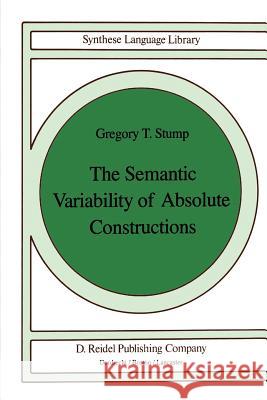
G.T. Stump
The Semantic Variability of Absolute Constructions G.T. Stump 9789027718969 Springer - książkaWidoczna okładka, to zdjęcie poglądowe, a rzeczywista szata graficzna może różnić się od prezentowanej.

The Semantic Variability of Absolute Constructions

ISBN-13: 9789027718969 / Angielski / Miękka / 1984 / 403 str.

G.T. Stump
cena 403,47
(netto: 384,26 VAT:  5%)

Najniższa cena z 30 dni: 385,52
Termin realizacji zamówienia:
ok. 22 dni roboczych
Bez gwarancji dostawy przed świętami

Darmowa dostawa!

The goal of this book is to investigate the semantics of absolute constructions in English; specifically, my object is to provide an explanation for the semantic variability of such constructions. As has been widely noted in traditional grammatical studies of English, free adjuncts and absolute phrases have the ability to playa number of specific logical roles in the sentences in which they appear; yet, paradoxically, they lack any overt indication of their logical connection to the clause which they modify. How, then, is the logical function of an absolute construction determined? In attempting to answer this question, one must inevitably address a number of more general issues: Is the meaning assigned to a linguistic expression necessarily determined by linguistic rules, or can the grammar of a language in some cases simply underdetermine the interpretation of expressions? Are the truthconditions of a sentence ever sensitive to the inferences of language users? If so, then is it possible to maintain the validity of any really substantive version of the Compositionality Principle? These are, of course, issues of great inherent interest to anyone concerned with the formal syntax and semantics of natural language, with the philosophy of language, or with language processing. The descriptive framework assumed throughout is the semantic theory developed by Richard Montague (1970a, 1970b, 1973) and his followers. (For a very thorough introduction to Montague semantics, the reader may refer to Dowty, Wall and Peters (1981 ).


Kategorie:
Nauka, Językoznawstwo
Kategorie BISAC:
Language Arts & Disciplines > Linguistics - Semantics
Philosophy > Reference
Language Arts & Disciplines > Grammar & Punctuation
Wydawca:
Springer
Seria wydawnicza:
Studies in Linguistics and Philosophy
Język:
Angielski
ISBN-13:
9789027718969
Rok wydania:
1984
Dostępne języki:
Angielski
Wydanie:
Softcover Repri
Numer serii:
000171771
Ilość stron:
403
Waga:
0.65 kg
Wymiary:
23.523.5 x 15.5
Oprawa:
Miękka
Wolumenów:
01
Dodatkowe informacje:
Bibliografia

I. The Semantic Variability of Free Adjuncts and Absolutes.- 1. Introduction to Free Adjuncts and Absolutes in English.- 1.1. The Free Adjunct Construction.- 1.2. The Nominative and Augmented Absolute Constructions.- 2. Traditional Thoughts on the Semantic Variability of Free Adjuncts and Absolutes.- 3. Plan of Discussion.- 4. Some Syntactic Conventions.- 4.1. Binary Features.- 4.2. Morphological Functions.- 4.3. Main Verb Marking.- 4.4. Subject Marking.- 4.5. Syntactic Subroutines.- Footnotes.- II. Modality and the Interpretation of Free Adjuncts.- 1. The Semantic Bifurcation of Free Adjuncts in Modal Contexts.- 2. Explaining the Entailment Properties of Strong and Weak Adjuncts in Modal Contexts.- 2.1. Kratzer’s Theory of Conditional Modality.- 2.2. The Roles of Strong and Weak Adjuncts in Modal Sentences.- 2.2.1. Weak Adjuncts in Modal Contexts.- 2.2.2. Strong Adjuncts in Modal Contexts.- 3. A Semantic Correlate of the Distinction between Strong and Weak Adjuncts.- 3.1. Carlson’s Ontology of Stages and Individuals.- 3.2. A Categorial Distinction between Stage-level and Individual-level Predicates.- 3.2.1 Be1 ? PIV i/PREDs.- 3.2.2 Be2 ? PIV i/PREDi.- 3.2.3 Be3 ? PIV s/PREDi.- 3.2.4 Be4 ? PIV s/PREDs.- 3.3. The Stage/Individual Distinction as a Semantic Correlate of the Weak/Strong Distinction.- 3.4. Adjuncts with As and With.- 4. Chapter Summary.- Footnotes.- III. Tense and the Interpretation of Free Adjuncts.- 1. Preliminaries.- 1.1. Interval Semantics.- 1.2. Temporal Abstracts.- 1.2.1. Rules of Tense.- 1.2.2. Shifting and Nonshifting Tenses.- 1.3. Two Categories of Time Adverbs.- 1.3.1. Time Adverbs of Category TA.- 1.3.2. Time Adverbs of Category MTA.- 1.4. The Semantics of Temporal Adverbial Clauses.- 1.4.1. The Analysis of Tense in Temporal Adverbial Clauses.- 1.4.2. Unbounded Dependencies in Temporal Adverbial Clauses.- 1.4.3. Temporal Adverbial Clauses with Main Tense Adverbs.- 1.4.4. Remarks on Some Unacceptable Temporal Adverbials.- 1.4.5. Remarks on the Assumed Truthconditions for Temporal Adverbial Clauses.- 1.4.5.1. When.- 1.4.5.2. While.- 1.4.5.3. Before.- 1.4.5.4. After.- 1.5. Summary of Tense and Time Adverb System.- 2. The Temporal Reference of Free Adjuncts.- 2.1. A-Abstracts.- 2.2. Deriving Conditional Adjuncts.- 2.3. Deriving Adsentential Adjuncts.- 3. Frequency Adverbs and the Distinction between Strong and Weak Adjuncts.- 3.1. The Semantics of Relative Frequency Adverbs.- 3.2. Adjuncts Restricting the Interpretation of Relative Frequency Adverbs.- 4. A Generalization Operator.- 4.1. Two Sorts of Interpretations for Temporal Adverbial Clauses.- 4.2. Generalization Operators.- 4.3. Adjuncts Restricting the Generalization Operator G”.- 5. Chapter Summary.- Footnotes.- IV. Aspect and the Interpretation of Free Adjuncts.- 1. The Perfect Tense and the Interpretation of Free Adjuncts.- 1.1. The Semantic Unspecificity of the Perfect.- 1.2. The Formal Semantics of the Perfect in Finite Clauses.- 1.3. The Formal Semantics of the Perfect in Free Adjuncts.- 2. An Argument for Free Adjuncts as Main Tense Adverbs.- 3. The Progressive Aspect and the Interpretation of Free Adjuncts.- 3.1. The Semantics of Present Participial Phrases.- 3.2. The Formal Semantics of Present Participial Adjuncts.- 4. Chapter Summary.- Footnotes.- V. The Formal Semantics of Absolutes.- 1. Modality and the Interpretation of Absolutes.- 1.1. Weak and Strong Absolutes.- 1.2. Formalizing the Distinction Between Strong and Weak Absolutes.- 1.3. Deriving Conditional Absolutes.- 2. Tense and the Interpretation of Absolutes.- 2.1. Absolutes and Relative Frequency Adverbs.- 2.2. Absolutes and the Generalization Operator G”.- 3. Absolutes as Main Tense Adverbs.- 4. Chapter Summary.- Footnotes.- VI. Inference and the Logical Role of Free Adjuncts and Absolutes.- 1. Summary of the Proposed Semantic Analysis of Free Adjuncts and Absolutes.- 2. The Role of Inference in the Interpretation of Free Adjuncts and Absolutes.- 2.1. Two Kinds of Inferences.- 2.2. Inferences, Adjuncts, and Absolutes.- 2.2.1. Carlson’s Ontology.- 2.2.2. Instantaneousness.- 2.2.3. Word Order.- 2.2.4. Knowledge of the World.- 2.2.5. Connective Adverbs.- 2.3. Pragmatically Admissible Values for L and M.- 3. On the Possibility of Deriving Absolute Constructions from Adverbial Subordinate Clauses.- 4. On the Possibility that the Logical Role of an Absolute Construction is Always Inferred.- 5. Theoretical Implications.- Footnotes.- Appendix - A Formal Fragment for Free Adjuncts and Absolutes.- 1. Intensional Logic.- 2. Syntax and Translation Rules for a Fragment of English.- 2.1. Syntax.- 2.2. Translation.- References.- Index of Names.- General Index.


Udostępnij

Facebook - konto krainaksiazek.pl


Opinie o Krainaksiazek.pl na Opineo.pl

Partner Mybenefit

Krainaksiazek.pl w programie rzetelna firma Krainaksiaze.pl - płatności przez paypal

Czytaj nas na:

Facebook - krainaksiazek.pl
  • książki na zamówienie
  • granty
  • książka na prezent
  • kontakt
  • pomoc
  • opinie
  • regulamin
  • polityka prywatności

Zobacz:

  • Księgarnia czeska

  • Wydawnictwo Książkowe Klimaty

1997-2025 DolnySlask.com Agencja Internetowa

© 1997-2022 krainaksiazek.pl
     
KONTAKT | REGULAMIN | POLITYKA PRYWATNOŚCI | USTAWIENIA PRYWATNOŚCI
Zobacz: Księgarnia Czeska | Wydawnictwo Książkowe Klimaty | Mapa strony | Lista autorów
KrainaKsiazek.PL - Księgarnia Internetowa

Polityka prywatnosci - link
Krainaksiazek.pl - płatnośc Przelewy24
Przechowalnia Przechowalnia






