• Wyszukiwanie zaawansowane
  • Kategorie
  • Kategorie BISAC
  • Książki na zamówienie
  • Promocje
  • Granty
  • Książka na prezent
  • Opinie
  • Pomoc
  • Załóż konto
  • Zaloguj się

The Representation of Old Truths in T.S. Eliot's New Verse » książka


zaloguj się | załóż konto
Logo Krainaksiazek.pl

koszyk

konto

szukaj
topmenu
Księgarnia internetowa
Szukaj
Książki na zamówienie
Promocje
Granty
Książka na prezent
Moje konto
Pomoc
 
 
Wyszukiwanie zaawansowane
Pusty koszyk
Bezpłatna dostawa dla zamówień powyżej 20 złBezpłatna dostawa dla zamówień powyżej 20 zł

Kategorie główne

• Nauka
 [2952079]
• Literatura piękna
 [1850969]

  więcej...
• Turystyka
 [71058]
• Informatyka
 [151066]
• Komiksy
 [35579]
• Encyklopedie
 [23181]
• Dziecięca
 [620496]
• Hobby
 [139036]
• AudioBooki
 [1646]
• Literatura faktu
 [228729]
• Muzyka CD
 [379]
• Słowniki
 [2932]
• Inne
 [445708]
• Kalendarze
 [1409]
• Podręczniki
 [164793]
• Poradniki
 [480107]
• Religia
 [510956]
• Czasopisma
 [511]
• Sport
 [61267]
• Sztuka
 [243299]
• CD, DVD, Video
 [3411]
• Technologie
 [219640]
• Zdrowie
 [100984]
• Książkowe Klimaty
 [124]
• Zabawki
 [2281]
• Puzzle, gry
 [3363]
• Literatura w języku ukraińskim
 [258]
• Art. papiernicze i szkolne
 [8020]
Kategorie szczegółowe BISAC

The Representation of Old Truths in T.S. Eliot's New Verse

ISBN-13: 9781137590572 / Angielski / Twarda / 2015 / 100 str.
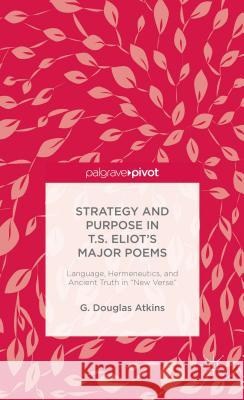
G. Douglas Atkins
The Representation of Old Truths in T.S. Eliot's New Verse G. Douglas Atkins 9781137590572 Palgrave Pivot - książkaWidoczna okładka, to zdjęcie poglądowe, a rzeczywista szata graficzna może różnić się od prezentowanej.

The Representation of Old Truths in T.S. Eliot's New Verse

ISBN-13: 9781137590572 / Angielski / Twarda / 2015 / 100 str.

G. Douglas Atkins
cena 201,72
(netto: 192,11 VAT:  5%)

Najniższa cena z 30 dni: 192,74
Termin realizacji zamówienia:
ok. 22 dni roboczych.

Darmowa dostawa!

Continuing his explorations of T. S. Eliot's most captivating yet difficult works, G. Douglas Atkins' new and insightful book takes on the question of Eliot and hermeneutics: understanding and being understood, putting-in-other-words, and, in Eliot's own words, 'restoring/ With a new verse the ancient rhyme.' This perspective opens new paths towards the elucidation of Ash-Wednesday and Four Quartets, in particular. Addressed to both the specialist and the non-specialist, the close, meditative readings that form the center of this engaging book mirror its subject, capturing an instance of the 'impossible union' of differences and opposites that lay at the heart of Eliot's Incarnational understanding.


Kategorie:
Nauka, Literaturoznawstwo
Kategorie BISAC:
Literary Criticism > American - General
Literary Criticism > Poetry
Poetry > European - English, Irish, Scottish, Welsh
Wydawca:
Palgrave Pivot
Język:
Angielski
ISBN-13:
9781137590572
Rok wydania:
2015
Wydanie:
2015
Ilość stron:
100
Waga:
0.25 kg
Wymiary:
21.59 x 13.97 x 0.79
Oprawa:
Twarda
Wolumenów:
01
Dodatkowe informacje:
Bibliografia
Obwoluta
Wydanie ilustrowane

Anthony Cuda, Associate Professor of English, University of North Carolina, Greensboro, USA

This is a brief and approachable work of literary criticism-written by an accomplished scholar in lucid prose-that allows readers to see a difficult modernist poet from a useful perspective. While this perspective may not ultimately prove of enduring significance to Eliot studies, the book is engaging, well written, and will benefit students and general readers; I recommend publication.

Overview and synopsis:
Atkins analyzes a selection of Eliot's major poetry by using the concept that he calls 'putting in other words,' a phrase that aims to convey how readers and writers understand words by 'translating' them into other words. The phrase allows Atkins to illustrate the similarities between Eliot as a poet (who adapts and translates texts, both his own and others') and his readers (who must interpret Eliot's poems by similar means). It is also an umbrella concept that allows him to address key issues in Eliot's thinking, including the relationship between tradition and innovation, the question of language and its efficacy, the problem of the divided self, and theological matters pertaining to Incarnation and the sacred. The conceptual framework is essentially hermeneutic and implicitly (though perhaps not intentionally) owes its linguistic bias to Hans Georg Gadamer, who viewed knowledge and understanding as the products of ongoing interpretative conversations in which each participant translates the other's language into his or her own.

The book proceeds roughly chronologically, with an introductory chapter that helps to define his terms and that gestures toward the enduring importance of the theme. Three body chapters address three major poems of Eliot's career, including The Waste Land, Ash-Wednesday, and Four Quartets, each with the aim of demonstrating how 'putting in other words' (what one may refer to as translation) helps readers to discern both (1) new ways of understanding particular poems and (2) unifying threads across poems and Eliot's career more generally. A concluding chapter meditates briefly upon the implications of Atkins's argument for our understanding of the kinds of knowledge that literature can offer. Atkins aims to use a method that mirrors his subject by including frequent and often lengthy quotations and then translating them into 'other words.'

Critical analysis:
Atkins does indeed interpret Eliot's poems with insight and lucidity, and the concept of 'putting in other words' proves a surprisingly useful way to think about the unity of Eliot's career as well as the acts of reading and interpretation that his work informs and influences. The chapter on The Waste Land is perhaps the least persuasive because it focuses so exclusively on very selective portions of the text (and perhaps because, by intention, it does not account for the vast array of scholarship on the poem). The fourth chapter (on Four Quartets) is the strongest because that each poem in that sequence dramatically echoes and translates themes from Eliot's earlier work and from earlier poems in the sequence. This iterative richness lends itself to Atkins's method, which is best when explaining how the new builds upon (translates or 'rhymes' with, in his phrase) the old.

I found the passages of distinct personal voice in the preface and the final chapter to be engaging and compelling; they reflect openly upon the scholarly life of this expert reader, and I wished for more of them. Conversely, I found the a weakness of the book to be a frequent paucity of commentary and interpretation following passages that the author quotes. On p. 10, for instance, Atkins could expound upon the key elements of this passage more fully; otherwise, why include it at such great length? Other instances appear on pp. 28 and 29, and pp. 30 and 31. I was struck by the seemingly unreflective use of dogmatic Christian terminology in chapter 3: Atkins refers

Preface
1. Introductory Essay: True Wit and 'the Really New'
2. In Other Words, Death by Water, or 'The Burial of the Dead': The New Verse of The Waste Land
3. The Word and Other Words: Ash-Wednesday: Six Poems
4. Restored in the New Verse of Four Quartets: The 'Ancient Rhyme' of Incarnation
5. A Short Essay concerning Literary Knowledge
Bibliography

G. Douglas Atkins is Professor Emeritus of English at the University of Kansas, USA, where he taught for 44 years. The winner of several awards for outstanding teaching, he is the author of twenty-two books and co-editor of three others, many of them published by Palgrave Macmillan. He now lives in Greenville, SC, and continues to write.

Continuing his explorations of T. S. Eliot's most captivating yet difficult works, G. Douglas Atkins' new and insightful book takes on the question of Eliot and hermeneutics: understanding and being understood, putting-in-other-words, and, in Eliot's own words, 'restoring/ With a new verse the ancient rhyme.' This perspective opens new paths towards the elucidation of Ash-Wednesday and Four Quartets, in particular. Addressed to both the specialist and the non-specialist, the close, meditative readings that form the center of this engaging book mirror its subject, capturing an instance of the 'impossible union' of differences and opposites that lay at the heart of Eliot's Incarnational understanding.

Atkins, G. Douglas G. Douglas Atkins is Professor of English at the U... więcej >


Udostępnij

Facebook - konto krainaksiazek.pl


Opinie o Krainaksiazek.pl na Opineo.pl

Partner Mybenefit

Krainaksiazek.pl w programie rzetelna firma Krainaksiaze.pl - płatności przez paypal

Czytaj nas na:

Facebook - krainaksiazek.pl
  • książki na zamówienie
  • granty
  • książka na prezent
  • kontakt
  • pomoc
  • opinie
  • regulamin
  • polityka prywatności

Zobacz:

  • Księgarnia czeska

  • Wydawnictwo Książkowe Klimaty

1997-2026 DolnySlask.com Agencja Internetowa

© 1997-2022 krainaksiazek.pl
     
KONTAKT | REGULAMIN | POLITYKA PRYWATNOŚCI | USTAWIENIA PRYWATNOŚCI
Zobacz: Księgarnia Czeska | Wydawnictwo Książkowe Klimaty | Mapa strony | Lista autorów
KrainaKsiazek.PL - Księgarnia Internetowa

Polityka prywatnosci - link
Krainaksiazek.pl - płatnośc Przelewy24
Przechowalnia Przechowalnia





