• Wyszukiwanie zaawansowane
  • Kategorie
  • Kategorie BISAC
  • Książki na zamówienie
  • Promocje
  • Granty
  • Książka na prezent
  • Opinie
  • Pomoc
  • Załóż konto
  • Zaloguj się

The Relevance of the Time Domain to Neural Network Models » książka


zaloguj się | załóż konto
Logo Krainaksiazek.pl

koszyk

konto

szukaj
topmenu
Księgarnia internetowa
Szukaj
Książki na zamówienie
Promocje
Granty
Książka na prezent
Moje konto
Pomoc
 
 
Wyszukiwanie zaawansowane
Pusty koszyk
Bezpłatna dostawa dla zamówień powyżej 20 złBezpłatna dostawa dla zamówień powyżej 20 zł

Kategorie główne

• Nauka
 [2946600]
• Literatura piękna
 [1856966]

  więcej...
• Turystyka
 [72221]
• Informatyka
 [151456]
• Komiksy
 [35826]
• Encyklopedie
 [23190]
• Dziecięca
 [619653]
• Hobby
 [140543]
• AudioBooki
 [1577]
• Literatura faktu
 [228355]
• Muzyka CD
 [410]
• Słowniki
 [2874]
• Inne
 [445822]
• Kalendarze
 [1744]
• Podręczniki
 [167141]
• Poradniki
 [482898]
• Religia
 [510455]
• Czasopisma
 [526]
• Sport
 [61590]
• Sztuka
 [243598]
• CD, DVD, Video
 [3423]
• Technologie
 [219201]
• Zdrowie
 [101638]
• Książkowe Klimaty
 [124]
• Zabawki
 [2473]
• Puzzle, gry
 [3898]
• Literatura w języku ukraińskim
 [254]
• Art. papiernicze i szkolne
 [8170]
Kategorie szczegółowe BISAC

The Relevance of the Time Domain to Neural Network Models

ISBN-13: 9781461429920 / Angielski / Miękka / 2013 / 226 str.
A. Ravishankar Rao; Guillermo A. Cecchi
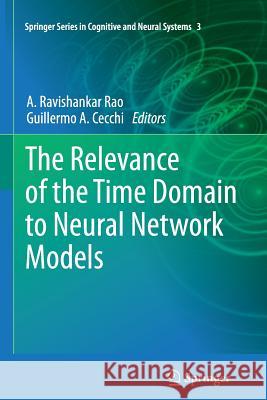
The Relevance of the Time Domain to Neural Network Models A. Ravishankar Rao Guillermo A. Cecchi 9781461429920 Springer - książkaWidoczna okładka, to zdjęcie poglądowe, a rzeczywista szata graficzna może różnić się od prezentowanej.

The Relevance of the Time Domain to Neural Network Models

ISBN-13: 9781461429920 / Angielski / Miękka / 2013 / 226 str.

A. Ravishankar Rao; Guillermo A. Cecchi
cena 605,23 zł
(netto: 576,41 VAT:  5%)

Najniższa cena z 30 dni: 578,30 zł
Termin realizacji zamówienia:
ok. 22 dni roboczych
Bez gwarancji dostawy przed świętami

Darmowa dostawa!
inne wydania

A significant amount of effort in neural modeling is directed towards understanding the representation of information in various parts of the brain, such as cortical maps 6], and the paths along which sensory information is processed. Though the time domain is integral an integral aspect of the functioning of biological systems, it has proven very challenging to incorporate the time domain effectively in neural network models. A promising path that is being explored is to study the importance of synchronization in biological systems. Synchronization plays a critical role in the interactions between neurons in the brain, giving rise to perceptual phenomena, and explaining multiple effects such as visual contour integration, and the separation of superposed inputs. The purpose of this book is to provide a unified view of how the time domain can be effectively employed in neural network models. A first direction to consider is to deploy oscillators that model temporal firing patterns of a neuron or a group of neurons. There is a growing body of research on the use of oscillatory neural networks, and their ability to synchronize under the right conditions. Such networks of synchronizing elements have been shown to be effective in image processing and segmentation tasks, and also in solving the binding problem, which is of great significance in the field of neuroscience. The oscillatory neural models can be employed at multiple scales of abstraction, ranging from individual neurons, to groups of neurons using Wilson-Cowan modeling techniques and eventually to the behavior of entire brain regions as revealed in oscillations observed in EEG recordings. A second interesting direction to consider is to understand the effect of different neural network topologies on their ability to create the desired synchronization. A third direction of interest is the extraction of temporal signaling patterns from brain imaging data such as EEG and fMRI. Hence this Special Session is of emerging interest in the brain sciences, as imaging techniques are able to resolve sufficient temporal detail to provide an insight into how the time domain is deployed in cognitive function. The following broad topics will be covered in the book: Synchronization, phase-locking behavior, image processing, image segmentation, temporal pattern analysis, EEG analysis, fMRI analyis, network topology and synchronizability, cortical interactions involving synchronization, and oscillatory neural networks. This book will benefit readers interested in the topics of computational neuroscience, applying neural network models to understand brain function, extracting temporal information from brain imaging data, and emerging techniques for image segmentation using oscillatory networks


Kategorie:
Informatyka
Kategorie BISAC:
Computers > Machine Theory
Computers > Artificial Intelligence - General
Medical > Neuroscience
Wydawca:
Springer
Seria wydawnicza:
Springer Series in Cognitive and Neural Systems
Język:
Angielski
ISBN-13:
9781461429920
Rok wydania:
2013
Wydanie:
2012
Numer serii:
000405989
Ilość stron:
226
Waga:
0.34 kg
Wymiary:
23.39 x 15.6 x 1.3
Oprawa:
Miękka
Wolumenów:
01
Dodatkowe informacje:
Wydanie ilustrowane

Acknowledgements Foreword 1. Introduction 2. Adaptation and contraction theory for the synchronization of complex neural networks 3. Temporal Coding is not only about Cooperation - it is also about Competition 4. Using Non-Oscillatory Dynamics to Disambiguate Simultaneous Patterns 5. Functional constraints on network topology via generalized sparse representations 6. Evolution of Time in Neural Networks: From the Present to the Past, and Forward to the Future 7. Synchronization of Coupled Pulse-Type Hardware Neuron Models for CPG Model 8. A Universal Abstract-Time Platform for Real-Time Neural Networks 9. Solving Complex Control Tasks via Simple Rule(s): Using Chaotic Dynamics in a Recurrent Neural Network Model 10. Time scale analysis of neuronal ensemble data used to feed neural network models 11. Simultaneous EEG-fMRI: Integrating Spatial and Temporal Resolution

A significant amount of effort in neural modeling is directed towards understanding the representation of external objects in the brain. There is also a rapidly growing interest in modeling the intrinsically-generated activity in the brain, as represented by the default mode network hypothesis, and the emergent behavior that gives rise to critical phenomena such as neural avalanches. Time plays a critical role in these intended modeling domains, from the exquisite discriminations in the mammalian auditory system to the precise timing involved in high-end activities such as competitive sports or professional music performance.

The growth in experimental high-throughput neuroscience techniques has allowed the multi-scale acquisition of neural signals, from individual electrode recordings to whole-brain functional magnetic resonance imaging activity, including the ability to manipulate neural signals with optogenetic approaches. This has created a deluge of experimental data, spanning multiple spatial and temporal scales, and posing the enormous challenge of its interpretation in terms of a predictive theory of brain function. In addition, there has been a massive growth in availability of computational power through parallel computing.

The Relevance of the Time Domain to Neural Network Models aims to develop a unified view of how the time domain can be effectively employed in neural network models. The book proposes that conceptual models of neural interaction are required in order to understand the data being collected. Simultaneously, these proposed models can be used to form hypotheses of neural interaction and system behavior that can be neuroscientifically tested. The book concentrates on a crucial aspect of brain modeling: the nature and functional relevance of temporal interactions in neural systems.

This book will appeal to a wide audience consisting of computer scientists and electrical engineers interested in brain-like computational mechanisms, computer architects exploring the development of high-performance computing systems to support these computations, neuroscientists probing the neural code and signaling mechanisms, mathematicians and physicists interested in modeling complex biological phenomena, and graduate students in all these disciplines who are searching for challenging research questions.

Rao, A. Ravishankar A. Ravishankar Rao is a research staff member with... więcej >
Cecchi, Guillermo A. Guillermo Cecchi is a Research Staff Member at IBM... więcej >


Udostępnij

Facebook - konto krainaksiazek.pl


Opinie o Krainaksiazek.pl na Opineo.pl

Partner Mybenefit

Krainaksiazek.pl w programie rzetelna firma Krainaksiaze.pl - płatności przez paypal

Czytaj nas na:

Facebook - krainaksiazek.pl
  • książki na zamówienie
  • granty
  • książka na prezent
  • kontakt
  • pomoc
  • opinie
  • regulamin
  • polityka prywatności

Zobacz:

  • Księgarnia czeska

  • Wydawnictwo Książkowe Klimaty

1997-2025 DolnySlask.com Agencja Internetowa

© 1997-2022 krainaksiazek.pl
     
KONTAKT | REGULAMIN | POLITYKA PRYWATNOŚCI | USTAWIENIA PRYWATNOŚCI
Zobacz: Księgarnia Czeska | Wydawnictwo Książkowe Klimaty | Mapa strony | Lista autorów
KrainaKsiazek.PL - Księgarnia Internetowa

Polityka prywatnosci - link
Krainaksiazek.pl - płatnośc Przelewy24
Przechowalnia Przechowalnia





