Foreword: “A Time for Choosing” Then and Now: Ronald Reagan’s Message and Young Americans”
Stewart McLaurin
Introduction: “A Time for Choosing:” The Speech’s Influence from 1964 to 2014
Jeffry Morrison
The Intellectual Roots of Reagan’s Foreign Policy
Ionut C. Popescu
Ronald Reagan’s Continuing Legacy in European Policy Debates
Claire Berlinski
“The Speech:” Reagan, the Russians, and the Bomb
Stephen Knott
Preserving America’s Written Constitution: Reagan's Defense of Ordered Liberty
Darren Patrick Guerra
American Exceptionalism and the Reagan Doctrine: The Belief that Won the Cold War
Joseph Loconte
The Speech and Domestic Policy: Reagan’s Liberal Anti-Socialism
Ryan T. Anderson Ideas that Travel: Coolidge, Reagan, and Conservative Economic Policy
Amity Shlaes
Ronald Reagan’s “A Time for Choosing:” A Christian Realist Reading
Eric Patterson
Eric D. Patterson is Dean and Professor at the Robertson School of Government at Regent University, USA, and Research Fellow at Georgetown University’s Berkley Center for Religion, Peace and World Affairs, USA.
Jeffry H. Morrison is Professor of Government at Regent University, USA, and Director of Academics at the federal government's James Madison Foundation in Virginia, USA.
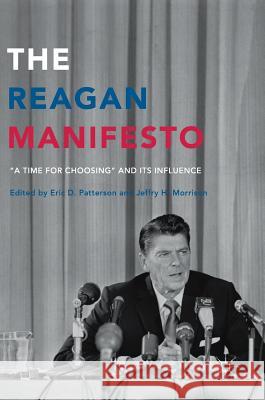
This book examines how Ronald Reagan’s electrifying 1964 televised speech, “A Time For Choosing,” ignited the conservative movement within the GOP. Ronald Reagan’s televised speech, or what many conservatives today simply call “The Speech,” was a call for action, telling Americans that now was “A Time for Choosing.” “The Speech” catapulted Reagan into national politics, the California governorship, and ultimately the presidency. The themes of the speech, including anti-Communism, strong national defense, and the need to protect the average American from taxes and bureaucracy, ignited the conservative movement in the GOP, resulting over time in the sidelining of the more liberal, establishment wing of the Republican Party. The contributors in this edited volume show how Ronald Reagan’s “coming out” speech on the national stage helped set the political agenda for the next three decades.