• Wyszukiwanie zaawansowane
  • Kategorie
  • Kategorie BISAC
  • Książki na zamówienie
  • Promocje
  • Granty
  • Książka na prezent
  • Opinie
  • Pomoc
  • Załóż konto
  • Zaloguj się

The Rational as Reasonable: A Treatise on Legal Justification » książka


zaloguj się | załóż konto
Logo Krainaksiazek.pl

koszyk

konto

szukaj
topmenu
Księgarnia internetowa
Szukaj
Książki na zamówienie
Promocje
Granty
Książka na prezent
Moje konto
Pomoc
 
 
Wyszukiwanie zaawansowane
Pusty koszyk
Bezpłatna dostawa dla zamówień powyżej 20 złBezpłatna dostawa dla zamówień powyżej 20 zł

Kategorie główne

• Nauka
 [2949965]
• Literatura piękna
 [1857847]

  więcej...
• Turystyka
 [70818]
• Informatyka
 [151303]
• Komiksy
 [35733]
• Encyklopedie
 [23180]
• Dziecięca
 [617748]
• Hobby
 [139972]
• AudioBooki
 [1650]
• Literatura faktu
 [228361]
• Muzyka CD
 [398]
• Słowniki
 [2862]
• Inne
 [444732]
• Kalendarze
 [1620]
• Podręczniki
 [167233]
• Poradniki
 [482388]
• Religia
 [509867]
• Czasopisma
 [533]
• Sport
 [61361]
• Sztuka
 [243125]
• CD, DVD, Video
 [3451]
• Technologie
 [219309]
• Zdrowie
 [101347]
• Książkowe Klimaty
 [123]
• Zabawki
 [2362]
• Puzzle, gry
 [3791]
• Literatura w języku ukraińskim
 [253]
• Art. papiernicze i szkolne
 [7933]
Kategorie szczegółowe BISAC

The Rational as Reasonable: A Treatise on Legal Justification

ISBN-13: 9789401085908 / Angielski / Miękka / 2012 / 276 str.
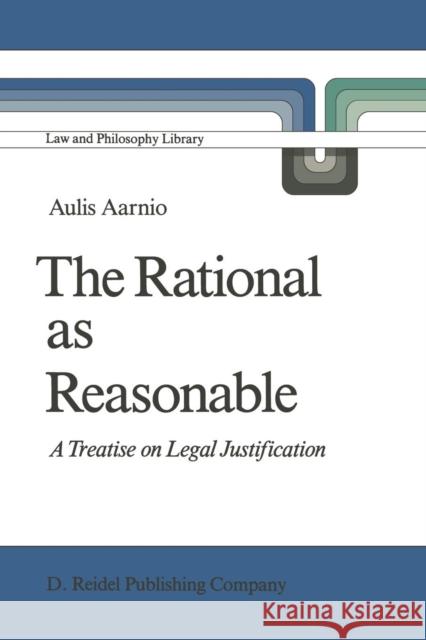
Aulis Aarnio
The Rational as Reasonable: A Treatise on Legal Justification Aarnio, Aulis 9789401085908 Springer - książkaWidoczna okładka, to zdjęcie poglądowe, a rzeczywista szata graficzna może różnić się od prezentowanej.

The Rational as Reasonable: A Treatise on Legal Justification

ISBN-13: 9789401085908 / Angielski / Miękka / 2012 / 276 str.

Aulis Aarnio
cena 806,99
(netto: 768,56 VAT:  5%)

Najniższa cena z 30 dni: 771,08
Termin realizacji zamówienia:
ok. 22 dni roboczych
Bez gwarancji dostawy przed świętami

Darmowa dostawa!
inne wydania

During the last half of the twentieth century, legal philosophy (or legal theory or jurisprudence) has grown significantly. It is no longer the domain of a few isolated scholars in law and philosophy. Hundreds of scholars from diverse fields attend international meetings on the subject. In some universities, large lecture courses of five hundred students or more study it. The primary aim of the Law and Philosophy Library is to present some of the best original work on legal philosophy from both the Anglo-American and European traditions. Not only does it help make some of the best work avail- able to an international audience, but it also encourages increased awareness of, and interaction between, the two major traditions. The primary focus is on full-length scholarly monographs, although some edited volumes of original papers are also included. The Library editors are assisted by an Editorial Advisory Board of internationally renowned scholars. Legal philosophy should not be considered a narrowly circumscribed field. Insights into law and legal institutions can come from diverse disciplines on a wide range of topics. Among the relevant disciplines or perspectives con- tributing to legal philosophy, besides law and philosophy, are anthropology, economics, political science, and sociology. Among the topics included in legal philosophy are theories of law; the concepts of law and legal institutions; legal reasoning and adjudication; epistemological issues of evidence and pro- cedure; law and justice, economics, politics, or morality; legal ethics; and theories oflegal fields such as criminal law, contracts, and property.


Kategorie:
Nauka, Filozofia
Kategorie BISAC:
Philosophy > Reference
Philosophy > History & Surveys - General
Law > Reference
Wydawca:
Springer
Seria wydawnicza:
Law and Philosophy Library
Język:
Angielski
ISBN-13:
9789401085908
Rok wydania:
2012
Wydanie:
1987
Numer serii:
000038988
Ilość stron:
276
Waga:
0.46 kg
Wymiary:
23.5 x 15.5
Oprawa:
Miękka
Wolumenów:
01

I: Introduction.- 1. The Point of Departure.- 1.1. The Routine Cases and the Hard Cases.- 1.2. The Dilemma of the Decision-Maker.- 1.3. On the Responsibility to Justify the Decisions.- 1.4. Legalism Contra Anti-Legalism.- 2. A Scientific Approach to the Contents of Legal Norms.- 2.1. The Scholar and the Judge.- 2.2. Legal Dogmatics and Social Sciences.- 2.3. Legal Dogmatics and Legal Practice.- 2.3.1. Normal Legal Practice.- 2.3.2. Judicial Practice.- 3. The Concept of Legal Dogmatics — A More Precise Formulation.- 4. The Angle of Approach and the Basic Problems.- II: The Ontology of Law.- 1. General Remarks.- 2. The Ontology of Interpretation in Legal Dogmatics.- 3. The Validity of a Legal Norm.- 3.1. Wróblewski’s Three Approaches.- 3.2. Systematic Validity.- 3.3. The Efficacy of Legal Norms.- 3.4. The Acceptability of a Legal Norm.- III: The Methodology of Interpretation in Legal Dogmatics.- 1. Basic Concepts.- 1.1. Two Research Strategies.- 1.2. A Norm Statement and an Interpretative Statement.- 1.2.1. The Concept of the Norm Statement.- 1.2.2. Conclusion.- 1.2.3. A Meaning Statement and an Interpretation Statement.- 1.2.4. A Norm Standpoint and an Interpretation Standpoint.- 1.2.5. Summary.- 1.3. The Concept of the Norm.- 2. A General Characterization of Interpretation and Interpretation Theory.- 2.1. Interpretation as a Hermeneutic Process.- 2.2. The Special Nature of Interpretation in Legal Dogmatics.- 3. The Sources of Law and the Directives of Legal Interpretation.- 3.1. On the Concept of the Sources of Law.- 3.1.1. The Source of Information.- 3.1.2. The Source of Reasoning.- 3.2. The List of the Sources of Law.- 3.2.1. The Finnish Catalogue of the Sources.- 3.2.2. General Remarks.- 3.3. The Categorization of the Sources of Law.- 3.3.1. The Bindingness of the Sources of Law.- 3.3.2. Authoritative Reasons and Substantial Reasons.- 3.4. Directives of Legal Interpretation.- 3.4.1. The Order of Preference of the Sources of Law.- 3.4.2. The Standards of the Reasoning Procedure.- 4. Justification of the Interpretative Standpoint: Structural Analysis.- 4.1. The Point of Departure: Disagreement on the Result of the Interpretation.- 4.2. The Scope for Interpretation: Gaps and Conflicts in the Legal Order.- 4.3. The Procedure of Discourse.- 4.4. Internal and External Justification.- 4.5. The Structure of the Ex-Justification Procedure.- 4.6. An Example of the Justification Procedure.- 4.6.1. Travaux Préparatoires.- 4.6.2. Systemic Interpretation.- 4.6.3. Court Decisions as Reasons.- 4.6.4. On the Doctrinal Opinion.- 4.6.5. Practical Reasons.- 4.6.6. Summary.- 4.7. The Relation Between the Systematization and the Interpretation of Legal Norms.- 4.7.1. The Concept of Systematization.- 4.7.2. An Example of Systematization: An Analysis of the Position of the Heir.- IV: The Acceptability of an Interpretative Statement.- 1. The Principle of the One Right Answer.- 1.1. A Terminological Clarification.- 1.2. Examples of the Doctrines of the One Right Answer.- 1.2.1. Ronald Dworkin’s Theory.- 1.2.2. Norm Statements as Norm Propositions.- 1.2.2.1. Norm Statements as Predictions.- 1.2.2.1.1. The Specific Nature of Legal Predictions.- 1.2.2.1.2. On the Alf Ross’ Predictive Theory.- 1.2.2.2. Ilkka Niiniluoto’s Approach.- 1.2.2.3. Norm Propositions as Technical Norms.- 1.2.2.3.1 General Remarks.- 1.2.2.3.2 Secondary Technical Norms.- 1.2.2.3.3 Primary Technical Norms.- 2. Acceptability and Rationality.- 2.1. The General Preconditions of the Justification of an Interpretative Standpoint.- 2.2 The Concept of Rational Acceptability.- 2.3 Why Be Rational?.- 2.4 The General Conditions of Rational Discourse.- 2.4.1 The Point of Departure.- 2.4.2 The Basic Principles and Rules of D-Rationality.- 2.4.2.1. Consistency-Rules.- 2.4.2.2. Efficiency-Rules.- 2.4.2.3. Sincerity-Rules.- 2.4.2.4. Generalization-Rules.- 2.4.2.5. Support-Rules.- 2.4.3. The Rules of the Burden of Proof.- 2.4.3.1. Procedural Rules of the Burden of Proof.- 2.4.3.2. Material Rules of the Burden of Proof.- 2.4.4 Summary.- 2.5. Interpretations and Evaluations.- 2.6. Knowledge, Certainty and Form of Life.- 2.7. The Audience and the Form of Life.- 2.7.1. Perelman’s Theory of the Audience.- 2.7.2. Some Clarifications.- 2.7.2.1. The Concrete Audience.- 2.7.2.2. The Ideal Audience.- 2.7.3. Rational Acceptability as a Regulative Principle for Legal Dogmatics.- Epilogue.- Notes.- Abbreviations.

Aarnio, Aulis Aulis Aarnio is Professor of Law at University of ... więcej >


Udostępnij

Facebook - konto krainaksiazek.pl


Opinie o Krainaksiazek.pl na Opineo.pl

Partner Mybenefit

Krainaksiazek.pl w programie rzetelna firma Krainaksiaze.pl - płatności przez paypal

Czytaj nas na:

Facebook - krainaksiazek.pl
  • książki na zamówienie
  • granty
  • książka na prezent
  • kontakt
  • pomoc
  • opinie
  • regulamin
  • polityka prywatności

Zobacz:

  • Księgarnia czeska

  • Wydawnictwo Książkowe Klimaty

1997-2025 DolnySlask.com Agencja Internetowa

© 1997-2022 krainaksiazek.pl
     
KONTAKT | REGULAMIN | POLITYKA PRYWATNOŚCI | USTAWIENIA PRYWATNOŚCI
Zobacz: Księgarnia Czeska | Wydawnictwo Książkowe Klimaty | Mapa strony | Lista autorów
KrainaKsiazek.PL - Księgarnia Internetowa

Polityka prywatnosci - link
Krainaksiazek.pl - płatnośc Przelewy24
Przechowalnia Przechowalnia





