• Wyszukiwanie zaawansowane
  • Kategorie
  • Kategorie BISAC
  • Książki na zamówienie
  • Promocje
  • Granty
  • Książka na prezent
  • Opinie
  • Pomoc
  • Załóż konto
  • Zaloguj się

The Politics of Humanity: Justice and Power » książka


zaloguj się | załóż konto
Logo Krainaksiazek.pl

koszyk

konto

szukaj
topmenu
Księgarnia internetowa
Szukaj
Książki na zamówienie
Promocje
Granty
Książka na prezent
Moje konto
Pomoc
 
 
Wyszukiwanie zaawansowane
Pusty koszyk
Bezpłatna dostawa dla zamówień powyżej 20 złBezpłatna dostawa dla zamówień powyżej 20 zł

Kategorie główne

• Nauka
 [2944077]
• Literatura piękna
 [1814251]

  więcej...
• Turystyka
 [70679]
• Informatyka
 [151074]
• Komiksy
 [35590]
• Encyklopedie
 [23169]
• Dziecięca
 [611005]
• Hobby
 [136031]
• AudioBooki
 [1718]
• Literatura faktu
 [225599]
• Muzyka CD
 [379]
• Słowniki
 [2916]
• Inne
 [443741]
• Kalendarze
 [1187]
• Podręczniki
 [166463]
• Poradniki
 [469211]
• Religia
 [506887]
• Czasopisma
 [481]
• Sport
 [61343]
• Sztuka
 [242115]
• CD, DVD, Video
 [3348]
• Technologie
 [219293]
• Zdrowie
 [98602]
• Książkowe Klimaty
 [124]
• Zabawki
 [2385]
• Puzzle, gry
 [3504]
• Literatura w języku ukraińskim
 [260]
• Art. papiernicze i szkolne
 [7151]
Kategorie szczegółowe BISAC

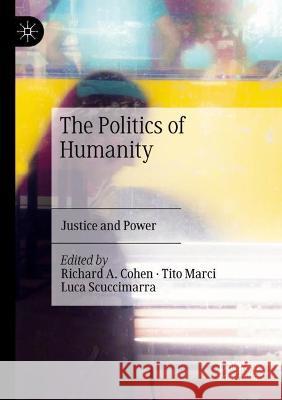
The Politics of Humanity: Justice and Power

ISBN-13: 9783030759599 / Angielski / Miękka / 2022
Cohen, Richard A.
The Politics of Humanity: Justice and Power Cohen, Richard A. 9783030759599 Springer International Publishing - książkaWidoczna okładka, to zdjęcie poglądowe, a rzeczywista szata graficzna może różnić się od prezentowanej.

The Politics of Humanity: Justice and Power

ISBN-13: 9783030759599 / Angielski / Miękka / 2022

Cohen, Richard A.
cena 483,04
(netto: 460,04 VAT:  5%)

Najniższa cena z 30 dni: 462,63
Termin realizacji zamówienia:
ok. 22 dni roboczych.

Darmowa dostawa!

This book is the collaborative response of engaged scholars from diverse countries and disciplines who are disturbed by the contemporary resurgence of anti-democratic movements and regimes throughout the world. These movements have manifest in vitriolic “nationalist” polemics, state-supported violence, and exclusionary anti-immigrant policies, less than a century after the rise and fall and horrific devastations of fascism in the early 20th century.   

Kategorie:
Nauka, Filozofia
Kategorie BISAC:
Philosophy > Political
Social Science > Socjologia
History > Asia - China
Wydawca:
Springer International Publishing
Język:
Angielski
ISBN-13:
9783030759599
Rok wydania:
2022
Waga:
0.33 kg
Wymiary:
21.0 x 14.8
Oprawa:
Miękka
Dodatkowe informacje:
Wydanie ilustrowane

“Introduction: The Politics of Humanity” by Richard A. Cohen

Part I: Principles of Justice
Chapter 1: “Ethics of Hospitality: The Limits of Cosmopolitan Rights” by Tito Marci
The paper re-examines, from a cosmopolitan perspective, the ethical and juridical topic of ‘hospitality’ in some of its paradoxical aspects that are more and more involved in difficult relationships with ‘outsiders’. On this base we will try to take another look at the problem posed by the growing phenomenon of migration in democratic and multi-ethnic societies, which, is bound to reappear, for good or for ill, on the level of social inclusion.  Rethinking the concept and the practice of hospitality (the terrain of relating among “others”) today becomes an operation as important as ever, since precisely now, with the development of globalization and migration processes over the entire surface of the earth, the way of relating among “outsiders” is presented as a fact decisive for our social coexistence. 

Chapter 2: “Cosmopolitanism versus Globalization: Breaking the Inevitable Ceremonial” by Richard A. Cohen
Appeal to the root of intelligibility - scientific, social, economic, political - in moral responsibility arising as singular response to the vulnerability and suffering of the singular other, being for-the-other before being for-oneself, ethics before interest, this “before” as the root significance of any priority, the very importance of importance.  Cosmopolitanism oriented by this primordial ethics, in contrast to the nihilism of globalization which puts the private accumulation of capital and the personal satisfaction of self-interests, and the governmental totalities allied to and enforcing such selfishness, before responsibility, responsibility to and for the neighbor, responsibility to and for the neighbor’s neighbors, and responsibility to and for all others, humanity.  In pursuit of the above, brief forays into Aristotle, Antonio Gramsci, Heinrich Heine, Herman Melville, Emmanuel Levinas and Socrates.       

Chapter 3: “Reassessing the ‘Humanitarian Turn’ in Global Politics” by Luca Scuccimarra
Some scholars have argued that one of the most characteristic aspects of the “new” post-1989 political and legal order has been the emergence – or re-emergence – of a form of international political morality based not on the “particularism” of the modern society of States, but rather on the universalism of the rising global society. Against the traditional State-centric approach to international relations, from the 1990s on there have been more and more positions favoring a real “global” turn of politics, founded on “universal principles that challenge the presumed moral supremacy of territorial boundaries and which favor instead the welfare of humanity generally” (Hayden). The aim of this chapter is to reconstruct the main issues at stake in the philosophical-political debate about the so-called “humanitarian turn” in global politics, in order to discuss their actual meaning in an age of “national-populist backlash.”   
   
Chapter 4: “Vulnerability and Intimacy:  Ethical Foundation for Social Relations, Confucius and Levinas” by Kuan-min Huang

In the Hobbesian model, the necessity for the state derives from a virtual contract originating out of a natural state of everyone against everyone. It thus defends self-protection by urging certain rights be given up to construct the state. Our contemporary situation demands that we consider an alternative model.  Accordingly, the present paper proposes to consider another view of the natural state considering temporality and affectivity.  Every human being, while persevering in existence, is subject to multiple health variations, physical and psychological. Human temporal finitude is expressed in such vulnerability.  A newborn baby needs motherly care.  The aged often need help in their daily activities. Such are fundamental facts of finite human vulnerability.  It signifies that living is not solitary monadic being but a being-together with other human beings.  Furthermore, such interactions are not only causal or instrumental, but affective. The affectivity of social life constitutes an ontological need for intimacy. Being intimate with someone (parents, lovers, family members, friends) constitutes basic social interactions, an affectivity manifest in communal life.  Based on these two factors – vulnerability and intimacy – the formation of community is founded on a very different foundation than more superficial analyses based in instrumentality, which treats of others by taking advantage of them, for profit, for efficiency.  Confucian ideas can contribute to better understanding community in this way, so that we can imagine a social phenomenology inspired by Confucian ethical thoughts.

Part II: Dangers to Justice
Chapter 5: “The ‘Migrant Crisis’ and the Rise of Anti-Humanitarian Populism in Europe” by Luca Scuccimarra
Over the last few years the so-called “migrant crisis” has been acquiring a growing relevance within the space of the political experience of the European Union and its generally out-of-synch member states. The contemporary debate on this issue also includes attempts to question the general reliability of this consolidated representation of the dynamics in progress, through a more or less successful effort to problematize the widely conditioning role that the “language of crisis” plays in the construction of our specific way of representing, interpreting and understanding contemporary migration. This chapter aims at highlighting some of the main passages of this line of critical reflection, discussing the contribution it may give to a deeper understanding of the so-called “populist turn” of contemporary politics.

Chapter 6: “Bourdieu, Brexit and Mobility Justice” by Deborah Reed-Danahay
This chapter considers questions of social justice and mobility in the context of Brexit with reference to the work of Pierre Bourdieu. Bourdieu was deeply concerned with forms of structural inequality. His concept of social space, with its focus on the relationship between social space and geographical or physical space, is a useful lens through which to examine the ways in which the capacity to be mobile or immobile in physical and social space is unevenly distributed and subject to relations of power and inequality.  The United Kingdom’s departure from the European Union at the end of January 2020, referred to as “Brexit,” resulted from the outcome of a Referendum on the question of staying or leaving in the EU put to the voters in the summer of 2016. The vote to leave was in part fueled by insecurities about immigrants and refugees, and reflects nationalist and anti-cosmopolitan sentiment.  The negotiations following the Referendum have resulted in policies restricting forms of geographical mobility to and from the UK.  Questions of mobility are central to Brexit, therefore, and mobility is a key pillar of the EU’s social and economic programs.  Bourdieu’s focus on trajectories in social and physical space, and his view of habitus as a position in social space, is deployed in this chapter in order to shed light on the injustices of mobility associated with Brexit.

Chapter 7: “The Future of Justice and Our Political Triangulation: Liberalism, Socialism and Fascism” by Richard A. Cohen

Contemporary philosophy realizes that time, like language and embodiment, is not an obstacle to truth and reality but a means to them.   Time means past, present, future, and the directionality of before and after.  Politics has its own temporality.  So, conservative politics aims to restore a selected past, progressive politics aims for a better future, and authoritarian politics supports the present status quo.  In each case, however, the dominant temporal dimension is the future.   According to Levinas, time is neither objective (clock time) nor subjective (temporal syntheses) but inter-subjective, a function of the diachrony of responsibility.  From such a perspective, morality is past oriented, attending to suffering already undergone, while politics is future oriented, i.e., aiming for a justice for all not yet instituted, still outstanding.  Hence politics is a struggle over the meaning of time, to return to a past justice or to move forward to a future justice.  The basic question is whether the world is already just enough (liberal democracy), or not yet just enough (social democracy).  The peculiarity of fascist politics, in contrast, is that in rejecting justice it rejects time altogether, preferring a delirious sensationalist or occasionalist present oblivious to history.  

Chapter 8: “What is Radically Wrong?” by Tito Marci
The paper analyses the issue of Radicalism in a contemporary context through a sociological perspective that involves a critique of the economic idea of exchange. On the basis of this critique, the paper will try to show how the concept of Radicalism takes its current meaning in relation to the cultural and political assets that have become predominant in western modern and global contemporary societies.
From a certain point of view, we can state that, to some extent, the social phenomena of political, religious, or cultural radicalization of individuals or groups could be also considered as an effect (a product of) or as a form of reaction to the radicalization of the economic exchange as absolute paradigm of social integration.

Chapter 9: “Totalitarian, State, and Civil Society: The Case of Hong Kong” by Kwok-kui Wong
This paper begins by arguing that the biggest threat of totalitarianism to Hong Kong is the undermining or even destruction of the mutual trust among the people in civil society.  It then shows that totalitarianism, communism in particular, is a form of nihilism in the Nietzschean sense that “the highest value devalues itself, the question ‘why?’ finds no answer,” invoking texts by Karl Marx, Sergey Nechaev and Hannah Arendt to argue this point. It then analyses how these processes of destruction are happening in Hong Kong in the form of what we may call “post-totalitarianism,” using Harvel’s term. Finally, using Hegel’s theory, the paper argues that civil society can act as a bulwark against the totalitarian state by championing arete as the common good.

Richard A. Cohen is Professor of Philosophy and Jewish Thought at the University at Buffalo, SUNY, USA.

Tito Marci is Dean of Law Faculty and Professor of Political Science and Sociology at the University of Rome, Sapienza, Italy.

 Luca Scuccimarra is Professor of History of Political Thought and Chair of Department of Political Science at the University of Rome, Sapienza, Italy.



“Humanism, human rights, and humanitarianism have been dismissed on both the right and the left as sentimental residues of a naïvely moralistic politics that does more harm than good when applied to the real world.  But when they are cynically abandoned, as has happened in our increasingly troubled times, the consequences can be dire.  In this volume, an international and interdisciplinary array of distinguished scholars breathes new life into these traditions for a world that needs them now more than ever.”
—Martin Jay, Ehrman Professor of European History Emeritus, University of California, Berkeley

“This collected volume is a passionate testimony for defending humanity, justice, and cosmopolitan values in times of multi-level global crisis. It brings together a range of distinguished international scholars addressing burning issues like migration and the political situation in Hong Kong, combined with principled reflections on the social, ethical, and legal foundations of human co-existence with an emphasis on difference, alterity, and vulnerability so urgently needed for a cosmopolitan conception of justice.”                                                                                                                                                                    —Sophie Loidolt, Professor of Philosophy, Chair of Practical Philosophy, Institut für Philosophie, Technische Universität Darmstadt, Germany

This book is the collaborative response of engaged scholars from diverse countries and disciplines who are disturbed by the contemporary resurgence of anti-democratic movements and regimes throughout the world. These movements have brought with them vitriolic “nationalist” polemics, state-supported violence, and exclusionary anti-immigrant policies, less than a century after the rise and fall and horrific devastations of fascism in the early 20th century.   

Richard A. Cohen is Professor of Philosophy and Jewish Thought at the University at Buffalo, SUNY, USA.

Tito Marci is Dean of Law Faculty and Professor of Political Science and Sociology at the University of Rome, Sapienza, Italy.

Luca Scuccimarra is Professor of History of Political Thought and Chair of Department of Political Science at the University of Rome, Sapienza, Italy.



Udostępnij

Facebook - konto krainaksiazek.pl


Opinie o Krainaksiazek.pl na Opineo.pl

Partner Mybenefit

Krainaksiazek.pl w programie rzetelna firma Krainaksiaze.pl - płatności przez paypal

Czytaj nas na:

Facebook - krainaksiazek.pl
  • książki na zamówienie
  • granty
  • książka na prezent
  • kontakt
  • pomoc
  • opinie
  • regulamin
  • polityka prywatności

Zobacz:

  • Księgarnia czeska

  • Wydawnictwo Książkowe Klimaty

1997-2026 DolnySlask.com Agencja Internetowa

© 1997-2022 krainaksiazek.pl
     
KONTAKT | REGULAMIN | POLITYKA PRYWATNOŚCI | USTAWIENIA PRYWATNOŚCI
Zobacz: Księgarnia Czeska | Wydawnictwo Książkowe Klimaty | Mapa strony | Lista autorów
KrainaKsiazek.PL - Księgarnia Internetowa

Polityka prywatnosci - link
Krainaksiazek.pl - płatnośc Przelewy24
Przechowalnia Przechowalnia




