• Wyszukiwanie zaawansowane
  • Kategorie
  • Kategorie BISAC
  • Książki na zamówienie
  • Promocje
  • Granty
  • Książka na prezent
  • Opinie
  • Pomoc
  • Załóż konto
  • Zaloguj się

The Pathway to Publishing: A Guide to Quantitative Writing in the Health Sciences » książka


zaloguj się | załóż konto
Logo Krainaksiazek.pl

koszyk

konto

szukaj
topmenu
Księgarnia internetowa
Szukaj
Książki na zamówienie
Promocje
Granty
Książka na prezent
Moje konto
Pomoc
 
 
Wyszukiwanie zaawansowane
Pusty koszyk
Bezpłatna dostawa dla zamówień powyżej 20 złBezpłatna dostawa dla zamówień powyżej 20 zł

Kategorie główne

• Nauka
 [2950560]
• Literatura piękna
 [1849509]

  więcej...
• Turystyka
 [71097]
• Informatyka
 [151150]
• Komiksy
 [35848]
• Encyklopedie
 [23178]
• Dziecięca
 [617388]
• Hobby
 [139064]
• AudioBooki
 [1657]
• Literatura faktu
 [228597]
• Muzyka CD
 [383]
• Słowniki
 [2855]
• Inne
 [445295]
• Kalendarze
 [1464]
• Podręczniki
 [167547]
• Poradniki
 [480102]
• Religia
 [510749]
• Czasopisma
 [516]
• Sport
 [61293]
• Sztuka
 [243352]
• CD, DVD, Video
 [3414]
• Technologie
 [219456]
• Zdrowie
 [101002]
• Książkowe Klimaty
 [124]
• Zabawki
 [2311]
• Puzzle, gry
 [3459]
• Literatura w języku ukraińskim
 [254]
• Art. papiernicze i szkolne
 [8079]
Kategorie szczegółowe BISAC

The Pathway to Publishing: A Guide to Quantitative Writing in the Health Sciences

ISBN-13: 9783030981747 / Angielski / Twarda / 2022
Dorothy L. Southern
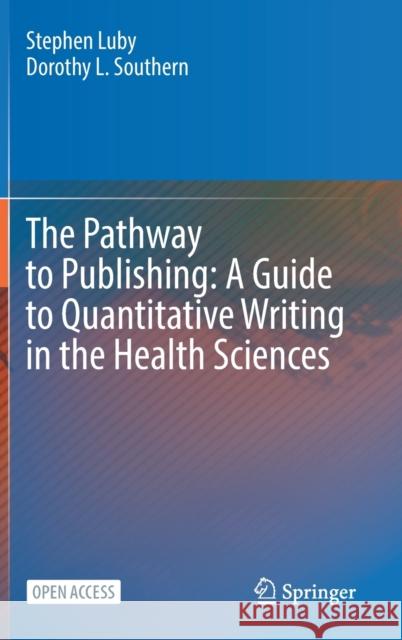
The Pathway to Publishing: A Guide to Quantitative Writing in the Health Sciences Dorothy L. Southern 9783030981747 Springer Nature Switzerland AG - książkaWidoczna okładka, to zdjęcie poglądowe, a rzeczywista szata graficzna może różnić się od prezentowanej.

The Pathway to Publishing: A Guide to Quantitative Writing in the Health Sciences

ISBN-13: 9783030981747 / Angielski / Twarda / 2022

Dorothy L. Southern
cena 201,24
(netto: 191,66 VAT:  5%)

Najniższa cena z 30 dni: 192,74
Termin realizacji zamówienia:
ok. 22 dni roboczych
Dostawa w 2026 r.

Darmowa dostawa!
inne wydania

Writing manuscripts is central to the advance of scientific knowledge. For an early career aspiring scientist, writing first author manuscripts is an opportunity to develop critical skills and to credential their expertise. Writing manuscripts, however, is difficult, doubly so for scientists who use English as a second language. Many science students intentionally avoid a writing-intensive curriculum. Careful, thorough reviews of draft manuscripts are difficult to secure, and experienced scientific supervisors face more demands on their time than they have time available. Weak draft manuscripts discourage supervising scientists investing the time to coach revisions. It is easier for experienced scientists to ignore the request, or to simply rewrite the article. Early career scientists are motivated to address these barriers but specific advice is difficult to find, and much of this advice is behind a pay wall. 


This essential, open access text presents writing lessons organized as common errors, providing students and early-career researchers with an efficient way to learn, and mentors with a quick-reference guide to reviewing. Error descriptions include specific examples drawn from real-world experiences of other early-career writers, and suggestions for how to successfully address and avoid these in the future. Versions of this book have been used by Stanford University, UC Davis, Johns Hopkins, and numerous international institutions and organizations for over a decade. 

Kategorie:
Nauka, Medycyna
Kategorie BISAC:
Medical > Research
Social Science > Socjologia
Social Science > Media Studies
Wydawca:
Springer Nature Switzerland AG
Język:
Angielski
ISBN-13:
9783030981747
Rok wydania:
2022
Waga:
0.46 kg
Wymiary:
23.5 x 15.5
Oprawa:
Twarda
Dodatkowe informacje:
Wydanie ilustrowane

1. Introduction
1.1 The pathway to publishing
1.2 Think before you write approach
1.2.1 Develop a framing document
1.2.2 Focus on the high level outline (HLO)
1.2.3 Use the ‘most common errors’
1.2.4 Understand authorship and mentoring responsibilities
1.2.5 Structure the writing and feedback process
1.3 The scientific writing style
1.4     Converting preliminary work into manuscripts
1.4.1 Converting reports into manuscripts
1.4.2 Converting posters and verbal presentations into manuscripts
1.5 The process of peer review

2. Most common errors
A. General research and writing practices
A1. Insufficient knowledge of the literature
A2. Not referencing statements
A3. Weak citations
A3a. Citing a secondary source
A3b. Presenting conclusions rather than data from references
A3c. Arguing from authority
A4. Endnotes not in standard style
A4a. Varying endnote notation
A5. Not using standard draft manuscript form
A6. Repeating information
A7. Labelling a scientific document as ‘final’
A8. Characterizing an observation as ‘the first’
A9. Errors in reasoning
A9a. Casual assertion of causality
A9b. Assuming association is causality
A9c. Assuming reported behavior reflects actual behavior
A9d. Confusing imperfect recall with recall bias
A9e. Confusing absence of recognition with absence
A9f. Asserting seasonality with a single year of data
A9g. Drawing conclusions using confirmation bias
A10. Constructing a multivariate model using only statistical criteria
A11. Plagiarism

B. Content of quantitative papers
B1. Improper focus or format of title and abstract
B2. Confusing the role of Introduction, Methods, Results, and Discussion
B3. Not writing the Methods section in chronological order
B4. Not emphasizing steps taken to protect human subjects
B5. Listing interpretations, but not defending one in the Discussion
B6. Not fully explaining limitations
B7. Writing generic recommendations
B8. Presenting new data in the Discussion
B9. Reporting the number of enrolled subjects in the Methods
B10. Specifying the contents of a questionnaire
B11. Naïve theories of change
B11a. Recommending a massive increase in funding
B11b. Ignoring incentives and barriers
B11c. Assuming weak states can implement
B12. An insufficiently focused Introduction
B13. Failure to clarify key sample size assumptions
B14. A high level outline that is not high level
B15. Specifying software used for routine data analysis
B16. Presenting rationale in the last sentence of the Introduction

C. Mechanics of writing
C1. Using non-standard abbreviations
C2. Using non-standard spaces
C3. Improper spelling
C4. Capitalization problems
C4a. USING ALL CAPITAL LETTERS
C4b. Capitalizing non-proper nouns
C5. Failure to spell out an isolated numeral < 10
C6. Starting a sentence with a numeral
C7. Not indenting paragraphs
C8. Not aligning text to the left
C9. Problems with parentheses
C10. Not recognizing when an abbreviation has become a name
C11. Misplaced commas in large numbers
C12. Varying fonts within the narrative
C13. Using bulleted lists rather than sentences
C14. Uninformative document names

D. Grammatical structures and stylistic strategies
D1. Using present rather than past tense
D2. Failure to use definite and indefinite articles
D3. Excessive use of passive voice
D4. Improper use of “we”
D5. Writing from a psychological perspective
D6. Using excessive sub-headings in the discussion section
D7. Misplaced modifiers
D8. Using nouns with awkward syntax in place of verbs
D9. Using different terms for the same object or the same idea

E. Achieving clarity and conciseness
E1. Labelling rather than explaining
E2. Using weak opening phrases for sentences
E3. Using adjectives and qualifiers
E4. Overusing studies or authors as sentence subjects
E5. Using non-descriptive numeric or alphabetical labels
E6. Using respectively
E7. Using the word etcetera
E8. Using foreign words
E9. Using local words, expressions or monetary figures
E10. Using the term ‘developing country’
E11. Using the term ‘socio-economic status’ as a synonym for wealth
E12. Using a technical term in its non-technical sense
E12a. Using the term ‘random’ in its non-technical sense
E12b. Using the term ‘reliable’ in its non-technical sense
E12c. Using the term ‘significant’ in its non-technical sense
E12d. Using the term ‘valid’ in its non-technical sense
E12e. Using the term ‘incidence’ incorrectly
E12f. Using the term ‘correlated’ incorrectly
E13. Using the verb ‘documented’
E14. Framing an argument in terms of need
E15. Using the term ‘illiterate’ as a synonym for ‘no formal education’
E16. Using the word ‘challenging’ as a synonym for ‘difficult’
E17. Describing a laboratory test result as positive
E18. Using increase or decrease in the absence of a time trend
E19. Describing a test as a gold standard

F.   Recording scientific data
F1. Using statistics in place of the study question to frame results
F1a. Framing narrative results around p-values
F2. Not presenting the core data
F3. Using too many decimal places
F4. Using too few decimal places
F5. Using incomplete headings for tables and figures
F6. Imbalance between table and narrative presentation of the results
F7. Pointing too explicitly to tables and figures
F8. Using inappropriate figures
F9. Using the wrong symbol to designate degree
F10. Using non-standard footnote symbols in tables
F11. Comparing to a varying baseline
F12. Generic data tables that lack a clear message
F13. Table layout that impairs comparisons*
F14. Maps with irrelevant details
F15. Numbering figures or tables out of sequence
F16. Listing results in a paragraph that are more clear in a table
F17. Using less informative denominators in a table
F18. p-value in a baseline table of a randomized controlled trial
F19. Emailing draft manuscripts with figures that are not compressed

G. Approaching publication
G1. Failure to respond to reviewers’ comments
G2. Incomplete response to reviews
G3. Invalid authorship line
G4. Missing acknowledgement section
G5. Choosing an inappropriate journal
G6. Not following a specific journal’s details of style
G7. Not using a checklist to review your paper before submission
G8. Exceeding the journal word limit
G9. Asking your senior author to recommend reviewers
G10. Responding to journal reviewers using the first person singular
G11. Retaining comments in subsequent drafts
G12. Not finding a description of the error code
G13. Requesting an unprofessionally short turnaround time
G14. Sending blank forms for co-authors to complete
G15. Not providing co-authors a copy of the submitted manuscript
G16. Not keeping co-authors informed of journal discussions
G17. Re-using an email thread when circulating a revised manuscript
G18. Not proofreading references prior to submission
G19. Not including text of the manuscript changes in response to reviewers
G20. Not including readability statistics

H. Slide and poster presentations
H1. Bullets on the wall
H2. Chart junk
H3. Copying a manuscript figure instead of developing a custom figure
H4. Photos with an unnatural aspect ratio
H5. Too many photographs on a single slide
H6. Field workers as the dominant subject of photographs
H7. Using bullets without hanging indents
H8. Using a pie chart
H9.   Using vertical bars when horizontal bars would communicate better
H10.   Including a final “Thank you” slide
H11.   Using sentences for bullet points
H12.   Too much space between bullets
H13.   Failure to separate ideas in a multi-lined title
H14.   Using 3 dimensional chart features as decorations

Appendix 1: Flowchart for reviewing scientific documents
Appendix 2: Concept note outline
Appendix 3: Critical questions for protocol development
Appendix 4: Framing document
Appendix 5: Conference/scientific meeting abstracts
Appendix 6: Quantitative manuscript high level outline (HLO)
Appendix 7: Example of quantitative manuscript HLO
Appendix 8:Authorship Scorecard
Appendix 9:JANE (Journal/Author Name Estimator)
Appendix 10: STROBE Statement
Appendix 11: CONSORT Statement
Appendix 12: List of common errors
Appendix 13: Concept note example
References

Stephen Luby, Professor of Medicine, Director of Research at Center of Innovation in Global Health, Stanford University


Dorothy Southern, Independent Scientific Writing Advisor

Writing manuscripts is central to the advance of scientific knowledge. For an early career aspiring scientist, writing first author manuscripts is an opportunity to develop critical skills and to credential their expertise. Writing manuscripts, however, is difficult, doubly so for scientists who use English as a second language. Many science students intentionally avoid a writing-intensive curriculum. Careful, thorough reviews of draft manuscripts are difficult to secure, and experienced scientific supervisors face more demands on their time than they have time available. Weak draft manuscripts discourage supervising scientists investing the time to coach revisions. It is easier for experienced scientists to ignore the request, or to simply rewrite the article. Early career scientists are motivated to address these barriers but specific advice is difficult to find, and much of this advice is behind a pay wall. 


This essential, open access text presents writing lessons organized as common errors, providing students and early-career researchers with an efficient way to learn, and mentors with a quick-reference guide to reviewing. Error descriptions include specific examples drawn from real-world experiences of other early-career writers, and suggestions for how to successfully address and avoid these in the future. Versions of this book have been used by Stanford University, UC Davis, Johns Hopkins, and numerous international institutions and organizations for over a decade. 

This book is licensed under the terms of the Creative Commons Attribution 4.0 International License "http://creativecommons.org/licenses/by/4.0/", which permits use, sharing, adaptation, distribution and reproduction in any medium or format, as long as you give appropriate credit to the original author(s) and the source, provide a link to the Creative Commons license and indicate if changes were made

The images or other third party material in this book are included in the book's Creative Commons license, unless indicated otherwise in a credit line to the material. If material is not included in the book's Creative Commons license and your intended use is not permitted by statutory regulation or exceeds the permitted use, you will need to obtain permission directly from the copyright holder.


Udostępnij

Facebook - konto krainaksiazek.pl


Opinie o Krainaksiazek.pl na Opineo.pl

Partner Mybenefit

Krainaksiazek.pl w programie rzetelna firma Krainaksiaze.pl - płatności przez paypal

Czytaj nas na:

Facebook - krainaksiazek.pl
  • książki na zamówienie
  • granty
  • książka na prezent
  • kontakt
  • pomoc
  • opinie
  • regulamin
  • polityka prywatności

Zobacz:

  • Księgarnia czeska

  • Wydawnictwo Książkowe Klimaty

1997-2025 DolnySlask.com Agencja Internetowa

© 1997-2022 krainaksiazek.pl
     
KONTAKT | REGULAMIN | POLITYKA PRYWATNOŚCI | USTAWIENIA PRYWATNOŚCI
Zobacz: Księgarnia Czeska | Wydawnictwo Książkowe Klimaty | Mapa strony | Lista autorów
KrainaKsiazek.PL - Księgarnia Internetowa

Polityka prywatnosci - link
Krainaksiazek.pl - płatnośc Przelewy24
Przechowalnia Przechowalnia






