• Wyszukiwanie zaawansowane
  • Kategorie
  • Kategorie BISAC
  • Książki na zamówienie
  • Promocje
  • Granty
  • Książka na prezent
  • Opinie
  • Pomoc
  • Załóż konto
  • Zaloguj się

The Paradox of Consensualism in International Law » książka


zaloguj się | załóż konto
Logo Krainaksiazek.pl

koszyk

konto

szukaj
topmenu
Księgarnia internetowa
Szukaj
Książki na zamówienie
Promocje
Granty
Książka na prezent
Moje konto
Pomoc
 
 
Wyszukiwanie zaawansowane
Pusty koszyk
Bezpłatna dostawa dla zamówień powyżej 20 złBezpłatna dostawa dla zamówień powyżej 20 zł

Kategorie główne

• Nauka
 [2949965]
• Literatura piękna
 [1857847]

  więcej...
• Turystyka
 [70818]
• Informatyka
 [151303]
• Komiksy
 [35733]
• Encyklopedie
 [23180]
• Dziecięca
 [617748]
• Hobby
 [139972]
• AudioBooki
 [1650]
• Literatura faktu
 [228361]
• Muzyka CD
 [398]
• Słowniki
 [2862]
• Inne
 [444732]
• Kalendarze
 [1620]
• Podręczniki
 [167233]
• Poradniki
 [482388]
• Religia
 [509867]
• Czasopisma
 [533]
• Sport
 [61361]
• Sztuka
 [243125]
• CD, DVD, Video
 [3451]
• Technologie
 [219309]
• Zdrowie
 [101347]
• Książkowe Klimaty
 [123]
• Zabawki
 [2362]
• Puzzle, gry
 [3791]
• Literatura w języku ukraińskim
 [253]
• Art. papiernicze i szkolne
 [7933]
Kategorie szczegółowe BISAC

The Paradox of Consensualism in International Law

ISBN-13: 9789041105165 / Angielski / Twarda / 1998 / 324 str.
O. A. Elias; C. L. Lim
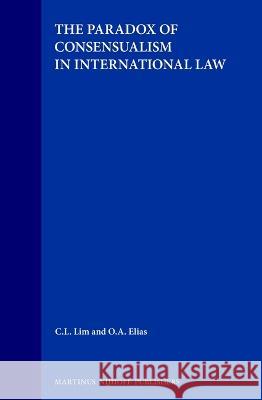
The Paradox of Consensualism in International Law Lim, C. L. 9789041105165 Kluwer Law International - książkaWidoczna okładka, to zdjęcie poglądowe, a rzeczywista szata graficzna może różnić się od prezentowanej.

The Paradox of Consensualism in International Law

ISBN-13: 9789041105165 / Angielski / Twarda / 1998 / 324 str.

O. A. Elias; C. L. Lim
cena 898,72
(netto: 855,92 VAT:  5%)

Najniższa cena z 30 dni: 898,72
Termin realizacji zamówienia:
ok. 30 dni roboczych
Bez gwarancji dostawy przed świętami

Darmowa dostawa!

If international law is derived from the consent of States, who should be in a better position to say what has been consented to than the disputing States themselves? It seems that if the doctrine of consent is taken seriously, there would be no room for an 'objective' legal answer to the question What is law?'. Furthermore, States do not necessarily employ the same criteria for determining the applicable law when engaged in dispute. And the doctrine of sovereignty is of very limited utility, since not all of substantive international law can be explained in terms of the atomic concept of sovereignty. This leaves consent as the mediating concept between the substantive doctrine of international law on the one hand and the actual practice of States (and others whose practice and participation in the global legal order help shape the body of international laws) on the other. Nevertheless, this is not to say that there is nothing higher' than the actual legal claims forwarded by international actors. International law is no mere superstition, since none argue that there is no (one) legal solution. In that sense, the unity of the international legal order is preserved. The problem is that the solutions actually forwarded in dispute are too numerous and international law too abstract to serve as arbiters between the competing claims. Thus, at the level of substantive doctrine there is a fragmentation of that earlier-mentioned picture of unity. But even here, only consent can mediate between unity and fragmentation, stability and change, order and justice, legislation and revolution. The strength of international law lies in its adaptability to political, strategic and diplomatic necessities. To suggest otherwise is to depart from a picture of international law that presumes the empirical verifiability of international laws. This book has as its principal concern certain orthodoxies of source thinking' in international law, and is aimed at working out the implications of these. It aims to show how certain theoretical conceptions have shaped the law in action, for good or ill. It will appeal to political theorists, diplomats, global decision-makers, and international lawyers who are interested in the question What can we do with the international law that we have?', as distinct from the question What should we do with international law?'.


Kategorie:
Nauka, Prawo i administracja
Kategorie BISAC:
Law > International
Law > Public
Wydawca:
Kluwer Law International
Seria wydawnicza:
Utrecht Studies in Air and Space Law
Język:
Angielski
ISBN-13:
9789041105165
Rok wydania:
1998
Numer serii:
000037617
Ilość stron:
324
Waga:
0.66 kg
Wymiary:
23.62 x 16.51 x 2.69
Oprawa:
Twarda
Wolumenów:
01
Dodatkowe informacje:
Bibliografia


Udostępnij

Facebook - konto krainaksiazek.pl


Opinie o Krainaksiazek.pl na Opineo.pl

Partner Mybenefit

Krainaksiazek.pl w programie rzetelna firma Krainaksiaze.pl - płatności przez paypal

Czytaj nas na:

Facebook - krainaksiazek.pl
  • książki na zamówienie
  • granty
  • książka na prezent
  • kontakt
  • pomoc
  • opinie
  • regulamin
  • polityka prywatności

Zobacz:

  • Księgarnia czeska

  • Wydawnictwo Książkowe Klimaty

1997-2025 DolnySlask.com Agencja Internetowa

© 1997-2022 krainaksiazek.pl
     
KONTAKT | REGULAMIN | POLITYKA PRYWATNOŚCI | USTAWIENIA PRYWATNOŚCI
Zobacz: Księgarnia Czeska | Wydawnictwo Książkowe Klimaty | Mapa strony | Lista autorów
KrainaKsiazek.PL - Księgarnia Internetowa

Polityka prywatnosci - link
Krainaksiazek.pl - płatnośc Przelewy24
Przechowalnia Przechowalnia






