• Wyszukiwanie zaawansowane
  • Kategorie
  • Kategorie BISAC
  • Książki na zamówienie
  • Promocje
  • Granty
  • Książka na prezent
  • Opinie
  • Pomoc
  • Załóż konto
  • Zaloguj się

The Pandemic of Argumentation » książka


zaloguj się | załóż konto
Logo Krainaksiazek.pl

koszyk

konto

szukaj
topmenu
Księgarnia internetowa
Szukaj
Książki na zamówienie
Promocje
Granty
Książka na prezent
Moje konto
Pomoc
 
 
Wyszukiwanie zaawansowane
Pusty koszyk
Bezpłatna dostawa dla zamówień powyżej 20 złBezpłatna dostawa dla zamówień powyżej 20 zł

Kategorie główne

• Nauka
 [2939893]
• Literatura piękna
 [1808953]

  więcej...
• Turystyka
 [70366]
• Informatyka
 [150555]
• Komiksy
 [35137]
• Encyklopedie
 [23160]
• Dziecięca
 [608786]
• Hobby
 [136447]
• AudioBooki
 [1631]
• Literatura faktu
 [225099]
• Muzyka CD
 [360]
• Słowniki
 [2914]
• Inne
 [442115]
• Kalendarze
 [1068]
• Podręczniki
 [166599]
• Poradniki
 [468390]
• Religia
 [506548]
• Czasopisma
 [506]
• Sport
 [61109]
• Sztuka
 [241608]
• CD, DVD, Video
 [3308]
• Technologie
 [218981]
• Zdrowie
 [98614]
• Książkowe Klimaty
 [124]
• Zabawki
 [2174]
• Puzzle, gry
 [3275]
• Literatura w języku ukraińskim
 [260]
• Art. papiernicze i szkolne
 [7376]
Kategorie szczegółowe BISAC

The Pandemic of Argumentation

ISBN-13: 9783030910198 / Angielski / Miękka / 2022 / 380 str.
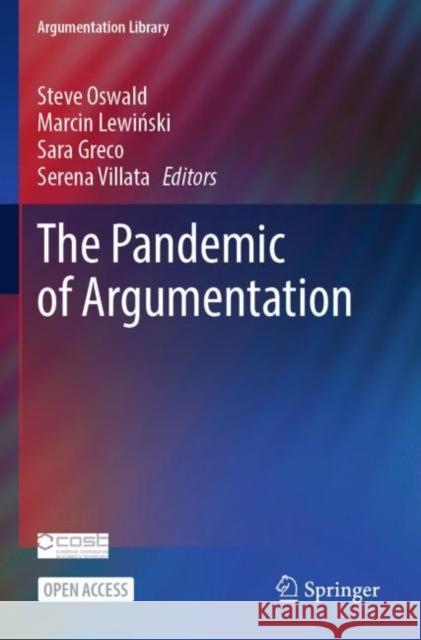
The Pandemic of Argumentation  9783030910198 Springer International Publishing - książkaWidoczna okładka, to zdjęcie poglądowe, a rzeczywista szata graficzna może różnić się od prezentowanej.

The Pandemic of Argumentation

ISBN-13: 9783030910198 / Angielski / Miękka / 2022 / 380 str.

cena 160,99
(netto: 153,32 VAT:  5%)

Najniższa cena z 30 dni: 154,18
Termin realizacji zamówienia:
ok. 22 dni roboczych.

Darmowa dostawa!
inne wydania

This open access book addresses communicative aspects of the current COVID-19 pandemic as well as the epidemic of misinformation from the perspective of argumentation theory. Argumentation theory is uniquely placed to understand and account for the challenges of public reason as expressed through argumentative discourse. The book thus focuses on the extent to which the forms, norms and functions of public argumentation have changed in the face of the COVID-19 pandemic. This question is investigated along the three main research lines of the COST Action project CA 17132: European network for Argumentation and Public PoLicY analysis (APPLY): descriptive, normative, and prescriptive.  The volume offers a broad range of contributions which treat argumentative phenomena that are directly related to the changes in public discourse in the wake of the outburst of COVID-19. The volume additionally places particular emphasis on expert argumentation, given (i) the importance expert discourse has had over the last two years, and (ii) the challenges that expert argumentation has faced in the public sphere as a result of scientific uncertainty and widespread misinformation. Contributions are divided into three groups, which (i) examine various features and aspects of public and institutional discourse about the COVID-19 pandemic, (ii) scrutinize the way health policies have been discussed, debated, attacked and defended in the public sphere, and (iii) consider a range of proposals meant to improve the quality of public discourse, and public deliberation in particular, in such a way that concrete proposals for argumentative literacy will be brought to light. Overall, this volume constitutes a timely inquiry into all things argumentative in pandemic discourse. This volume is of interest to a broad readership including philosophers, linguists, communication and legal scholars, and members of the wider public who seek to better understand the discourse surrounding communicative phenomena in times of crisis.
COST (European Cooperation in Science and Technology) is a funding organisation for research and innovation networks. For more information: www.cost.eu

Kategorie:
Nauka, Filozofia
Kategorie BISAC:
Philosophy > Reference
Language Arts & Disciplines > Linguistics - General
Social Science > Media Studies
Wydawca:
Springer International Publishing
Seria wydawnicza:
Argumentation Library
Język:
Angielski
ISBN-13:
9783030910198
Rok wydania:
2022
Ilość stron:
380
Waga:
0.53 kg
Wymiary:
23.39 x 15.6 x 1.98
Oprawa:
Miękka
Wolumenów:
01
Dodatkowe informacje:
Wydanie ilustrowane

Chapter 1. The Pandemic of Argumentation.- Part I: Arguing About The Pandemic.- Chapter 2. Arguing About “COVID”: Metalinguistic Arguments on What Counts As A “Covid-19 Death”. Chapter 3. ‘Covid-19’: Meaning and Reference.- Chapter 4. Political Interference and Argumentative Styles.- Chapter 5. The Evaluative Component in Pragmatic Argumentation: An Analysis of Public Discourse During the First Wave of the Sars-Cov-2 Pandemic in Italy.- Chapter 6. Spaces of Argumentation and their Interaction: Some Elements of Thought Inspired by Controversies and Dispute in France During the Covid-19 Crisis.- Chapter 7. The Argumentative Potential of Doubt: From Legitimate Concerns to Conspiracy Theories About Covid-19 Vaccines. Chapter 8. Analysing the Public Debate About Lockdown.- Chapter 9. Responding to the COVID Conspiracy Theories: Why Narratives Themselves are More Powerful Arguments than Fact-Checking.- Chapter 10. Reshaping Society through an Expanded Understanding of the Role of Analogy: Or How the Co-Vid Crisis Can Lead to a Better World.- Chapter 11. Expert Uncertainty: Arguments Bolstering the Ethos of Expertise in Situations of Uncertainty.- Chapter 12. Conditional Perfection, Scientific Schizophrenia and Political Decisions: On the Argumentative Dark Side of Pandemic Discourse.- Part II: Justifying and Promoting Health Policies.- Chapter 13. Good and Ought in Argumentation: COVID-19 as a Case Study.- Chapter 14. Visual Argumentation and Law: Broadcasting and Justifying the Norms During the Pandemic.- Chapter 15. Securitisation and the Rediscovery of the Invisible Enemy in Times of Pandemic: Analysing Political Discourses from the European South.- Chapter 16. The UK Government’s ‘Balancing Act’ in the Pandemic. Arguing from Competing Concerns: Lives, Livelihoods and Liberties.- Chapter 17. Practical Conflicts between Law and Morality: An Argumentative Analysis of the Case of Coronavirus Contact-Tracing Apps.- Chapter 18. How to Deal with Deep Disagreements? The Role of Rhetoric in Crisis Communication: The Case of COVID-19.- Chapter 19. On Arguments from Ignorance in Policy-Making.- Chapter 20. Persuasion, Politics, and COVID-19: Audience as a Political Category.- Part III: Elements of Argumentative Literacy.- Chapter 21. Inoculating Students Against Conspiracy Theories: The Case of Covid-19.- Chapter 22. Staying up to Date with Argument Checking: Outdated News as Defeasible Arguments.- Chapter 23. Combatting Conspiratorial Thinking with Controlled Argumentation Dialogue Environments.- Chapter 24. Is Interpretation of Conspiracy Theories done in a Fair and Useful Way?.- Chapter 25. How to Handle Reasonable Disagreement: The Case of Covid-19.- Chapter 26. Constructing Arguments about COVID-19 Governmental Guidelines.- Chapter 27. “I (Don’t) Agree with You, So You Are (In)Competent” The Role of One’s Own Opinion in Accepting Arguments from Expert Opinion.

Steve Oswald is Senior Lecturer in English Linguistics at the University of Fribourg Switzerland. His theoretical, empirical, and experimental research navigates the interface between cognitive pragmatics and argumentation theory and tackles classical issues related to the use of persuasive and deceptive language. He has co-edited 8 collective volumes devoted to issues in argumentation theory, pragmatics, and rhetoric and published his research in numerous academic journals and collective volumes. He serves as vice-chair of COST Action CA17132 and currently leads 2 research projects on implicit meaning in argumentation and on rephrase strategies in argumentation. More information can be found on his website: www.steveoswald.ch.


Marcin Lewiński is an Assistant Professor and the Chair of the Reasoning and Argumentation Lab (ArgLab) at the Nova Institute of Philosophy, Nova University of Lisbon, Portugal. He completed his PhD at the University of Amsterdam (2010), and from 2010 to 2016 worked as a post-doctoral fellow of the Portuguese Foundation for Science and Technology (FCT), before becoming an assistant professor in 2016. His work focuses on the basic issues in the philosophy of language and argumentation theory such as rationality of everyday conversations, practical reasoning, pragmatic meaning, social and strategic aspects of speech acts, fallacies. He is currently leading the Horizon 2020 COST Action project CA17132, European Network for Argumentation and Public Policy Analysis (2018-2023), where philosophical and linguistic concepts and methods are applied to a critical study of public argument.

Sara Greco (PhD in communication sciences, 2009) is Associate Professor of argumentation at USI – Università della Svizzera italiana in Lugano (Switzerland) at the Institute of Argumentation, Linguistics and Semiotics. She has published widely on argumentation theory, using linguistic and discourse analytical instruments to study spoken and written argumentative discourse. Her research concentrates on argumentation as an alternative to conflict (see the monograph Argumentation in dispute mediation: A reasonable way to handle conflict, John Benjamins 2011) and on the formal and informal design of dialogue spaces in different communication contexts. She also works on the analysis of public controversies, with a focus on the debate surrounding sustainability of the fashion industry. Greco is a member of the Steering Board of the European Conference on Argumentation. Since 2018, she is leader of the empirical working group in the Cost Action APPLY “European network of argumentation and public policy analysis” 

Serena Villata is a tenured research fellow (CR1) in computer science at the CNRS and she pursues her research at the I3S laboratory. Her research area is Artificial Intelligence (AI), and her current work focuses on artificial argumentation, with a specific focus on legal and medical texts, political debates and social network harmful content (abusive language, disinformation). Her work conjugates argument-based reasoning frameworks with natural language arguments extracted from text. She is the author of more than 150 scientific publications in AI. Since July 2019, she has been awarded with a Chair in Artificial Intelligence at the Interdisciplinary Institute for Artificial Intelligence 3IA Cote d’Azur on “Artificial Argumentation for Humans”. She became the Deputy Scientific Director of the 3IA Côte d'Azur Institute in January 2021. Since December 2019, she is a member of the National Pilot Committee for Digital Ethics (CNPEN).


This open access book addresses communicative aspects of the current COVID-19 pandemic as well as the epidemic of misinformation from the perspective of argumentation theory. Argumentation theory is uniquely placed to understand and account for the challenges of public reason as expressed through argumentative discourse. The book thus focuses on the extent to which the forms, norms and functions of public argumentation have changed in the face of the COVID-19 pandemic. This question is investigated along the three main research lines of the COST Action project CA 17132: European network for Argumentation and Public PoLicY analysis (APPLY): descriptive, normative, and prescriptive.


The volume offers a broad range of contributions which treat argumentative phenomena that are directly related to the changes in public discourse in the wake of the outburst of COVID-19. The volume additionally places particular emphasis on expert argumentation, given (i) the importance expert discourse has had over the last two years, and (ii) the challenges that expert argumentation has faced in the public sphere as a result of scientific uncertainty and widespread misinformation. Contributions are divided into three groups, which (i) examine various features and aspects of public and institutional discourse about the COVID-19 pandemic, (ii) scrutinize the way health policies have been discussed, debated, attacked and defended in the public sphere, and (iii) consider a range of proposals meant to improve the quality of public discourse, and public deliberation in particular, in such a way that concrete proposals for argumentative literacy will be brought to light. Overall, this volume constitutes a timely inquiry into all things argumentative in pandemic discourse. This volume is of interest to a broad readership including philosophers, linguists, communication and legal scholars, and members of the wider public who seek to better understand the discourse surrounding communicative phenomena in times of crisis.


Udostępnij

Facebook - konto krainaksiazek.pl


Opinie o Krainaksiazek.pl na Opineo.pl

Partner Mybenefit

Krainaksiazek.pl w programie rzetelna firma Krainaksiaze.pl - płatności przez paypal

Czytaj nas na:

Facebook - krainaksiazek.pl
  • książki na zamówienie
  • granty
  • książka na prezent
  • kontakt
  • pomoc
  • opinie
  • regulamin
  • polityka prywatności

Zobacz:

  • Księgarnia czeska

  • Wydawnictwo Książkowe Klimaty

1997-2026 DolnySlask.com Agencja Internetowa

© 1997-2022 krainaksiazek.pl
     
KONTAKT | REGULAMIN | POLITYKA PRYWATNOŚCI | USTAWIENIA PRYWATNOŚCI
Zobacz: Księgarnia Czeska | Wydawnictwo Książkowe Klimaty | Mapa strony | Lista autorów
KrainaKsiazek.PL - Księgarnia Internetowa

Polityka prywatnosci - link
Krainaksiazek.pl - płatnośc Przelewy24
Przechowalnia Przechowalnia






