• Wyszukiwanie zaawansowane
  • Kategorie
  • Kategorie BISAC
  • Książki na zamówienie
  • Promocje
  • Granty
  • Książka na prezent
  • Opinie
  • Pomoc
  • Załóż konto
  • Zaloguj się

The Onlife Manifesto: Being Human in a Hyperconnected Era » książka


zaloguj się | załóż konto
Logo Krainaksiazek.pl

koszyk

konto

szukaj
topmenu
Księgarnia internetowa
Szukaj
Książki na zamówienie
Promocje
Granty
Książka na prezent
Moje konto
Pomoc
 
 
Wyszukiwanie zaawansowane
Pusty koszyk
Bezpłatna dostawa dla zamówień powyżej 20 złBezpłatna dostawa dla zamówień powyżej 20 zł

Kategorie główne

• Nauka
 [2946912]
• Literatura piękna
 [1852311]

  więcej...
• Turystyka
 [71421]
• Informatyka
 [150889]
• Komiksy
 [35717]
• Encyklopedie
 [23177]
• Dziecięca
 [617324]
• Hobby
 [138808]
• AudioBooki
 [1671]
• Literatura faktu
 [228371]
• Muzyka CD
 [400]
• Słowniki
 [2841]
• Inne
 [445428]
• Kalendarze
 [1545]
• Podręczniki
 [166819]
• Poradniki
 [480180]
• Religia
 [510412]
• Czasopisma
 [525]
• Sport
 [61271]
• Sztuka
 [242929]
• CD, DVD, Video
 [3371]
• Technologie
 [219258]
• Zdrowie
 [100961]
• Książkowe Klimaty
 [124]
• Zabawki
 [2341]
• Puzzle, gry
 [3766]
• Literatura w języku ukraińskim
 [255]
• Art. papiernicze i szkolne
 [7810]
Kategorie szczegółowe BISAC

The Onlife Manifesto: Being Human in a Hyperconnected Era

ISBN-13: 9783319040929 / Angielski / Twarda / 2014 / 264 str.
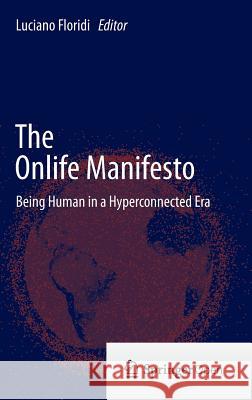
Luciano Floridi
The Onlife Manifesto: Being Human in a Hyperconnected Era Luciano Floridi 9783319040929 Springer International Publishing AG - książkaWidoczna okładka, to zdjęcie poglądowe, a rzeczywista szata graficzna może różnić się od prezentowanej.

The Onlife Manifesto: Being Human in a Hyperconnected Era

ISBN-13: 9783319040929 / Angielski / Twarda / 2014 / 264 str.

Luciano Floridi
cena 181,16
(netto: 172,53 VAT:  5%)

Najniższa cena z 30 dni: 173,50
Termin realizacji zamówienia:
ok. 22 dni roboczych
Bez gwarancji dostawy przed świętami

Darmowa dostawa!

What is the impact of information and communication technologies (ICTs) on the human condition? In order to address this question, in 2012 the European Commission organized a research project entitled The Onlife Initiative: concept reengineering for rethinking societal concerns in the digital transition. This volume collects the work of the Onlife Initiative. It explores how the development and widespread use of ICTs have a radical impact on the human condition.ICTs are not mere tools but rather social forces that are increasingly affecting our self-conception (who we are), our mutual interactions (how we socialise); our conception of reality (our metaphysics); and our interactions with reality (our agency). In each case, ICTs have a huge ethical, legal, and political significance, yet one with which we have begun to come to terms only recently.The impact exercised by ICTs is due to at least four major transformations: the blurring of the distinction between reality and virtuality; the blurring of the distinction between human, machine and nature; the reversal from information scarcity to information abundance; and the shift from the primacy of stand-alone things, properties, and binary relations, to the primacy of interactions, processes and networks.Such transformations are testing the foundations of our conceptual frameworks. Our current conceptual toolbox is no longer fitted to address new ICT-related challenges. This is not only a problem in itself. It is also a risk, because the lack of a clear understanding of our present time may easily lead to negative projections about the future. The goal of The Manifesto, and of the whole book that contextualises, is therefore that of contributing to the update of our philosophy. It is a constructive goal. The book is meant to be a positive contribution to rethinking the philosophy on which policies are built in a hyperconnected world, so that we may have a better chance of understanding our ICT-related problems and solving them satisfactorily.The Manifesto launches an open debate on the impacts of ICTs on public spaces, politics and societal expectations toward policymaking in the Digital Agenda for Europe's remit. More broadly, it helps start a reflection on the way in which a hyperconnected world calls for rethinking the referential frameworks on which policies are built.


Kategorie:
Nauka, Ekonomia i biznes
Kategorie BISAC:
Philosophy > Reference
Science > General
Social Science > Media Studies
Wydawca:
Springer International Publishing AG
Język:
Angielski
ISBN-13:
9783319040929
Rok wydania:
2014
Dostępne języki:
Angielski
Wydanie:
2015
Ilość stron:
264
Waga:
5.44 kg
Wymiary:
23.523.5 x 15.5
Oprawa:
Twarda
Wolumenów:
01
Dodatkowe informacje:
Wydanie ilustrowane

Introduction;  Luciano Floridi.- Preface.- The Onlife Manifesto.- Commentary by Ess; Charles Ess.- Commentary by Floridi; Luciano Floridi.- Commentary by Ganascia; Jean-Gabriel Ganascia.- Commentary by Hildebrandt; Mireille Hildebrandt.- Commentary by Laouris; Yiannis Laouris.- Commentary by Pagallo; Ugo Pagallo.- Commentary by Simon; Judith Simon.- Commentary by Thorseth; May Thorseth.- The Onlife Initiative.- Background Document: Rethinking public spaces in the digital transition.- Part I. Hyperconnectivity.- Hyperhistory and the Philosophy of Information Policies; Luciano Floridi.- Views and Examples on Hyper-connectivity;  Jean-Gabriel Ganascia.- Part II. Identity, selfhood and attention.- The Onlife Manifesto Philosophical Backgrounds Media Usages and the Futures of Democracy and Equality; Charles Ess.- Towards a Grey Ecology; Stefana Broadbent and Claire Lobet-Maris.- Reengineering and Reinventing both Democracy and the Concept of Life in the Digital Era; Yiannis Laouris.- Part III. Complexity, responsibility and governance.- Distributed Epistemic Responsibility in a Hyperconnected Era;  Judith Simon.- Good Onlife Governance: On Law, Spontaneous Orders, and Design; Ugo Pagallo.- Part IV. The public sphere in a computational era.- The Public(s) Onlife – A Call for Legal Protection by Design; Mireille Hildebrandt.- Rethinking the Human Condition in a Hyperconnected Era: Why Freedom is not about Sovereignty but about Beginnings; Nicole Dewandre.- Designing the public sphere: information technologies and the politics of mediation; Peter-Paul Verbeek.- Towards an Online Bill of Rights; Sarah Oates.- On Tolerance and Fictitious Publics; May Thorseth.- The Onlife Initiative – Conclusion.

Luciano Floridi is Professor of Philosophy and Ethics of Information at the University of Oxford, Oxford Internet Institute, and Fellow of St Cross College, Oxford.

His research areas are the philosophy of information, information/computer ethics, philosophy of technology, epistemology, and philosophy of logic. For his work Floridi has received various recognitions including the APA's Barwise Prize, the IACAP's Covey Award, and the INSEIT's Weizenbaum Award. He is the first philosopher to have been awarded the Gauss Professorship by the Göttingen Academy of Sciences. He is an AISB and BCS Fellow, and a Member of the Académie Internationale de Philosophie des Sciences. He was Chairman of EU Commission's 'Onlife' research group and UNESCO Chair in Information and Computer Ethics at the University of Hertfordshire.

What is the impact of information and communication technologies (ICTs) on the human condition? In order to address this question, in 2012 the European Commission organized a research project entitled The Onlife Initiative: concept reengineering for rethinking societal concerns in the digital transition. This volume collects the work of the Onlife Initiative. It explores how the development and widespread use of ICTs have a radical impact on the human condition.

ICTs are not mere tools but rather social forces that are increasingly affecting our self-conception (who we are), our mutual interactions (how we socialise); our conception of reality (our metaphysics); and our interactions with reality (our agency). In each case, ICTs have a huge ethical, legal, and political significance, yet one with which we have begun to come to terms only recently.

The impact exercised by ICTs is due to at least four major transformations: the blurring of the distinction between reality and virtuality; the blurring of the distinction between human, machine and nature; the reversal from information scarcity to information abundance; and the shift from the primacy of stand-alone things, properties, and binary relations, to the primacy of interactions, processes and networks.

Such transformations are testing the foundations of our conceptual frameworks. Our current conceptual toolbox is no longer fitted to address new ICT-related challenges. This is not only a problem in itself. It is also a risk, because the lack of a clear understanding of our present time may easily lead to negative projections about the future. The goal of The Manifesto, and of the whole book that contextualises, is therefore that of contributing to the update of our philosophy. It is a constructive goal. The book is meant to be a positive contribution to rethinking the philosophy on which policies are built in a hyperconnected world, so that we may have a better chance of understanding our ICT-related problems and solving them satisfactorily.

The Manifesto launches an open debate on the impacts of ICTs on public spaces, politics and societal expectations toward policymaking in the Digital Agenda for Europe’s remit. More broadly, it helps start a reflection on the way in which a hyperconnected world calls for rethinking the referential frameworks on which policies are built.




Udostępnij

Facebook - konto krainaksiazek.pl


Opinie o Krainaksiazek.pl na Opineo.pl

Partner Mybenefit

Krainaksiazek.pl w programie rzetelna firma Krainaksiaze.pl - płatności przez paypal

Czytaj nas na:

Facebook - krainaksiazek.pl
  • książki na zamówienie
  • granty
  • książka na prezent
  • kontakt
  • pomoc
  • opinie
  • regulamin
  • polityka prywatności

Zobacz:

  • Księgarnia czeska

  • Wydawnictwo Książkowe Klimaty

1997-2025 DolnySlask.com Agencja Internetowa

© 1997-2022 krainaksiazek.pl
     
KONTAKT | REGULAMIN | POLITYKA PRYWATNOŚCI | USTAWIENIA PRYWATNOŚCI
Zobacz: Księgarnia Czeska | Wydawnictwo Książkowe Klimaty | Mapa strony | Lista autorów
KrainaKsiazek.PL - Księgarnia Internetowa

Polityka prywatnosci - link
Krainaksiazek.pl - płatnośc Przelewy24
Przechowalnia Przechowalnia



