• Wyszukiwanie zaawansowane
  • Kategorie
  • Kategorie BISAC
  • Książki na zamówienie
  • Promocje
  • Granty
  • Książka na prezent
  • Opinie
  • Pomoc
  • Załóż konto
  • Zaloguj się

The Nature of Living Being: From Distinguishing Distinctions to Ethics » książka


zaloguj się | załóż konto
Logo Krainaksiazek.pl

koszyk

konto

szukaj
topmenu
Księgarnia internetowa
Szukaj
Książki na zamówienie
Promocje
Granty
Książka na prezent
Moje konto
Pomoc
 
 
Wyszukiwanie zaawansowane
Pusty koszyk
Bezpłatna dostawa dla zamówień powyżej 20 złBezpłatna dostawa dla zamówień powyżej 20 zł

Kategorie główne

• Nauka
 [2950560]
• Literatura piękna
 [1849509]

  więcej...
• Turystyka
 [71097]
• Informatyka
 [151150]
• Komiksy
 [35848]
• Encyklopedie
 [23178]
• Dziecięca
 [617388]
• Hobby
 [139064]
• AudioBooki
 [1657]
• Literatura faktu
 [228597]
• Muzyka CD
 [383]
• Słowniki
 [2855]
• Inne
 [445295]
• Kalendarze
 [1464]
• Podręczniki
 [167547]
• Poradniki
 [480102]
• Religia
 [510749]
• Czasopisma
 [516]
• Sport
 [61293]
• Sztuka
 [243352]
• CD, DVD, Video
 [3414]
• Technologie
 [219456]
• Zdrowie
 [101002]
• Książkowe Klimaty
 [124]
• Zabawki
 [2311]
• Puzzle, gry
 [3459]
• Literatura w języku ukraińskim
 [254]
• Art. papiernicze i szkolne
 [8079]
Kategorie szczegółowe BISAC

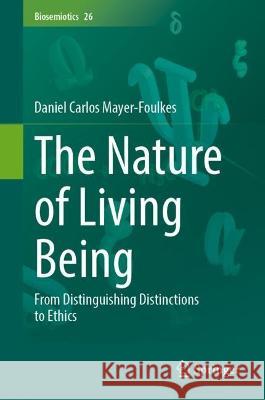
The Nature of Living Being: From Distinguishing Distinctions to Ethics

ISBN-13: 9783031247880 / Angielski
Daniel Carlos Mayer-Foulkes
The Nature of Living Being: From Distinguishing Distinctions to Ethics Daniel Carlos Mayer-Foulkes 9783031247880 Springer - książkaWidoczna okładka, to zdjęcie poglądowe, a rzeczywista szata graficzna może różnić się od prezentowanej.

The Nature of Living Being: From Distinguishing Distinctions to Ethics

ISBN-13: 9783031247880 / Angielski

Daniel Carlos Mayer-Foulkes
cena 483,04
(netto: 460,04 VAT:  5%)

Najniższa cena z 30 dni: 462,63
Termin realizacji zamówienia:
ok. 22 dni roboczych
Dostawa w 2026 r.

Darmowa dostawa!

This book proposes a bold idea. Living beings are distinguishing distinctions. Single cells and multicellular organisms maintain themselves distinct by drawing distinctions. This iswhatorganisms are andwhatthey do. From this starting point, key issues examined range across ontology, epistemology, phenomenology, logic, and ethics. Topics discussed include the origin of life, the nature and purpose of biology, the relation between life and logic, the nature and limits of formal logic, the nature of subjects, the subject-object relation, subject-subject relationships and the deep roots of ethics. The book provides a radical new foundation to think about philosophy and biology and appeals to researchers and students in these fields. It powerfully debunks mechanical thinking about living beings and shows the vast reservoir of insights into aliveness available in the arts and humanities.


This book proposes a bold idea. Living beings are distinguishing distinctions. Single cells and multicellular organisms maintain themselves distinct by drawing distinctions. This is what organisms are and what they do. From this starting point, key issues examined range across ontology, epistemology, phenomenology, logic, and ethics. Topics discussed include the origin of life, the nature and purpose of biology, the relation between life and logic, the nature and limits of formal logic, the nature of subjects, the subject-object relation, subject-subject relationships and the deep roots of ethics. The book provides a radical new foundation to think about philosophy and biology and appeals to researchers and students in these fields. It powerfully debunks mechanical thinking about living beings and shows the vast reservoir of insights into aliveness available in the arts and humanities.  

Kategorie:
Nauka, Filozofia
Kategorie BISAC:
Philosophy > Reference
Philosophy > Metaphysics
Science > Philosophy & Social Aspects
Wydawca:
Springer
Seria wydawnicza:
Biosemiotics
Język:
Angielski
ISBN-13:
9783031247880

Acknowledgments

Introduction and Summary
Chapter 1 Distinction-Distinguishing
The Proper Conjugate Form 
Inquiry
Monkeys
Monkeys as Philosophical Object
Laura, First Night Sleeping with Her in Room 1
The Problem of Anthropomorphism
Chapter 2 Distinguishing Distinctions
Distinction: A/Ā, A=A 
Definitions of Distinction
Abstract Definition: Distinction as Perfect Continence
Chemotaxis 
Do Only Living Beings Distinguish? 
Establishing Bet Structure 
Distinguishing as Scheme of Recurrence
Nesting of Distinctions 
Repetition and Monkeys 
Chapter 3 ב and the Emergence of Living Being 
The First ב 
What is Life? How did Life Emerge? 
Autopoiesis 
Homeostasis, Growth, Decay 
Autopoiesis with or without Cognition I 
What is an Itself 
Liposomal Structures and Flow
Autopoiesis with or without Cognition II
Nonliving species and the Limitations of Narrow Darwinism 
Chapter 4 Empirical Evidence for ב 
Emergent Probability 
Empirical Evidence for ב: Circadian Rhythms 
What Constitutes a Circadian Clock? 
Earliest Indication (EI) 
EI as Integrator-Operator 
Monkeys EIs and Social Life  
Chapter 5 Formal Definition of Distinction
Introduction 
The Axioms of Laws of Form 
Implicit Definition
The Formalism of Laws of Form 
Lower and Upper Schemes: Living Being and Mathematics 
Living Beings: Joinings 
Foundations, and Proper and Borrowed Content of Distinction 
Louie and the Rope 
Chapter 6 The Mathematical Ideal and the Elision of the Subject 
Proper and Borrowed Content of @@L and @@A 
Values and Name 
Substantialism and Liminalism
Naming as Integrator-Operator 
Insights and Expression 
Convergence of Platonism and Phenomenology 
I/World 
Chapter 7 Four Kinds Of Things 
Things 
Different Kinds of Things 
Byproducts
Products 
The Nonliving 
Joinings: Empirical Evidence in Biology 
Autonomous Cells 
Living Takes Place in Environments
We are Environments 
Endosymbiosis 
Major Evolutionary Transitions and Social Evolution 
Sexual Reproduction 
Chapter 8 [Subjects] 
Organisms as Objects and as [Subjects] 
Identity-Unity-Whole 
Skin and Membranes 
Mem-brains 
Identity-Unity-Whole and Unity-Identity-Whole 
Organisms and Organization  
Kate Opens a Door
Charlie Jumping
Chapter 9 Living Being 
Boundaries 
Microbial Partnerships
Kinds of Wholes 
Liminality and Hymenomorphism 
Ethics 
Relationships 
Levinas’ Ethics and [Ethics]
Chapter 10 The Paradoxical Nature of Aliveness and [Ethics] 
Dis-eliding the Dynamics of Joinings 
The Paradox of Relationships 
Paradox in Groups
Paradox of Dependency 
Paradox of Boundaries 
Paradox of Regression 
Paradox of Repetition 
Inner Conflict, Transparency/Opaqueness and the Unfolding of Anticipation 
The Structure of Ethics
Returning Home 
A Final Monkey Story: How Charlie Became the Leader of the Group
Postscript
APPENDIX Internal Critique of Laws of Form
Glossary
Bibliography

Daniel Mayer (Mexico City, 1956) is a researcher in the epistemology of biology, an organizational consultant, and a leadership educator. For decades he has reflected on the nature of organization, both of organisms and of organizations. This is the topic of this book. This project began in the 1980’s during ten years work (four as curator) at The Monkey Sanctuary, then a world-renowned center for conservation of Amazon woolly monkeys in the UK, and has continued during his career as a consultant and as an educator. He has read papers on these topics at the Annual Lonergan Symposium, at Loyola Marymount University (Los Angeles, CA), at the Annual International Gathering in Biosemiotics, and is a regular participant in the Leadership for Change conferences at the University of San Diego. From 2005 to 2019 he was Adjunct Faculty for the Masters of Science in Organizational Leadership at National University, San Diego CA. Founder and CEO of Living Leadership (livingleadership.online), he designs and implements experiential team methodologies for online teaching based on the group-relations approach. Married to Mexican author Vicky Nizri, they have two children and six grandchildren.

This book proposes a bold idea. Living beings are distinguishing distinctions. Single cells and multicellular organisms maintain themselves distinct by drawing distinctions. This is what organisms are and what they do. From this starting point, key issues examined range across ontology, epistemology, phenomenology, logic, and ethics. Topics discussed include the origin of life, the nature and purpose of biology, the relation between life and logic, the nature and limits of formal logic, the nature of subjects, the subject-object relation, subject-subject relationships and the deep roots of ethics. The book provides a radical new foundation to think about philosophy and biology and appeals to researchers and students in these fields. It powerfully debunks mechanical thinking about living beings and shows the vast reservoir of insights into aliveness available in the arts and humanities.



Udostępnij

Facebook - konto krainaksiazek.pl


Opinie o Krainaksiazek.pl na Opineo.pl

Partner Mybenefit

Krainaksiazek.pl w programie rzetelna firma Krainaksiaze.pl - płatności przez paypal

Czytaj nas na:

Facebook - krainaksiazek.pl
  • książki na zamówienie
  • granty
  • książka na prezent
  • kontakt
  • pomoc
  • opinie
  • regulamin
  • polityka prywatności

Zobacz:

  • Księgarnia czeska

  • Wydawnictwo Książkowe Klimaty

1997-2025 DolnySlask.com Agencja Internetowa

© 1997-2022 krainaksiazek.pl
     
KONTAKT | REGULAMIN | POLITYKA PRYWATNOŚCI | USTAWIENIA PRYWATNOŚCI
Zobacz: Księgarnia Czeska | Wydawnictwo Książkowe Klimaty | Mapa strony | Lista autorów
KrainaKsiazek.PL - Księgarnia Internetowa

Polityka prywatnosci - link
Krainaksiazek.pl - płatnośc Przelewy24
Przechowalnia Przechowalnia



