The Multi-Agent Transport Simulation MATSim » książka





The Multi-Agent Transport Simulation MATSim
ISBN-13: 9781909188754 / Angielski / Twarda / 2016 / 620 str.
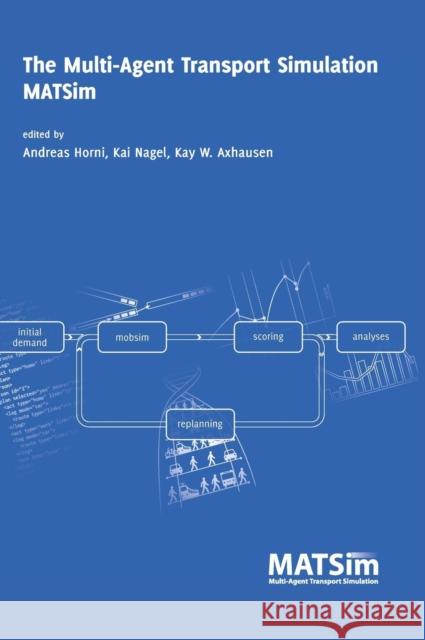
The MATSim (Multi-Agent Transport Simulation) software project was started around 2006 with the goal of generating traffic and congestion patterns by following individual synthetic travelers through their daily or weekly activity programme. It has since then evolved from a collection of stand-alone C++ programs to an integrated Java-based framework which is publicly hosted, open-source available, automatically regression tested. It is currently used by about 40 groups throughout the world. This book takes stock of the current status. The first part of the book gives an introduction to the most important concepts, with the intention of enabling a potential user to set up and run basic simulations. The second part of the book describes how the basic functionality can be extended, for example by adding schedule-based public transit, electric or autonomous cars, paratransit, or within-day replanning. For each extension, the text provides pointers to the additional documentation and to the code base. It is also discussed how people with appropriate Java programming skills can write their own extensions, and plug them into the MATSim core. The project has started from the basic idea that traffic is a consequence of human behavior, and thus humans and their behavior should be the starting point of all modelling, and with the intuition that when simulations with 100 million particles are possible in computational physics, then behavior-oriented simulations with 10 million travelers should be possible in travel behavior research. The initial implementations thus combined concepts from computational physics and complex adaptive systems with concepts from travel behavior research. The third part of the book looks at theoretical concepts that are able to describe important aspects of the simulation system; for example, under certain conditions the code becomes a Monte Carlo engine sampling from a discrete choice model. Another important aspect is the interpretation of the MATSim score as utility in the microeconomic sense, opening up a connection to benefit cost analysis. Finally, the book collects use cases as they have been undertaken with MATSim. All current users of MATSim were invited to submit their work, and many followed with sometimes crisp and short and sometimes longer contributions, always with pointers to additional references. We hope that the book will become an invitation to explore, to build and to extend agent-based modeling of travel behavior from the stable and well tested core of MATSim documented here.
The MATSim (Multi-Agent Transport Simulation) software project was started around 2006 with the goal of generating traffic and congestion patterns by following individual synthetic travelers through their daily or weekly activity programme. It has since then evolved from a collection of stand-alone C++ programs to an integrated Java-based framework which is publicly hosted, open-source available, automatically regression tested. It is currently used by about 40 groups throughout the world. This book takes stock of the current status.The first part of the book gives an introduction to the most important concepts, with the intention of enabling a potential user to set up and run basic simulations.The second part of the book describes how the basic functionality can be extended, for example by adding schedule-based public transit, electric or autonomous cars, paratransit, or within-day replanning. For each extension, the text provides pointers to the additional documentation and to the code base. It is also discussed how people with appropriate Java programming skills can write their own extensions, and plug them into the MATSim core.The project has started from the basic idea that traffic is a consequence of human behavior, and thus humans and their behavior should be the starting point of all modelling, and with the intuition that when simulations with 100 million particles are possible in computational physics, then behavior-oriented simulations with 10 million travelers should be possible in travel behavior research. The initial implementations thus combined concepts from computational physics and complex adaptive systems with concepts from travel behavior research. The third part of the book looks at theoretical concepts that are able to describe important aspects of the simulation system; for example, under certain conditions the code becomes a Monte Carlo engine sampling from a discrete choice model. Another important aspect is the interpretation of the MATSim score as utility in the microeconomic sense, opening up a connection to benefit cost analysis.Finally, the book collects use cases as they have been undertaken with MATSim. All current users of MATSim were invited to submit their work, and many followed with sometimes crisp and short and sometimes longer contributions, always with pointers to additional references.We hope that the book will become an invitation to explore, to build and to extend agent-based modeling of travel behavior from the stable and well tested core of MATSim documented here.




Czytaj nas na:
KrainaKsiazek.PL - Księgarnia Internetowa


