The Missing Peace: The Role of Religion in the Arab-Israeli Conflict » książka





The Missing Peace: The Role of Religion in the Arab-Israeli Conflict
ISBN-13: 9780996592437 / Angielski / Miękka / 2015 / 202 str.
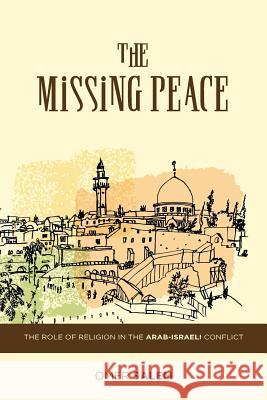
The Missing Peace: The Role of Religion in the Arab-Israeli Conflict
ISBN-13: 9780996592437 / Angielski / Miękka / 2015 / 202 str.
(netto: 81,54 VAT: 5%)
Najniższa cena z 30 dni: 84,90
ok. 16-18 dni roboczych.
Darmowa dostawa!
Egypt in the sixties and seventies for the Salem family was a balance between keeping Islamic tradition at home and attending the secular system of public schools, which would provide us with the best of opportunities, and form us into what my parents considered model Muslims. Both traditional Islamic practice and a breadth of scholarship were to be revered, in line with the great Islamic thinkers that always inspired us like Imam Mohamed Abdu and M. Rashid Reda.1 I was first exposed to other cultures and peoples when I traveled on foot and auto-stop on a forty-day journey to Europe in the summer of 1974. I was only fourteen at the time, but that journey taught me many valuable lessons, including the importance of being independent, self-sufficient, relating to others and understanding between cultures and people. That journey to Europe was followed by three more journeys to Europe and the Middle East for the following three summers, before our family emigrated and settled in California in the late seventies. Having lived in three different countries on three different continents, I have had no choice but to consider many different points of view, not only in my own acclimation from Egyptian to American culture, and then to Indian culture and back to American, but in my desire to understand the Middle East conflict at its root. Many of my relatives and friends still reside in Egypt. Therefore, my interest in solving the conflict is both on an ideological and personal level. My personal and global journey included study at Berkeley and Stanford universities, after which I established myself in a real estate investment business. I then embarked on a trek to the Indian subcontinent, where I spent some time with the pacifist Muslim Tablighi Jamaat movement and experienced again a taste of wandering, joined with outreach to other Muslims and simplicity in living. My passion for solving the conflicts in the Middle East led me to pursue a master's degree at Yale Divinity School, then a PhD defended at AlAzhar University, Cairo, Egypt, which I was granted in 2015.
Egypt in the sixties and seventies for the Salem family was a balance between keeping Islamic tradition at home and attending the secular system of public schools, which would provide us with the best of opportunities, and form us into what my parents considered model Muslims. Both traditional Islamic practice and a breadth of scholarship were to be revered, in line with the great Islamic thinkers that always inspired us like Imam Mohamed Abdu and M. Rashid Reda.1I was first exposed to other cultures and peoples when I traveled on foot and auto-stop on a forty-day journey to Europe in the summer of 1974. I was only fourteen at the time, but that journey taught me many valuable lessons, including the importance of being independent, self-sufficient, relating to others and understanding between cultures and people. That journey to Europe was followed by three more journeys to Europe and the Middle East for the following three summers, before our family emigrated and settled in California in the late seventies. Having lived in three different countries on three different continents, I have had no choice but to consider many different points of view, not only in my own acclimation from Egyptian to American culture, and then to Indian culture and back to American, but in my desire to understand the Middle East conflict at its root. Many of my relatives and friends still reside in Egypt. Therefore, my interest in solving the conflict is both on an ideological and personal level.My personal and global journey included study at Berkeley and Stanford universities, after which I established myself in a real estate investment business. I then embarked on a trek to the Indian subcontinent, where I spent some time with the pacifist Muslim Tablighi Jamaat movement and experienced again a taste of wandering, joined with outreach to other Muslims and simplicity in living. My passion for solving the conflicts in the Middle East led me to pursue a master’s degree at Yale Divinity School, then a PhD defended at AlAzhar University, Cairo, Egypt, which I was granted in 2015.




Czytaj nas na:
KrainaKsiazek.PL - Księgarnia Internetowa


