• Wyszukiwanie zaawansowane
  • Kategorie
  • Kategorie BISAC
  • Książki na zamówienie
  • Promocje
  • Granty
  • Książka na prezent
  • Opinie
  • Pomoc
  • Załóż konto
  • Zaloguj się

The Microwave Engineering Handbook: Microwave Systems and Applications » książka


zaloguj się | załóż konto
Logo Krainaksiazek.pl

koszyk

konto

szukaj
topmenu
Księgarnia internetowa
Szukaj
Książki na zamówienie
Promocje
Granty
Książka na prezent
Moje konto
Pomoc
 
 
Wyszukiwanie zaawansowane
Pusty koszyk
Bezpłatna dostawa dla zamówień powyżej 20 złBezpłatna dostawa dla zamówień powyżej 20 zł

Kategorie główne

• Nauka
 [2949965]
• Literatura piękna
 [1857847]

  więcej...
• Turystyka
 [70818]
• Informatyka
 [151303]
• Komiksy
 [35733]
• Encyklopedie
 [23180]
• Dziecięca
 [617748]
• Hobby
 [139972]
• AudioBooki
 [1650]
• Literatura faktu
 [228361]
• Muzyka CD
 [398]
• Słowniki
 [2862]
• Inne
 [444732]
• Kalendarze
 [1620]
• Podręczniki
 [167233]
• Poradniki
 [482388]
• Religia
 [509867]
• Czasopisma
 [533]
• Sport
 [61361]
• Sztuka
 [243125]
• CD, DVD, Video
 [3451]
• Technologie
 [219309]
• Zdrowie
 [101347]
• Książkowe Klimaty
 [123]
• Zabawki
 [2362]
• Puzzle, gry
 [3791]
• Literatura w języku ukraińskim
 [253]
• Art. papiernicze i szkolne
 [7933]
Kategorie szczegółowe BISAC

The Microwave Engineering Handbook: Microwave Systems and Applications

ISBN-13: 9781461360674 / Angielski / Miękka / 2013 / 558 str.
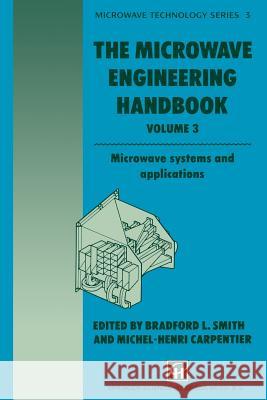
B. F. Smith; M. H. Carpentier
The Microwave Engineering Handbook: Microwave Systems and Applications Smith, B. 9781461360674 Springer - książkaWidoczna okładka, to zdjęcie poglądowe, a rzeczywista szata graficzna może różnić się od prezentowanej.

The Microwave Engineering Handbook: Microwave Systems and Applications

ISBN-13: 9781461360674 / Angielski / Miękka / 2013 / 558 str.

B. F. Smith; M. H. Carpentier
cena 887,69
(netto: 845,42 VAT:  5%)

Najniższa cena z 30 dni: 848,19
Termin realizacji zamówienia:
ok. 22 dni roboczych
Bez gwarancji dostawy przed świętami

Darmowa dostawa!

The Microwave Engineering Handbook provides the only complete reference available on microwave engineering. The three volumes of the handbook cover the entire field of microwave engineering, from basic components to system design. All entries in the handbook are written by experts in the area, bringing together an unrivalled collection of expertise on microwave technology. Volume 3: Microwave systems and applications provides a thorough introduction to the principal applications of microwave technology. Telecommunication, broadcasting, detection and ranging and scientific and industrial applications are covered with appendices on microwave measurement and frequency allocation. This volume shows the range of current and developing applications for microwave technology and will enable readers to appreciate the variety of applications and the requirements for the various system types.


Kategorie:
Technologie
Kategorie BISAC:
Technology & Engineering > Electrical
Technology & Engineering > Microwaves
Technology & Engineering > Telecommunications
Wydawca:
Springer
Seria wydawnicza:
Microwave and RF Techniques and Applications
Język:
Angielski
ISBN-13:
9781461360674
Rok wydania:
2013
Wydanie:
1993
Numer serii:
000297397
Ilość stron:
558
Waga:
0.87 kg
Wymiary:
23.5 x 15.5
Oprawa:
Miękka
Wolumenów:
01

1 Point-to-point transmission, terrestrial line-of-sight links, terrestrial troposcatter links.- 1.1 General.- 1.2 Principles of radio relays.- 1.2.1 Repeater functions.- 1.2.2 Carrier frequency utilization.- 1.2.3 Different types of repeaters.- 1.2.4 Different types of terminals.- 1.2.5 Special features of antennas for radio relay links.- 1.2.6 Feeders.- 1.3 Analogue microwave links.- 1.3.1 General.- 1.3.2 Characteristics of the signals transmitted.- 1.3.3 Analogue modulation.- 1.3.4 Technological aspects.- 1.3.5 Operating aid facilities.- 1.3.6 Frequency modulation distortions.- 1.3.7 Performances of analogue microwave links.- 1.3.8 Quality improvement.- 1.3.9 Transmission quality.- 1.4 Digital microwave links.- 1.4.1 Characteristics of the signals transmitted.- 1.4.2 Digital modulation.- 1.4.3 Technological aspects.- 1.4.4 Other specific features of digital microwave links.- 1.4.5 Performances of digital microwave links.- 1.4.6 Techniques used for improving quality.- 1.4.7 Predicting outages due to propagation.- 1.5 Specific nature of over-the-horizon microwave links.- 1.5.1 Properties of the propagation medium.- 1.5.2 Equipment characteristics.- 1.5.3 Transmission quality.- References.- 2 Satellite links.- 2.1 General.- 2.1.1 Introduction.- 2.1.2 Communication satellite systems.- 2.1.3 Utilization of the radio frequency spectrum.- 2.1.4 Specific characteristics.- 2.1.5 Main applications and techniques.- 2.1.6 Historical overview.- 2.1.7 Existing satellite systems.- 2.2 Basic principles.- 2.2.1 The basic satellite communication link.- 2.2.2 Definitions and formulae.- 2.2.3 Other topics.- 2.2.4 The link budget.- 2.2.5 Link quality.- 2.3 Communication satellite technology.- 2.3.1 Communication satellite construction.- 2.3.2 Communication satellite payload.- 2.4 Earth stations.- 2.4.1 General.- 2.4.2 The antenna system.- 2.4.3 The low noise amplifier (LNA).- 2.4.4 Measurements of noise temperatures and antenna G/T.- 2.4.5 The high power amplifier (HPA).- 2.4.6 The up-and down-converters (U/C, D/C).- 2.5 Conclusions and prospects.- References.- 3 Low and medium power translators and transmitters.- 3.1 Optimization of the input design of a television translator.- 3.1.1 Brief review: what are the design possibilities?.- 3.1.2 Optimization of antinomic couple noise factor/input stage linearity.- 3.2 Development of television transmitter modulation stages.- 3.2.1 Vision and sound IF modulation.- 3.2.2 IF vision corrector.- 3.2.3 Non-linearity correction of the vision channel.- 3.2.4 Output wideband converter.- 3.3 Optimization of the output design of a television transmitter or translator and enhancing the level of transistorization.- 3.3.1 Analysis of the distortions generated in a power amplifier.- 3.3.2 Non-linearity correctors.- 3.3.3 Amplifier assemblies.- 3.3.4 Improvement of reliability.- 3.3.5 Overall characteristics of transmitters.- 3.4 Conclusion.- Appendix 3.A The frequency spectrum and broadcasting channels.- 4 Radar systems.- 4.1 The history of radar.- 4.1.1 Before 1935.- 4.1.2 Since 1935; the pulse radar.- 4.1.3 The angular measurement.- 4.1.4 Pulse compression and coded radars.- 4.1.5 Doppler filtering.- 4.1.6 Electronic scanning.- 4.2 General description of radar systems.- 4.2.1 Basic principles derived from the theory of radar systems.- 4.2.2 About the parasitic noise.- 4.2.3 Radar block diagram.- 4.2.4 About antennas.- 4.2.5 About transmitters.- 4.2.6 About receivers.- 4.2.7 Choice of wavelengths — basic examples of radar parameters.- 4.2.8 Radar cross-section—target fluctuation—stealth targets.- 4.2.9 Problems: analysis of a multifunction radar.- 4.2.10 Pulse compression.- 4.2.11 About digital processing.- 4.2.12 Action against clutter.- 4.2.13 Pulse-Doppler radars.- 4.3 Main applications of radar systems.- 4.3.1 Surveillance radars.- 4.3.2 Fire control radar systems.- 4.3.3 Radar systems on board aircraft.- 4.3.4 Instrumentation radars.- 4.3.5 Other applications.- 4.4 Expected evolution of radar systems.- 4.4.1 Multifunction and multimode in radar systems.- 4.4.2 Present and future implementation of ancient ideas—active antennas.- 4.4.3 High resolution in distance.- 4.4.4 New wavelengths.- References.- 5 Electronic confrontation.- 5.1 Introduction.- 5.2 Electronic support measures (ESM).- 5.2.1 General.- 5.2.2 Reception techniques.- 5.2.3 Direction-finding techniques.- 5.2.4 Location measurements.- 5.2.5 Evolution of the systems.- 5.3 Electronic countermeasures (ECM).- 5.3.1 Introduction.- 5.3.2 Main operational uses of jammers.- 5.3.3 Jamming techniques.- 5.3.4 Main effects of jammers.- 5.3.5 Evolution of jamming facilities.- 5.4 ECCM applied to radio frequency links.- 5.4.1 General.- 5.4.2 Jamming protection techniques.- 5.4.3 Signal interception protection techniques.- 5.4.4 Conclusion.- 5.5 ECCM applied to radars.- 5.5.1 General.- 5.5.2 Radar range in the presence of jamming.- 5.5.3 General principles used against jamming.- 5.5.4 Main ECCM techniques.- 5.6 System design methodology.- 5.6.1 New tools to be incorporated into operational systems.- 5.6.2 Strategic intelligence: an in-depth analysis.- 5.6.3 Tactical intelligence: quick analysis of situations and priorities.- 5.6.4 Self-protection of weapon systems: a highly complex function.- 5.6.5 Air strike: active support at several levels.- 5.6.6 Counter-mobility: neutralization by jamming.- 5.6.7 Radioelectric superiority: preventing the use of the spectrum by the enemy.- 5.6.8 Elimination of the enemy anti-aircraft defence: extensive use of ESM and ECM.- 6 Infrared.- 6.1 Introduction.- 6.1.1 General definition.- 6.1.2 Spectral bands.- 6.1.3 Infrared system classification.- 6.2 Short historical background.- 6.3 Theory notes.- 6.3.1 Optical quantities and relationships.- 6.3.2 Photometry and radiometry.- 6.3.3 Atmosphere.- 6.3.4 Sources.- 6.3.5 Optical materials.- 6.3.6 Detectors.- 6.4 Infrared techniques.- 6.4.1 Instrument design considerations for passive IR detection.- 6.4.2 Performances of passive infrared optronic systems.- 6.4.3 Laser detection techniques.- 6.4.4 IR laser system performance.- 6.5 Military applications of infrared.- 6.5.1 Military applications of passive infrared.- 6.5.2 Military applications of active infrared systems.- 6.5.3 Military applications of semi-active infrared.- 6.5.4 Military applications of point-to-point links.- 6.6 Developments and trends in the infrared field.- 6.6.1 Optical windows and IR domes.- 6.6.2 Stabilization and scanning.- 6.6.3 Optical systems.- 6.6.4 Detectors.- 6.6.5 Cooling devices.- 6.6.6 Laser emitters.- 6.6.7 Processing devices.- 6.6.8 Display.- 7 Industrial, scientific and medical (ISM) applications of microwaves present and prospective.- 7.1 Introduction.- 7.2 High power applications.- 7.2.1 Microwave heating.- 7.2.2 High energy scientific applications.- 7.2.3 The problems of leakage: the personnel exposure standards.- 7.2.4 Conclusion.- 7.3 Active sensors and systems.- 7.3.1 Radar type sensors and miscellaneous.- 7.3.2 Non-destructive control.- 7.3.3 Microwave active imaging.- 7.3.4 Conclusion.- 7.4 Passive sensors and systems.- 7.4.1 Principles.- 7.4.2 Radiometric receivers.- 7.4.3 Applications of radiometry.- 7.4.4 Conclusion.- 7.5 Conclusion.- References.- 8 Radioastronomy.- 8.1 Introduction.- 8.2 Radio telescopes.- 8.2.1 Single dish.- 8.2.2 Interferometry and aperture synthesis.- 8.3 Cosmic radio emission.- 8.3.1 Continuum emission.- 8.3.2 Line emission.- 8.4 Continuum radio sources.- 8.4.1 The Galaxy.- 8.4.2 Extragalactic radio sources.- 8.5 The 21 cm hydrogen line.- 8.6 Interstellar molecules.- 8.6.1 The discovery.- 8.6.2 Astrochemistry.- 8.6.3 Cosmic maser amplification.- 8.6.4 The concept of a two-level maser.- 8.7 Conclusion and prospects.- Appendix 8.A Units and constants in astronomy.- References.- Problems.


Udostępnij

Facebook - konto krainaksiazek.pl


Opinie o Krainaksiazek.pl na Opineo.pl

Partner Mybenefit

Krainaksiazek.pl w programie rzetelna firma Krainaksiaze.pl - płatności przez paypal

Czytaj nas na:

Facebook - krainaksiazek.pl
  • książki na zamówienie
  • granty
  • książka na prezent
  • kontakt
  • pomoc
  • opinie
  • regulamin
  • polityka prywatności

Zobacz:

  • Księgarnia czeska

  • Wydawnictwo Książkowe Klimaty

1997-2025 DolnySlask.com Agencja Internetowa

© 1997-2022 krainaksiazek.pl
     
KONTAKT | REGULAMIN | POLITYKA PRYWATNOŚCI | USTAWIENIA PRYWATNOŚCI
Zobacz: Księgarnia Czeska | Wydawnictwo Książkowe Klimaty | Mapa strony | Lista autorów
KrainaKsiazek.PL - Księgarnia Internetowa

Polityka prywatnosci - link
Krainaksiazek.pl - płatnośc Przelewy24
Przechowalnia Przechowalnia






