• Wyszukiwanie zaawansowane
  • Kategorie
  • Kategorie BISAC
  • Książki na zamówienie
  • Promocje
  • Granty
  • Książka na prezent
  • Opinie
  • Pomoc
  • Załóż konto
  • Zaloguj się

The Material Point Method: Theory, Implementations and Applications » książka


zaloguj się | załóż konto
Logo Krainaksiazek.pl

koszyk

konto

szukaj
topmenu
Księgarnia internetowa
Szukaj
Książki na zamówienie
Promocje
Granty
Książka na prezent
Moje konto
Pomoc
 
 
Wyszukiwanie zaawansowane
Pusty koszyk
Bezpłatna dostawa dla zamówień powyżej 20 złBezpłatna dostawa dla zamówień powyżej 20 zł

Kategorie główne

• Nauka
 [2946600]
• Literatura piękna
 [1856966]

  więcej...
• Turystyka
 [72221]
• Informatyka
 [151456]
• Komiksy
 [35826]
• Encyklopedie
 [23190]
• Dziecięca
 [619653]
• Hobby
 [140543]
• AudioBooki
 [1577]
• Literatura faktu
 [228355]
• Muzyka CD
 [410]
• Słowniki
 [2874]
• Inne
 [445822]
• Kalendarze
 [1744]
• Podręczniki
 [167141]
• Poradniki
 [482898]
• Religia
 [510455]
• Czasopisma
 [526]
• Sport
 [61590]
• Sztuka
 [243598]
• CD, DVD, Video
 [3423]
• Technologie
 [219201]
• Zdrowie
 [101638]
• Książkowe Klimaty
 [124]
• Zabawki
 [2473]
• Puzzle, gry
 [3898]
• Literatura w języku ukraińskim
 [254]
• Art. papiernicze i szkolne
 [8170]
Kategorie szczegółowe BISAC

The Material Point Method: Theory, Implementations and Applications

ISBN-13: 9783031240690 / Angielski
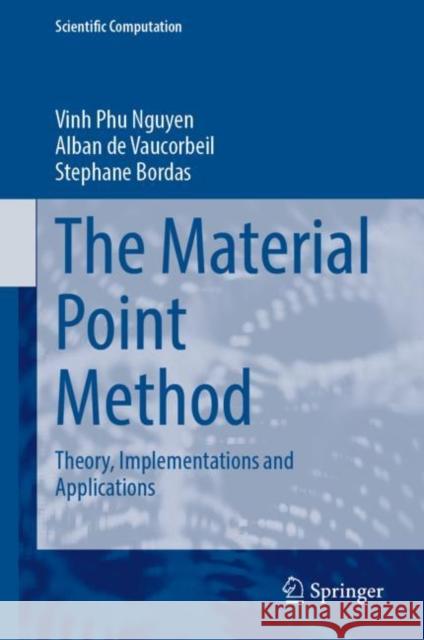
Nguyen Vinh Phu; Alban de Vaucorbeil; Stephane Bordas
The Material Point Method: Theory, Implementations and Applications Nguyen Vinh Phu Alban de Vaucorbeil Stephane Bordas 9783031240690 Springer - książkaWidoczna okładka, to zdjęcie poglądowe, a rzeczywista szata graficzna może różnić się od prezentowanej.

The Material Point Method: Theory, Implementations and Applications

ISBN-13: 9783031240690 / Angielski

Nguyen Vinh Phu; Alban de Vaucorbeil; Stephane Bordas
cena 726,29 zł
(netto: 691,70 VAT:  5%)

Najniższa cena z 30 dni: 655,41 zł
Termin realizacji zamówienia:
ok. 22 dni roboczych
Bez gwarancji dostawy przed świętami

Darmowa dostawa!
inne wydania

This book provides an introduction to the fundamental theory, practical implementation, and core and emerging applications of the material point method (MPM) and its variants. The MPM combines the advantages of both finite element analysis (FEM) and meshless/meshfree methods (MMs) by representing the material by a set of particles overlaid on a background mesh that serves as a computational scratchpad.The book shows how MPM allows a robust, accurate, and efficient simulation of a wide variety of material behaviors without requiring overly complex implementations. MPM and its variants have been shown to be successful in simulating a large number of high deformation and complicated engineering problems such as densification of foam, sea ice dynamics, landslides, and energetic device explosions, to name a few, and have recently found applications in the movie industry. It is hoped that this comprehensive exposition on MPM variants and their applications will not only provide an opportunity to re-examine previous contributions, but also to re-organize them in a coherent fashion and in anticipation of new advances.Sample algorithms for the solutions of benchmark problems are provided online so that researchers and graduate students can modify these algorithms and develop their own solution algorithms for specific problems. The goal of this book is to provide students and researchers with a theoretical and practical knowledge of the material point method to analyze engineering problems, and it may help initiate and promote further in-depth studies on the subjects discussed.


This book provides an introduction to the fundamental theory, practical implementation, and core and emerging applications of the material point method (MPM) and its variants. The MPM combines the advantages of both finite element analysis (FEM) and meshless/meshfree methods (MMs) by representing the material by a set of particles overlaid on a background mesh that serves as a computational scratchpad.The book shows how MPM allows a robust, accurate, and efficient simulation of a wide variety of material behaviors without requiring overly complex implementations. MPM and its variants have been shown to be successful in simulating a large number of high deformation and complicated engineering problems such as densification of foam, sea ice dynamics, landslides, and energetic device explosions, to name a few, and have recently found applications in the movie industry. It is hoped that this comprehensive exposition on MPM variants and their applications will not only provide an opportunity to re-examine previous contributions, but also to re-organize them in a coherent fashion and in anticipation of new advances.Sample algorithms for the solutions of benchmark problems are provided online so that researchers and graduate students can modify these algorithms and develop their own solution algorithms for specific problems. The goal of this book is to provide students and researchers with a theoretical and practical knowledge of the material point method to analyze engineering problems, and it may help initiate and promote further in-depth studies on the subjects discussed.

Kategorie:
Technologie
Kategorie BISAC:
Technology & Engineering > Engineering (General)
Science > Fizyka matematyczna
Computers > Computer Science
Wydawca:
Springer
Seria wydawnicza:
Scientific Computation
Język:
Angielski
ISBN-13:
9783031240690

Contents

1 Introduction

1.1 Background

1.2 Mesh-based and meshfree methods

1.3 Lagrangian and Eulerian descriptions

1.4 What is MPM

1.5 A literature review 

1.6 Layout

1.7 About this book 

1.8 Notations 


2 Governing equations and spatial discretization 

2.1 Basic concepts of continuum mechanics 

2.2 Constitutive models 

2.3 Strong form 

2.4 Weak form and spatial discretization 

2.5 MPM as FEM with particles as integration points 

2.6 Summary 


3 Explicit time integration 

3.1 Standard formulation (velocity formulation) 

3.2 Modified update stress last (MUSL) 

3.3 MUSL in the momentum formulation 

3.4 Update stress first (USF) 

3.5 Velocity (momentum) projection 

3.6 Staggered central difference 

3.7 Summary 

3.8 Two and three dimensional problems 

3.9 Axisymmetric problems 

3.10 Volumetric locking 

3.11 Source of errors in MPM 


4 Implementation 

4.1 MPM and FEM 

4.2 Computational grid 

4.3 Shape functions 

4.4 Initial particle distribution 

4.5 Initial and boundary conditions 

4.6 Adaptive time step 

4.7 Visualization 

4.8 Load deflection curves 

4.9 Verification tests 


5 MPMat: a MPM Matlab code 

5.1 MPM codes 

5.2 One dimension 

5.3 Two dimensions 

5.4 Three dimensions 

5.5 Axis-symmetric MPM 

5.6 B-splines MPM 

5.7 Some efficiency improvements 

5.8 More improvements using MEX files 

5.9 Examples 


6 Generalized Interpolation Material Point Method 

6.1 Cell crossing instability 

6.2 GIMP 

6.3 Polygonal CPDI 

6.4 Ghost cells in GIMP/CPDIs 

6.5 Implementation of (u/cp)GIMP 

6.6 Implementation of CPDI 

6.7 Implementation of CPDI2s (CPDI-Q4, CPDI-T3) 

6.8 Implementation of CPDI-Poly 

6.9 New treatment of boundary tractions 

6.10 A new visualization with CPDI2 

6.11 Examples 


7 Contact in MPM 

7.1 A brief on contact mechanics 

7.2 General contact algorithm in MPM 

7.3 Contact without friction 

7.4 Contact with Coulomb friction 

7.5 Computation of normals 

7.6 Contact between a deformable solid and a rigid wall 

7.7 Implementation 

7.8 Examples 


8 Implicit time integration 

8.1 Explicit and implicit methods 

8.2 Implicit dynamics MPM 

8.3 Quasi-static MPM 

8.4 Quasi-static analyses using an explicit code 

8.5 Matrix free implicit methods 


9 Fracture modeling in MPM 

9.1 Continuous and discontinuous modeling of fractures 

9.2 Discontinuous crack modeling in MPM: CRAMP 

9.3 Continuous crack modeling in MPM 

9.4 Examples 


10 Applications to geoengineering 

10.1 Collapse of a soil column 

10.2 Silo discharging 

10.3 Blast and fragmentation modeling 

10.4 Adaptive MPM formulations 


11 Fluid-structure interaction 

11.1 Fluid dynamics 

11.2 Modelling surface tension 

11.3 Modeling membranes 

11.4 Equivalence between CPDI and FEM-MPM 

11.5 Monolithic fluid-structure interaction using MPM 

11.6 Examples 


12 High order material point methods 

12.1 Scattered data interpolation 

12.2 Least square approximations 

12.3 Moving least square approximation 

12.4 Moving least square MPM 

12.5 Examples 


13 Uintah-MPM 

13.1 Installation and execution 

13.2 Input files 

13.3 Load curve 

13.4 Uintah GUI 

13.5 Uintah concepts 

13.6 Code 


A Derivation of CPDI basis functions 

A.1 CPDI-L2 basis 

A.2 CPDI-L3 basis 

A.3 CPDI-Q4 basis 

A.4 Derivation of CPDI-T3 basis 

A.5 Derivation of CPDI-Tet4 weighting and gradient weighting function 


B Constitutive models 

B.1 Elastic models 

B.2 Elastic-plastic models 

B.3 Compressible hyperelastic model 


C Utilities 

C.1 Scripts to plot basis functions 

C.2 Symbolic calculus 

C.3 Generation of particles 

C.4 Consistent units 


D Explicit Lagrangian finite elements 

D.1 Updated Lagrangian finite elements 

D.1.1 General flowchart 

D.1.2 Computation of internal force 

D.1.3 Lumped mass matrix 

D.2 Total Lagrangian finite elements 

D.2.1 Flowchart 

D.2.2 Computation of internal force 

D.3 Implementation 

D.4 Examples 

D.4.1 One dimensional convergence test 

D.4.2 Two dimensional convergence test 

D.4.3 Large deformation vibration of a cantilever beam 


E Implicit Lagrangian finite elements

E.1 Implicit dynamics FEM 

E.1.1 General case 

E.1.2 Linear case 

E.2 Implementation 

E.3 Examples 


F Implementing the material point method using Julia

F.1 Julia-based implementation of MPM 

F.1.1 Using ‘for’ loops versus vectorization 

F.1.2 Composite types versus arrays 

F.1.3 A simple MPM code in Julia 

F.2 Some syntax differences between Matlab and Julia 

F.3 Code organization 

F.4 Numerical examples 

F.4.1 Impact of two elastic bodies 

F.4.2 Cantilever beam 

F.4.3 High-velocity impact 

Stéphane Bordas is Professor in Computational Mechanics at the University of Luxembourg. Prior to this, he was Professor of Engineering, Chair of Engineering, and Director for the Institute of Mechanics and Advanced Materials at Cardiff University. He received his Ph.D. in Theoretical and Applied Mechanics from Northwestern University in December 2003. He currently serves on the editorial Board for Advances in Engineering Software (Elsevier) and Computers and Structures (Elsevier) and is Regular Reviewer for 42 ISI journals. In 2011, he was awarded the European Research Council Starting Independent Grant Award.

Dr Vinh Phu Nguyen is a lecturer at the Faculty of Engineering, Monash University.  He received his Ph.D. in Computational Mechanics from Delft University of Technology in 2011, where his focus was multiscale failure modeling of quasi-brittle materials. His current research interests include computational  fracture mechanics  (phase-field fracture/damage models, cohesive zone models), and numerical methods for large deformation problems (material point method).

Dr Alban de Vaucorbeil is a Research Fellow at the Institute for Frontier Materials, Deakin University (Australia). He received his Ph.D. in Material Engineering from the University of British Columbia, Vancouver, Canada in 2016 where his focus was the modelling of cluster strengthening in Aluminium alloys. Alban's research focuses on the development and use of numerical methods for the study of problems in both Mechanical Engineering and Materials Engineering. He is a Australian Research Council DECRA fellow. 


This book provides an introduction to the fundamental theory, practical implementation, and core and emerging applications of the material point method (MPM) and its variants. The MPM combines the advantages of both finite element analysis (FEM) and meshless/meshfree methods (MMs) by representing the material by a set of particles overlaid on a background mesh that serves as a computational scratchpad.

The book shows how MPM allows a robust, accurate, and efficient simulation of a wide variety of material behaviors without requiring overly complex implementations. MPM and its variants have been shown to be successful in simulating a large number of high deformation and complicated engineering problems such as densification of foam, sea ice dynamics, landslides, and energetic device explosions, to name a few, and have recently found applications in the movie industry. It is hoped that this comprehensive exposition on MPM variants and their applications will not only provide an opportunity to re-examine previous contributions, but also to re-organize them in a coherent fashion and in anticipation of new advances.

Sample algorithms for the solutions of benchmark problems are provided online so that researchers and graduate students can modify these algorithms and develop their own solution algorithms for specific problems. The goal of this book is to provide students and researchers with a theoretical and practical knowledge of the material point method to analyze engineering problems, and it may help initiate and promote further in-depth studies on the subjects discussed.




Udostępnij

Facebook - konto krainaksiazek.pl


Opinie o Krainaksiazek.pl na Opineo.pl

Partner Mybenefit

Krainaksiazek.pl w programie rzetelna firma Krainaksiaze.pl - płatności przez paypal

Czytaj nas na:

Facebook - krainaksiazek.pl
  • książki na zamówienie
  • granty
  • książka na prezent
  • kontakt
  • pomoc
  • opinie
  • regulamin
  • polityka prywatności

Zobacz:

  • Księgarnia czeska

  • Wydawnictwo Książkowe Klimaty

1997-2025 DolnySlask.com Agencja Internetowa

© 1997-2022 krainaksiazek.pl
     
KONTAKT | REGULAMIN | POLITYKA PRYWATNOŚCI | USTAWIENIA PRYWATNOŚCI
Zobacz: Księgarnia Czeska | Wydawnictwo Książkowe Klimaty | Mapa strony | Lista autorów
KrainaKsiazek.PL - Księgarnia Internetowa

Polityka prywatnosci - link
Krainaksiazek.pl - płatnośc Przelewy24
Przechowalnia Przechowalnia



